El cuento del ESTIGMA DE LA SERPIENTE INCA es parte de la trilogia de cuentos del libro EL ESPECTRO DE SARAH ELLEN ROBERTS Y OTROS RELATOS, puede adquirirla en la TIENDA KINDLE DE AMAZON
Chronicles of a man seeking his fate after Spanish conquest and the start of the Viceroyalty of Peru.
Mi primera novela publicada fue publicada el 29 de Agosto del 2022:
EL SECRETO DEL DUCADO DE ALBIZZI
SELVAGGIA
SINOPSIS:
Rosaura Montefiore, antes de morir en un terrible accidente, transmite a su joven hija, lady Selvaggia Pazzi, una dura verdad que hará que su vida cambie radicalmente a un punto que ni siquiera ella puede imaginárselo, siendo acosada y perseguida. Quien para sobrevivir deberá enfrascarse en resolver un secreto oculto inscrito en un medallón misterioso.
Selvaggia no estará sola en este peligroso juego; una poderosa e influyente organización secreta francmasónica, bajo el mando de su Gran Maestre Jean Renouard, empleará todos los medios posibles para que el secreto no salga a la luz. Y en este conflicto, ella, tendrá como aliados a una bella y misteriosa amazona veneciana, y al guardabosque de Sombra Negra, conocido como «Cacciatore di lupi».
Esta sugerente y apasionante historia llena de acción y aventuras, sin pausas, con sorprendentes revelaciones, donde se entre mezclan verdades y mentiras. Es una trama llena de símbolos, misterios, suposiciones y giros inesperados.
Publicado y vendido en Tiendas Kindle de Amazon en formato eBook y Libro tapa blanda. (SETIEMBRE 2022)
Ventas en:
Compre en Tiendas Kindle de Amazon
En el siguiente video encontrara el contenido del ebook y libro de tapa blanda (180 paginas).
Cualquier información referente a como adquirir el ebook o libro escribir a:
herwarth3@gmail.com
Se reserva el derecho de contestar si no es del tema sugerido.
El Estigma de la Serpiente Inka Herwarth Morales Cronicas de un hombre que busca su destino después conquista española y el inicio del virreinato del Perú. Cuento incluido en el eBook EL ESPECTRO DE SARAH ELLEN ROBERTS Y OTROS RELATOS El Espectro de Sarah Ellen Roberts y otros cuentos; nos presentan tres cuentos caracterizados con matices diferentes donde se entremezclan elementos sobrenaturales, superstición, terror, magia y manipulación mediática en las historias que son productos de hechos reales o imaginarios del autor que son presentados de manera ficticia.
DE VENTA EN TIENDAS KINDLE DE AMAZON
(Stigma Snake Inka)
By: Herwarth Morales
(Chronicles of a man seeking his fate after Spanish conquest and the start of the Viceroyalty of Peru)
If you are interested in reading this story, you can acquire
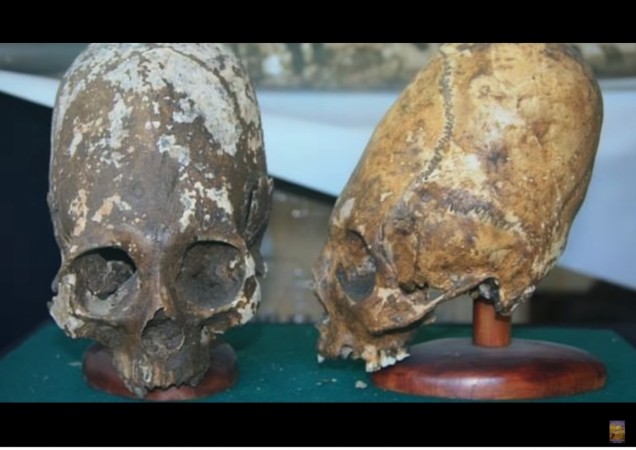
Conspiracy theorists and alien enthusiasts believe that these skulls are evidence of ancient alien visitations on our planet.
The DNA test results carried out on the 3,000-year-old elongated Paracas skulls to find whether they belonged to an alien race have been released.
The elongated craniums were discovered in Peru and have extraordinarily huge foreheads. Conspiracy theorists and alien enthusiasts believe that these skulls are evidence of ancient aliens visiting our planet.
The DNA research was carried out by Brian Foerster, who initially believed that these skulls wouldn't fit into the "known evolutionary tree".
These Paracas skulls were discovered in 1928 in the desert peninsula of Paracas which is located on the southern coast of Peru by Julio Tello, a native archaeologist.
"The mitochondrial DNA (from the mother) presented mutations unknown to any man, primate or any other animal and the mutations suggested we are dealing with a completely new human-like being, very distant from Homo sapiens, Neanderthals or Denisovans," Tello had said in 2015, while discussing the earlier DNA tests on skulls, a report by Express revealed.
"I am not sure it will even fit into the known evolutionary tree," he added.
A research by skeptics unveiled that people involved in this research had a history of involvement and belief in research related to subjects which are paranormal, such as Yeti and alien hybrids, which are said to be a cross breed between aliens and humans.
These skulls are just another example of intentional cranial deformation, which was observed in many ancient South American tribes, according to the disbelievers.
The details of the DNA tests have been released by Foerster, who is the director of the Paracas History Museum. And he accepts that the skulls are probably humans in origin.
Two videos regarding the updates about the DNA of these skulls were uploaded by Foerster, but doesn't mention anything about extra-terrestrials in them.
He described about how the Paracas skulls seemed to share DNA links with other elongated craniums which were found between the Black Sea and the Caspian Sea.
According to Foerster, skull elongation is not caused only by artificial cranial deformation, rather by genetics with some of the elongated skulls cranial volume being up to 25 percent larger and 60 percent heavier than conventional human skulls, Express stated.
The skulls could not be deformed purposely through flattening or head binding as the skull's shape can be changed by cranial deformation but it doesn't change the skull's volume and weight.
"What it does show for sure is that the Paracas elongated skull people were not 100 percent Native American. They were a mix or even you could say, in some ways, a hybrid of different people," Foerster said while speaking at the Elongated Skulls Symposium in Los Angeles.
"Their blood types are very complicated as well, they should be blood type O if they're 100 percent Native American and that's not the case. We are likely looking at a sub-species of humanity as regards to the Paracas. It seems to be a lot of DNA evidence from extreme eastern Europe and extreme western Asia."
"More specifically I'm talking about the area in between the Black Sea and the Caspian Sea where ancient elongated skull people lived I think about 3,000 years ago. So, I think we are looking at a migration pattern starting in the Caspian Black Sea area and then entering through the Persian Gulf and then moving eastwards eventually winding up on the coast of Peru."
"It appears that the largest elongated skulls on the planet have been found, A in Paracas, Peru and B in the Caucasus area in between the Black Sea and the Caspian Sea. So my theory is that there was a sub-species of human which we are going to be eventually calling Homo-Sapiens-Sapiens-Paracas, and they were living in the area in between the Caspian and Black Sea. They were invaded by somebody and so they were forced to flee," he added.
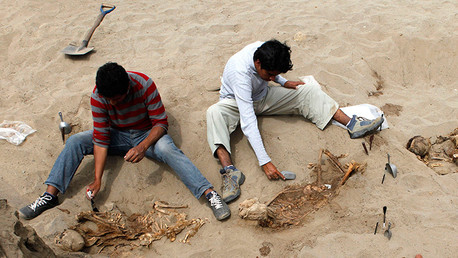
In 1928, more than 300 odd skeletal remains in a complex grave system were found by archaeologist Tello. According to scientists, it was the most extreme example of skull elongation ever found.
Las clases altas de la sociedad preincaica vendaban la cabeza de los niños para darle forma alargada.
Los científicos creen haber descubierto el motivo por el cual los antiguos peruanos alargaban los cráneos. El alargamiento de los cráneos era un sello distintivo de la elite gobernante en las tribus Collagua, según informa ScienceNews.
El bioarqueólogo antropológico Mathew Velasco, de la Universidad de Cornell (EE.UU.), examinó 211 calaveras de los indios Collagua, que vivían en lo que actualmente es la provincia de Caylloma, en el sur de Perú. Los cráneos analizados pertenecen al periodo comprendido entre los siglos XII y XV, y tienen una forma inusual. Aproximadamente 300 años antes de la llegada de los incas al Perú en 1450, los grandes representantes de la sociedad preincaica vendaban su cabeza durante la infancia para darle forma alargada.
De este modo fue como se desarrolló el signo de pertenencia a altos grupos de la sociedad. Según los expertos, las mujeres de Collagua cuyos cráneos eran alargados de manera artificial tenían menos posibilidades de morir en accidentes o ataques, y su dieta era más diversa. Por el contrario, se cree que los cráneos hallados que tienen una forma plana desde la parte posterior de la cabeza pertenecían a las clases bajas de dicha tribu.
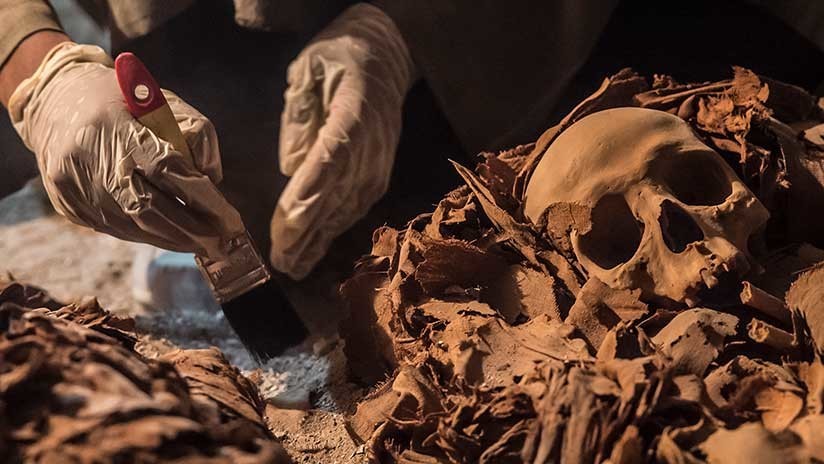
Fotos: Hallan en Perú un templo y 14 tumbas funerarias preincaicas
Velasco analizó un total de 211 cráneos preincaicos de grupos tempranos (entre 1150 y 1300) y tardíos (entre 1300 y 1450), todos mediante análisis de radiocarbono. Según los resultados de la investigación, el 39% de los cráneos del primer grupo fueron alargados de manera intencionada, mientras que aproximadamente el 74% del segundo grupo hizo lo propio.
Según Velasco, además de los Collagua, esta técnica de alteración de los cráneos también se observó en otras culturas antiguas, donde este tipo de lesiones se consideraban un signo de belleza y expresaban la pertenencia a un estatus social más alto. Para ello, se utilizaba la técnica de tirar de la cabeza del bebé con una tela, o de sujetarla entre dos palos de madera.