Mostrando entradas con la etiqueta alien. Mostrar todas las entradas

sábado, 30 de mayo de 2020

El misterio de las Momias de Nazca, por History Channel


¿Un mensaje del más allá?

Un documental avanza sobre las investigaciones de los restos fósiles hallados en Perú en 2017, cuyo origen está en el centro de una controversia científica.

"Momias de Nazca", un documental que intenta dar nuevas pistas acerca del descubrimiento arqueológico realizado en Perú en 2017.

El próximo sábado 30 de mayo, a las 21.50, History Channel estrena Momias de Nazca, un programa especial que investiga el origen de los fósiles de momias de tres dedos encontrados en Perú en el año 2017 y analiza su supuesta vinculación con extraterrestres.


Presentado por el periodista mexicano Jaime Maussan, este documental cuenta con la palabra de distintos expertos -médicos, periodistas, biólogos y radiólogos- convocados desde México, Rusia y Estados Unidos para analizar el caso de los restos hallados en el departamento de Nazca, en Perú.

Hace tres años allí se encontraron cuerpos de cráneos alargados, torsos estrechos y extremidades con apenas tres dedos cada una. Tienen características humanoides, pero a simple vista no parecen cuerpos de la evolución humana.

Las Momias de Nazca, con características humanoides, pero con marcadas singularidades.

En Perú se habló de estos restos como falsificaciones construidas con partes humanas reales. Otros dicen que se trata de la evidencia de presencia extraterrestre en el planeta. Es una controversia aún en disputa.

Mientras algunos exámenes de ADN determinaron que las momias eran efectivamente humanas, otras muestras no pudieron determinarlo. Algunos científicos aseguran que las características anatómicas de la calavera, su estructura interna y las suturas occipitales, parietales y frontales presentes serían muy difíciles de falsificar.

La ciencia aún no pudo dar una respuesta clara sobre las momias de Nazca y es por eso que las versiones y teorías de que se tratan de extraterrestres ganan cada vez más fuerza. Fueron halladas en una tumba ubicada muy cerca de las denominadas “líneas de Nazca” (Perú) y dos de ella, bautizadas como María y Vavita (sería un bebé). Desde su descubrimiento distintos especialistas trabajan sobre sus restos para tratar de explicar su origen.

Momias de Nazca

Maussan empezó en 2017 una investigación científica sobre los orígenes de esas nueve momias de tres dedos. La investigación continúa: este especial da cuenta de su desarrollo y revela los resultados finales de las pruebas realizadas en las momias.

Todo se centra en María, con fecha de carbono de aproximadamente 1.700 años de antigüedad. El trabajo de colocar el ADN de las momias en registros fósiles y compararlo con los humanos modernos y antiguos ha comenzado, y cada hallazgo arroja más preguntas.

El misterio de las momias con tres dedos que podrían ser extraterrestres

Según explicaron los especialistas, el cuerpo de María data del siglo V antes de Cristo (mil años antes de la llegada de los españoles a América), y tiene 23 pares de cromosomas, como el ser humano. Los estudios sobre el cadáver de María pudieron ser realizados porque al momificarlo se utilizó cloruro de cadmio, sustancia que la mantuvo en muy buen estado.

Las Momias de Nazca son el eje de un misterio que todo indica que tardará en ser resuelto.

“Diferentes leyendas señalan la existencia de seres venidos de las estrellas que habitaron entre nosotros. Y este descubrimiento de las momias de Nazca abre la posibilidad de que las antiguas civilizaciones de nuestro planeta podrían haber estado en contacto con seres muy extraños, los cuales, de acuerdo con los análisis de ADN no son similares a ninguna de las especias de nuestro mundo”, asegura Maussan.

Y agrega: “Este hallazgo nos ayudaría no sólo a cambiar el pasado, sino que nos acercaría al futuro de los seres humanos, cuando volvamos a tener un contacto con otros seres inteligentes, una posibilidad que aún parece de ciencia ficción, pero que cada vez está más cerca de hacerse realidad”.

El misterio de las Momias de Nazca fue abordado por científicos de distintas partes del mundo, sin que hayan llegado aún a una conclusión.

Nazca es una zona que envuelve otros misterios, como las “Líneas de Nazca”, figuras que se pueden ver desde el aire trazadas en el desierto de esa región. Se trata de un conjunto de gigantescos geoglifos que forman figuras animales, humanas y geométricas.

Sus orígenes y creación han tenido decenas de teorías, inclusive vinculadas con los alienígenas. Están quienes aseguran que se trata de dibujos realizados por culturas diferentes con el fin de ser “centros de adoración” para las divinidades, o incluso como calendarios. Sin embargo, el escritor suizo Erich von Däniken asoció, en 1968, estas líneas a pistas de aterrizaje para naves alienígenas.

E.S.

martes, 13 de marzo de 2018

They mysterious Nazca Lines of Peru - Altered Dimensions Paranormal

The Nazca Lines are a collection of unusual, large ancient geoglyphs etched into the high plateaus of the Nazca Desert in southern Peru. The largest are nearly a quarter-mile long and depict a variety of objects and shapes including more than 70 drawings of animals such as birds, fish, llamas, jaguars, and monkeys - many of which would have been unknown to inhabitants of the area. Some depict human-like entities. They cover an area about 170 square miles and are only visible from the air.

The drawings are believed to have been created sometime between 500 BC and 500 AD. They were made by gouging shallow lines about 6-inches deep into the ground, removing the natural iron oxide-coated reddish pebbles and exposing the grayish ground beneath. Because of the isolated location and dry, windless environment, the drawings have remained preserved for thousands of years.

The purpose of the lines is unclear. Some theorize they could be related to astronomy or cosmology meaning the area acted as a sort of observatory. Some believe they contain religious significance to the original artists. Some believe they are related to an ancient alien-influence culture attempting to communicate with the "people in the sky". Others believe they were drawn by aliens themselves, possibly in an attempt to communicate with others in the sky.

Below are a sampling of the Nazca Lines drawings.

lunes, 12 de marzo de 2018

Las momias misteriosas Nazca de Perú no son de humanos.

¿Los alienígenas son reales? Los cuerpos momificados de tres dedos no son humanos, revela la prueba de las momias de Nazca, que parecen ser de humanos, en realidad no lo son. Tienen 23 cromosomas como los humanos, pero una estructura de costillas muy diferente.

Las momias misteriosas que se encuentran en Perú no son de humanos.

Las muestras de tejido de la misteriosa momia que se encontró en una tumba cerca de las Líneas de Nazca en el sur de Perú a principios de 2017 fueron llevadas a Rusia por un equipo de genetistas de San Petersburgo, para romper su genoma. Y, encontraron que la momia que parecía ser de un ser humano no es en realidad.

La momia llamada María con un cráneo alargado y solo tres dedos de manos y pies datan del siglo V d. C. Después del análisis preliminar, se descubrió que ella también tiene 23 cromosomas como los humanos. Sin embargo, la estructura de las costillas de la momia es muy diferente a la de un ser humano, informó Sputnik. Tiene forma de quilla en la parte superior y la jaula consiste en costillas semicirculares.

Los científicos incluso estudiaron cuidadosamente los órganos internos de la momia. "Vemos claramente los contornos de la tráquea y los bronquios, del corazón y sus cámaras, incluso podemos ver la forma de las válvulas. También podemos ver con bastante claridad los contornos del diafragma , el hígado y el bazo ", dijo la radióloga Natalia Zaloznaya.

Los científicos también descubrieron que el polvo blanco utilizado para preservar a los muertos y momificarlo es cloruro de cadmio; el efecto antibacteriano del químico ha mantenido a María preservada.

"En este momento estamos haciendo un análisis detallado para ver si la forma de la posición de todos los cromosomas, de todos los aminoácidos, coincide con la nuestra", dijo el profesor de la Universidad Nacional de Investigación de Rusia, Konstantin Korotkov.

Además de María, otra momia pequeña - Vavita, encontrada en Perú también fue analizada. Los investigadores dicen que Vavita tenía nueve meses cuando murió y que María era una mujer adulta, haciéndoles creer que podrían haber sido madre e hija.

Korotkov dijo que han visto cuatro momias más de 70 centímetros cada una, a quienes llamaron "Verdants". Cada uno de ellos tiene dos brazos, dos piernas, una cabeza, un par de ojos y una boca. Incluso tienen cavidades en la boca, pero sorprendentemente, las mandíbulas inferiores no son flexibles; está presente como un todo único con el resto del cráneo.

"Los escáneres tomográficos revelan sus esqueletos. El tejido tiene naturaleza biológica y su composición química indica que son humanos. Su ADN presenta 23 pares de cromosomas, como nosotros. Los cuatro son hombres, cada uno con un cromosoma Y. Parecen humanos, pero no lo son. Su estructura anatómica es diferente ", explicó Korotkov.

Korotkov dijo que es difícil decir quiénes eran estos "hombres pequeños", pero dijo que podrían ser extraterrestres o bio robots.

Agregó: "En cuanto a las criaturas de 70 cm, no estoy seguro, pero María y Vavita podrían haber sido representantes de una raza determinada que posiblemente haya alcanzado una etapa de avance mucho antes que nosotros. Tal vez miles de años antes".

viernes, 9 de marzo de 2018

Científicos rusos diseccionan la momia 'extraterrestre' de Perú y esto es lo que encuentran


Los genetistas rusos de San Petersburgo se dedicaron a revelar el misterio de la inusual momia hallada en la ciudad peruana de Nazca.

María —así la bautizaron los investigadores a la mujer momificada de Perú— murió aproximadamente en el siglo V. Curiosamente, tiene un cráneo alargado y tres dedos largos en cada mano y pie. La estructura de las costillas tampoco se parece a la de los seres humanos.

© YOUTUBE/ GAIA

El enigma de la momia 'extraterrestre' peruana, ¿por fin al descubierto?

El extraño aspecto físico de la momia fue causa de numerosas especulaciones sobre su supuesto origen extraterrestre.

Tras estudiar su esqueleto, los científicos rusos pudieron descubrir la disposición de los órganos internos de la momia.

Además, los investigadores de San Petersburgo están completando un análisis detallado del ADN de María.

"Vemos claramente los contornos de la tráquea y los bronquios principales, vemos claramente los contornos del corazón y las cámaras, incluso los contornos de las válvulas son visibles. Podemos ver con bastante claridad los contornos del diafragma, el hígado y el bazo ", explica la radióloga Natalia Zalóznaya.

"Es una criatura antropomórfica, tiene 23 cromosomas, al igual que nosotros. Estamos realizando el análisis detallado para saber si todos los cromosomas y aminoácidos están colocados de la misma manera que los nuestros", explicó el científico Konstantín Korotkov a la cadena Mir 24.


El investigador agregó que el estudio permitirá entender si las características genéticas de la momia tienen que ver con las de personas de distintas partes del mundo. Así los científicos pretenden identificar la procedencia de María.

Cabe destacar que los restos se han conservado hasta nuestros días gracias al cloruro de cadmio, un compuesto cristalino blanco que se utilizó para cubrir el cadáver.

lunes, 5 de marzo de 2018

Misteriosa momia "humanoide" de Perú: Científicos rusos anuncian primeros resultados de sus análisis


Reuters Guadalupe Pardo

Сientíficos rusos tratan de 'hackear' el genoma de esta momia de aspecto alienígena.

Científicos rusos han iniciado el análisis del ADN de la más destacada momia de las encontradas cerca de la ciudad peruana de Nazca a principios del año pasado,informa el canal ruso Mir 24. Esta criatura de aspecto alienígena, con un cráneo alargado y tan solo tres dedosen cada una de sus extremidades, ha sido bautizada por los investigadores como María.

Un grupo de genetistas de San Petersburgo llevó a Rusialas muestras de tela de la criatura extraña para tratar de 'hackear' su genoma. María, cuya momia fue encontrada por un campesino peruano, murió aproximadamente en el siglo V, un mil años antes del descubrimiento de América.

Los datos del análisis preliminar ha mostrado que la momia "es un ser humanoide, es decir, también tiene 23 cromosomas como nosotros".

"Ahora ya se está llevando a cabo un análisis detallado para ver si la forma de la posición de todos los cromosomas, de todos los aminoácidos, coincide con la nuestra", comentó a un periodista de Mir 24 el profesor de la Universidad Nacional de Investigación rusa Konstantín Korotkov.

Hallan en Perú la momia de un ser "no humano" (VIDEO)

Según este, los científicos también planean identificar la procedencia de la inusual criatura: "¿Tiene la momia rasgos comunes con algunas personas que viven enAmérica del Sur, África o en otro lugar, y hay alguna diferencia?".

Su esqueleto es inusual 

Además, la momia resultó tener una estructura de costillas diferente a la humana. Gracias a esto, los científicos pueden estudiar mejor la disposición de los órganos internos de María.

"Vemos claramente los contornos de la tráquea y los bronquios, vemos claramente los contornos del corazón y las cámaras, incluso son visibles los contornos de las válvulas. Podemos ver con bastante claridad los contornos del diafragma, el hígado y el bazo", explicó la radióloga Natalia Zaloznaya.

Los investigadores incluso lograron determinar cuál era la sustancia que ayudó a conservar a María hasta el día de hoy. El polvo blanco con el que esa civilización desconocida cubría a sus difuntos es cloruro de cadmio, un químico que con su efecto antibacterial mantuvo conservada a la momia hasta nuestros tiempos.

Ahora, los genetistas rusos planean continuar 'hackeando' el genoma de la misteriosa criatura hallada en Perú en colaboración con investigadores del país latinoamericano. Para avanzar con sus trabajos, los científicos de San Petersburgo incluso quieren solicitar el envío de la momia a la ciudad rusa. 

sábado, 17 de febrero de 2018

Mystery behind the origin of 3,000-year-old 'alien' Paracas skulls revealed by DNA testing


Conspiracy theorists and alien enthusiasts believe that these skulls are evidence of ancient alien visitations on our planet.
The DNA test results carried out on the 3,000-year-old elongated Paracas skulls to find whether they belonged to an alien race have been released.
The elongated craniums were discovered in Peru and have extraordinarily huge foreheads. Conspiracy theorists and alien enthusiasts believe that these skulls are evidence of ancient aliens visiting our planet.
The DNA research was carried out by Brian Foerster, who initially believed that these skulls wouldn't fit into the "known evolutionary tree".
These Paracas skulls were discovered in 1928 in the desert peninsula of Paracas which is located on the southern coast of Peru by Julio Tello, a native archaeologist.
"The mitochondrial DNA (from the mother) presented mutations unknown to any man, primate or any other animal and the mutations suggested we are dealing with a completely new human-like being, very distant from Homo sapiens, Neanderthals or Denisovans," Tello had said in 2015, while discussing the earlier DNA tests on skulls, a report by Express revealed.
"I am not sure it will even fit into the known evolutionary tree," he added.
A research by skeptics unveiled that people involved in this research had a history of involvement and belief in research related to subjects which are paranormal, such as Yeti and alien hybrids, which are said to be a cross breed between aliens and humans.
These skulls are just another example of intentional cranial deformation, which was observed in many ancient South American tribes, according to the disbelievers.
The details of the DNA tests have been released by Foerster, who is the director of the Paracas History Museum. And he accepts that the skulls are probably humans in origin.
Two videos regarding the updates about the DNA of these skulls were uploaded by Foerster, but doesn't mention anything about extra-terrestrials in them.
He described about how the Paracas skulls seemed to share DNA links with other elongated craniums which were found between the Black Sea and the Caspian Sea.
According to Foerster, skull elongation is not caused only by artificial cranial deformation, rather by genetics with some of the elongated skulls cranial volume being up to 25 percent larger and 60 percent heavier than conventional human skulls, Express stated.
The skulls could not be deformed purposely through flattening or head binding as the skull's shape can be changed by cranial deformation but it doesn't change the skull's volume and weight.
"What it does show for sure is that the Paracas elongated skull people were not 100 percent Native American. They were a mix or even you could say, in some ways, a hybrid of different people," Foerster said while speaking at the Elongated Skulls Symposium in Los Angeles. 
"Their blood types are very complicated as well, they should be blood type O if they're 100 percent Native American and that's not the case. We are likely looking at a sub-species of humanity as regards to the Paracas. It seems to be a lot of DNA evidence from extreme eastern Europe and extreme western Asia."
"More specifically I'm talking about the area in between the Black Sea and the Caspian Sea where ancient elongated skull people lived I think about 3,000 years ago. So, I think we are looking at a migration pattern starting in the Caspian Black Sea area and then entering through the Persian Gulf and then moving eastwards eventually winding up on the coast of Peru." 
"It appears that the largest elongated skulls on the planet have been found, A in Paracas, Peru and B in the Caucasus area in between the Black Sea and the Caspian Sea. So my theory is that there was a sub-species of human which we are going to be eventually calling Homo-Sapiens-Sapiens-Paracas, and they were living in the area in between the Caspian and Black Sea. They were invaded by somebody and so they were forced to flee," he added.
In 1928, more than 300 odd skeletal remains in a complex grave system were found by archaeologist Tello. According to scientists, it was the most extreme example of skull elongation ever found. 


sábado, 10 de febrero de 2018

Noticias sobre los cráneos alargados de Paracas

Video explicativo de la historia real de los craneos alargados de Paracas


En el medio paranormal, la cura para un día de noticias lento es ver qué se está cocinando en Perú. La semana pasada, hicimos que el conductor del camión aventara su vehículo sobre las antiguas líneas de Nazca, destruyendo partes de estos famosos e inexplicables geoglifos a fin de evitar pagar un peaje. Ha pasado un tiempo desde que escuchamos algo sobre las momias de tres dedos, pero no hay nada nuevo en los informes. ¡Afortunadamente, los cráneos alargados vinieron al rescate! "Esto podría reescribir la historia tal como la conocemos". Sí, fue otro momento de "Esto lo cambia todo" durante el fin de semana cuando se celebró el Simposio Elongated Skulls en Los Ángeles. Organizado por el autor, conferenciante y cineasta LA Marzulli, reunió a una variedad de oradores sobre el tema de los cráneos de Paracas, incluyendo el camarógrafo Richard Shaw, el experto forense Chase Kloetske, el arqueólogo Mondo Gonzales, la artista forense 3D Marcia K. Moore, el antropólogo Rick Woodward, el médico Dr. Michael Alday y el quiropráctico Dr. Malcolm Warren. Sin embargo, la gran noticia sobre las pruebas de ADN de los cráneos provino de Marzulli y Brien Forester de Hidden Inca Tours. Si esos dos últimos nombres te resultan familiares, es probable que tengan un "¡esto lo cambia todo!" Similar. momento en 2016, cuando se realizaron pruebas de ADN en los cráneos alargados de Paracas en Perú. En ese momento, revelaron que los resultados de las pruebas mostraron que los cráneos no eran de Perú, pero tampoco eran extraños. Se cree que los humanos vinieron de Europa y Mesopotamia, especialmente Siria. Eso fue interesante y ciertamente agregó un giro al cual los humanos llegaron por primera vez a las Américas, pero no un cambio de juego. ¿Fue el Simposio de cráneos alargados? El sitio web megalithicmarvels.com dio una sinopsis de la charla de Brien Forester. "Los resultados del ADN en realidad fueron increíblemente complicados ... Me tomará un tiempo descubrir realmente qué significan los resultados. Lo que sí muestra con certeza es que las personas con cráneo alargado de Paracas no eran 100% indígenas. Eran una mezcla o incluso podrías decir, de alguna manera, un híbrido de diferentes personas ". Espera un minuto ... esto suena familiar. Entonces es cuando Forester agrega un nuevo giro. "Parece que se han encontrado los cráneos alargados más grandes del planeta," A "en Paracas, Perú y" B "en el área del Cáucaso, entre el Mar Negro y el Mar Caspio ... así que mi teoría es que había una subespecies de humanos que eventualmente llamaremos Homo-Sapiens-Sapiens-Paracas, y que vivían en el área entre el Mar Caspio y el Mar Negro ". Y ... "Fueron invadidos por alguien ... y entonces se vieron obligados a huir". Forester establece un camino para que esta subespecie navegue desde el Golfo Pérsico hasta Perú. Ahí es donde él cree, y dice que algunos de los otros oradores están de acuerdo, que estas personas naturalmente de cráneo largo se asentaron y florecieron durante un tiempo. "... debido a las anomalías encontradas con algunas de las Calaveras alargadas del cementerio de Chongos en Perú, no tienen otra opción que afirmar que algunas de estas antiguas Paracas eran una subespecie de la humanidad ... tenía que ser genética , tenían que nacer con estas anormalidades. Tenían el pelo rojo oscuro ... los Paracas reales eran los que tenían la cabeza alargada, no la gente común ... la familia real de los Paracas, vivían en casas subterráneas subterráneas y yo creo que la razón es que tenían una piel de color claro, probablemente ojos sensibles debido a la extrema luz del sol ... " Entonces, Forester cree que los cráneos largos son una anormalidad genética, no el resultado de la unión, y aquellos con ellos fueron considerados como líderes y superiores. La palabra clave es "cree", no prueba. Esto sin duda refuerza la idea de que la composición genética de los nativos sudamericanos es realmente una mezcla variada. También continúa desilusionando a aquellos que quieren creer que los cráneos alargados son extraterrestres. Sin embargo, no prueba cómo los Paracas podrían ser una subespecie separada, mientras que los demás cultivos de cráneo alargados no lo son. Esperemos que el próximo "esto lo cambie todo" las pruebas de ADN lleguen durante otra semana de noticias lenta.

New DNA Test Results on Peru’s Elongated Skulls

Video the skull Paracas


In the paranormal business, the cure for a slow news day is to see what’s cooking in Peru. Last week, we had the truck driverplowing his vehicle over the ancient Nazca lines, destroying portions of these famous and unexplained geoglyphs in the name of avoiding to pay a toll. It’s been a while since we heard anything about the three-fingered mummies but there’s nothing new to reports. Fortunately, the elongated skulls came to the rescue!
“This could re-write history as we know it.”

Yes, it was another “This changes everything” moment over the weekend when the Elongated Skulls Symposium was held in Los Angeles. Hosted by author, lecturer and film maker L.A. Marzulli, it brought together a variety of speakers on the subject of the Paracas skulls, including videographer Richard Shaw, forensic expert Chase Kloetske, archaeologist Mondo Gonzales, 3D forensic artist Marcia K. Moore, anthropologist Rick Woodward, medical doctor Dr. Michael Alday, and chiropractor Dr. Malcolm Warren. However, the big news on DNA testing of the skulls came from Marzulli and Brien Forester of Hidden Inca Tours.
If those last two names sound familiar, it’s probably because they had a similar “this changes everything!” moment in 2016 whenDNA tests were reportedly conducted on the Paracas elongated skulls of Peru. At that time, they revealed that the test results showed the skulls were not from Peru but were not alien either. The humans were believed to have come from Europe and Mesopotamia, especially Syria. That was interesting and certainly added a twist to which humans first arrived in the Americas, but not a game-changer. Was the Elongated Skulls Symposium?
The website megalithicmarvels.com gave a synopsis of the talk by Brien Forester.
“The DNA results actually were incredibly complicated… It’s gonna take me some time to actually figure out what the results mean. What it does show for sure is that the Paracas elongated skull people were not 100% Native American. They were a mix or even you could say, in some ways, a hybrid of different people.”

Wait a minute … this sounds familiar. That’s when Forester adds a new twist.
“It appears that the largest elongated skulls on the planet have been found, “A” in Paracas, Peru and “B” in the Caucasus area in between the Black Sea and the Caspian Sea… so my theory is that there was a sub-species of human which we are going to be eventually calling Homo-Sapiens-Sapiens-Paracas, and they were living in the area in between the Caspian and Black Sea.”

And …
“They were invaded by somebody… and so they were forced to flee.”

Forester lays out a path for this sub-species to sail from the Persian Gulf to Peru. That’s where he believes, and says some of the other speakers agree, that these naturally long-skulled people settled and flourished for a time.
“ … because of the abnormalities found with some of the Elongated Skulls from the Chongos cemetery in Peru they have no other choice but to state that some of these ancient Paracas were a sub-species of humanity… it had to be genetic, they had to be born with these abnormalities. They had dark red hair… the royal Paracas were the ones with elongated heads, not the common people… the royal family of the Paracas, they lived in subterranean underground houses and I think the reason for that is that they had light-colored skin, probably sensitive eyes because of the extreme sunshine…”

So, Forester believes the long skulls are a genetic abnormality, not the result of binding, and those with them were regarded as leaders and superiors. The key word is “believes,” not proves. This certainly reinforces the idea that the genetic makeup of Native South Americans is truly a varied mix. It also continues to disappoint those who want to believe the elongated skull beings are aliens. However, it doesn’t prove how the Paracas could be a separate sub-species while all other elongated skull cultures are not.
Let’s hope the next ‘this changes everything’ DNA tests come during another slow news week.

Paul Seaburn Paul Seaburn is one of the most prolific writers at Mysterious Universe. He’s written for TV shows such as "The Tonight Show", "Politically Incorrect" and an award-winning children’s program. He's been published in “The New York Times" and "Huffington Post” and has co-authored numerous collections of trivia, puzzles and humor. Paul likes to add a bit of humor to each MU post he crafts. After all, the mysterious doesn't always have to be serious.

The Paracas skulls are not just elongated, they are missing the sagittal suture and they have a larger cranial volume. The foramen magnum is set further back towards the occipital bone, changing the entire way the head sits on the spine. None of these can be affected by head binding. It might have a been a dominant genetic trait, but still human. Just because they’re not mainstream archaeologists or scholars, does not mean the discovery is not important.

This was an incredibly inept and partial review of the 2 and 3/4 hour symposium. Obviously, this writer didn’t view the entire conference or really understand the data. Just quoting Brien Foerster, who is a good researcher, and a good friend of mine but would admit to not being either a forensic expert nor a DNA genetics scientist. That data was presented by two doctors, an anthropologist, and an archeologist. And, Richard Shaw, me, isn’t a videographer . I’ve directed or produced over a dozen documentaries and one feature film since 2003. I don’t do wedding videos. I’ve been exploring this phenomenon with LA Marzulli the past five years. The big new evidence is that at least 50 DNA samples were taken, the largest number of samples perhaps ever done of the elongated skull people, were analyzed by three independent genetics labs. Two in California, and one in Canada. All three specialize in Paleo DNA — the experts necessary for pulling ancient DNA from centuries old bone powder, taken under the surface to avoid contamination — as the labs dictated. Chase Kloetzke, a forensic expert who DISPROVED the Star Child skull of being from alien origin. The results of the Paracas skulls were shown by Archeologist Mondo Gonzales, each set of Haplo groups explained, and nothing left to chance. Special lab containers and sterile conditions were used and the grinding tools were also sterilized. Also, anthropologist Rick Woodward proved, along with the doctors present, that those elongated heads that were natural could be shown to be that way because of a complete repositioning of the foramen magnum at the base of the skull. Dr. Warren also showed how additional holes inside the skull were not normal, but used to pass nerves and musculature to handle the face and other areas due to the unusual placement of the rest of the forehead, palette and occipital areas. Simple cradle headboarding can’t effectively move this opening 10cm or more into the back of the skull without killing the individual. So, overwhelming scientific evidence was presented. If scientists rather wish to offer their results from the ancient books they rely on instead of using modern science, then we’re back in the times of Galileo and Copernicus, where any truth shown is punishable today by the idiots in power.

jueves, 16 de noviembre de 2017

Imagen de la Orca descubierta en las lineas de Nazca


Se ha encontrado un "dibujo" masivo de una ballena asesina en las legendarias Líneas de Nazca de Perú. Podría ser la imagen más antigua jamás registrada en el sitio.

En 2013, los científicos encontraron lo que creían que era una representación enorme de una criatura marina a aproximadamente 250 millas al sur de Lima. Investigadores de la Comisión de Arqueología de Culturas No Europeas (KAAK) del Instituto Arqueológico Alemán colaboraron en el proyecto con otros socios, incluidos miembros del Instituto Andino de Estudios Arqueológicos (INDEA). Después de años de análisis, trabajo de restauración y debate, han confirmado que es una orca.

"Tal vez es el geo-glifo más antiguo de la era de Nasca", dijo Markus Reindel, arqueólogo de KAAK y jefe del proyecto Nasca Palpa, al periódico alemán Welt.

El geoglifo mide aproximadamente 200 pies de largo. Hay aproximadamente 1,500 más en la región, la mayoría de ellos datan de 200 aC. a 600 d.C. Además de su potencial para ser aún más viejo, la orca plantea varias preguntas inmediatas, como por qué un mamífero marino estaba siendo representado en el medio del desierto peruano. El geoglifo también presentaba misteriosos símbolos y una "cabeza de trofeo" que, según los teólogos, podría significar que la imagen tenía un propósito religioso.

Las partes de la imagen se crearon en relieve negativo, lo que significa que las áreas de suelo expuesto son las que forman las líneas reales, en lugar de pilas levantadas de piedras; este estilo es más indicativo de los geoglifos de Nazca más antiguos. Pero otras partes sí presentan una construcción de relieve positivo, que está más asociada con Paracas, una cultura separada e incluso más antigua. Las pruebas de suelo del geoglifo de la orca datan potencialmente de 200 aC. Es concebible que haya sido diseñado no solo por Nazca, sino también por los Paracas, quienes crearon geoglifos en este estilo desde aproximadamente el año 800 aC. a 200 aC

Una de las Líneas de Nazca en Perú (imagen representativa). Diego Delso / CC

Las líneas de Nazca fueron redescubiertas hace casi 100 años en el desierto del sur de Perú. Los geoglifos más grandes tienen más de 1,000 pies de largo. Su propósito sigue siendo un misterio; los arqueólogos piensan que pudieron haber sido religiosos (su tamaño colosal era mejor para ser visibles para las deidades del cielo), o quizás que eran herramientas para registrar la astronomía. La geógrafa María Reiche, que dedicó su vida a estudiar las líneas, creía que representaban constelaciones. Mientras tanto, su protegida pensó que representaban contra-constelaciones, no las estrellas, sino el espacio oscuro en el medio.

lunes, 9 de octubre de 2017

NAZCA TOMB ALIENS: Government 'cover up' claim over 'mummified bodies' found in cave

Mexican paranormal journalist Jaimie Maussan, who is at the forefront of the investigation into the shocking alleged discoveries says there is an attempt by scientists and the Peruvian Ministry of Culture to label the bodies a hoax because it is feared the "truth" will lead to history having to be rewritten.
Around six bodies, which included a three-fingered corpses of varying sizes, were reportedly found in a tomb near the Nazca Lines in southern Peru.
Conspiracy theory website Gaia.com ran a series of videos which claimed the bodies had been found in a tomb near the Nazca Lines in southern Peru and it was thought they could be a newly undiscovered species or even alien.
The bodies were carbon dated to between 245 to 410 AD, but genuine scientists believe they have been created to look like aliens using the "grave-robbed" mummified remains of anciently-buried humans.
Scientists said the bodies were built using genuine human mummified remains but Mr Maussan said they had "not even seen them".
He made the claims in a filmed interview with British ufologist Steve Mera who visited Peru.
Mr Mera said: "There has been a lot of international attention, but surprisingly it has been very quiet here in Peru.
"Do you believe the government has been trying to pressure, to maybe keep it quiet?
"You went to the Ministry of Culture to try to present your findings, can you tell us how that meeting went?"
Mr Maussan said: "The attitude of the government,the Ministry of Culture, is really to reject these findings, it is very disturbing... the real victim here is the truth.
"People around the world deserve the truth about this.
"They are trying to stop this, they are fearful this could be true and we will have to rewrite the books of history, everything we know could change and that is too fearful for many people.
"Even without the bodies they are saying this is not true.
"This is physical evidence in the hands of society for the first time, and they want to take that away from us."
Mr Mera suggested it was very "coincidental" that statements from Peruvian scientists and the government saying it was a criminal hoax were made just before Mr Maussan and his team announced their preliminary findings at a press conference.
Mr Mera added: "They said it was all fake. How can they do that if they have not seen them?"
Mr Maussan said: "They did an event to declare our findings a hoax, a fraud.
"They don't have the bodies, they don't have the X-rays, they don't have the CAT scans... they have not presented anything one shred of evidence that backs their word."
After the interview, Mr Mera said he pondered on the claims.
He said: "They have discredited it, but are doing it without laying a single finger on any of the bodies.
"How can they do that if they have not seen them?"
The organisers of the ninth annual World Congress on Mummy Studies, which took place in Lima, Peru, last August, issued an angry call on Facebook for an official inquiry into whether archaeological crimes have been committed.
The congress brings together world experts in mummies and skeletons in a new location each year.
Under the heading ‘The Fraud of Extraterrestrial Mummies’, translated from Spanish, the congress said it believed real human mummified remains had been mutated and re-arranged to create bogus alien-looking creatures.
Other scientists looked at X-ray images of the three-fingered hands released by Gaia.com and said they had been created using identifiable human hand bones from a number of bodies.
Express.co.uk has contacted the Peruvian Ministry of Culture and awaits a response.


viernes, 15 de septiembre de 2017

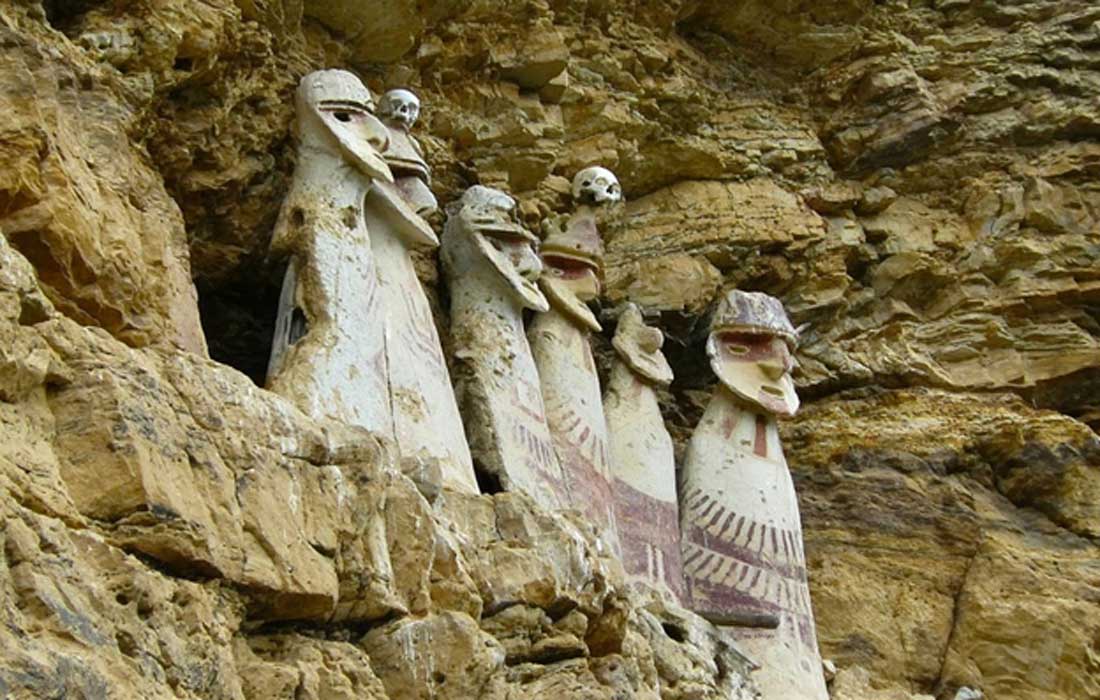
The Cloud Warriors: Sarcophagi Sentries Perched on the Cliffs in Peru


Researchers would have never guessed what they would find inside a seven-foot-tall statue when it came crashing down the Peruvian cliffside in the Utcubamba valley in 1928. The sculpture was a sarcophagus holding a carefully wrapped mummy. Its discovery was just the beginning to the fascinating story of the Cloud Warriors.

Chachapoya mummies. (pmoroni/ CC BY SA 2.0 )

As more of the sarcophagi were found, they became known as the purunmachu, where the ‘ Warriors of the Clouds ’ placed their dead. Although looters had reached many of the sarcophagi before archaeologists, several purunmachu were discovered intact, hidden high up on cliff ledges.

Cloud Warriors: The Mysterious Power of the Lost Chachapoya CultureKuelap, Peru - Ancient Fortress of the Cloud WarriorsFive incredible funerary practices from the ancient world

Sarcophagi on a cliff face, Chachapoyas, Amazonas, Peru. (Jorge Gobbi/ CC BY 2.0 )

The Chachapoya people, commonly known as the Cloud Warriors, began living in the cloud forests of the Amazonas region of present day Peru as early as 200 AD. The Inca culture conquered their region shortly before the Spanish arrived. It only took about a decade for the Chachapoya people to lose most of their cultural traditions following the Inca conquest. Then the Spanish arrival decimated the remainder of the Cloud Warriors. Yet the purunmachu remained patiently standing on the cliffsides.

The Karajía Six, Chachapoya sarcophagi. (A. Davey/ CC BY NC ND 2.0)

Purunmachu sarcophagi were made in a series of steps. First, clay was sculpted around the carefully wrapped bodies of the dead. Then a mixture of mud and straw was applied. Finally, the sarcophagi were painted cream colored of white and decorative details such as necklaces, feathered tunics, and faces were painted on in yellow and red. When placed on a ledge of a high cliff, the sarcophagi look like sentries guarding the dead.

Archaeologists may have found children’s cemetery belonging to ‘Warriors of the Clouds’Ten Precariously Situated Cliffside Constructions from the Ancient WorldScientists Set to Unravel Secrets of Oldest Peruvian Mummies Ever Found

Chachapoya mummies wrapped in cloth. (C-Monster/ CC BY NC 2.0 )

Eventually, the Chachapoya people were forgotten, what they held sacred had been lost in the years that passed, and many of their sarcophagi were destroyed by looters in search of treasure.

miércoles, 30 de agosto de 2017

Bizarre 'alien' tomb found by Brit investigators in Peru

UFO investigators claim that the discovery of mummified 'aliens' in a tomb in Peru are linked to the Roswell UFO conspiracy.

British UFO boffins travelled to Cusco in Peru to look into five 1,700 year-old mummies that conspiracy theorists claim look more reptilian than human.

New images of the "alien mummies" were unveiled during a press conference called "The mummies of Nazca" in Peru by Mexican ufologist and journalist Jamie Maussan last month.

Investigadores de OVNI afirman que el descubrimiento de "alienígenas" momificados en una tumba en Perú están vinculados a la conspiración OVNI de Roswell.

Británicos UFO boffins viajó a Cusco en Perú para mirar en cinco mil 1.700 momias de edad que los teóricos de la conspiración dicen mirar más reptilian que humanos.

Nuevas imágenes de las "momias alienígenas" fueron reveladas durante una conferencia de prensa titulada "Las momias de Nazca" en Perú por el ufólogo y periodista mexicano Jamie Maussan el mes pasado.

UFO investigators claim that the discovery of mummified 'aliens' in a tomb in Peru are linked to the Roswell UFO conspiracy.

British UFO boffins travelled to Cusco in Peru to look into five 1,700 year-old mummies that conspiracy theorists claim look more reptilian than human.

Steve Mera claims he was told a foldable 'alien' metal was found in Peru

Major Jesse Marcel from the Roswell Army Air Field with debris found 75 miles north west of Roswell in June 1947

But while they were out there they were told that a "self-folding foil-like metal" was also found in the tomb.

The metal could be the same self-repairing material that UFOlogists claim was found near the crash site in Roswell, in the US state of New Mexico.

He said: "Some of these things are getting out there, and one of these things was apparently just like the Roswell... incident.

"This foil that unfolds itself - some of this was found and sold for only $8,000 to someone in Asia.

He added: "The (Peruvian) government is struggling to contain this problem of tomb raiders... who are getting hold of these artefacts and are being sold across the world on some sort of black market."

New images of the "alien mummies" were unveiled during a press conference called "The mummies of Nazca" in Peru by Mexican ufologist and journalist Jamie Maussan last month.

In the summer of 1947, a farmer discovered unidentifiable debris in his sheep fields just outside Roswell, New Mexico.

The debate rumbles on, with people continuing to make claims about “leaked US government documents”, which supposedly prove it was a cover-up.

X-rays of the so-called mummified remains were shown during a press conference to attempt to banish claims that they were fake

Could there be a link between mummified remains in Peru and the Roswell incident?

This included X-rays of the mummified remains so Maussan could banish claims that they were fake or made of plaster, Ruptly has reported.

Mr Maussan alleges that of the five bodies discovered, three of them had "characteristics that are closer to reptiles than humans".

He added: "Nobody has proved it is a fraud.

"We are going to present preliminary evidence that will determine in the vision of the media, in the collective vision of the popular conscious, the validity that it has."

Maussan has claimed carbon dating samples of the body dates between 245 to 410 AD, though the result has not been verified as true.

Footage of the so-called mummified alien was released in June though some were not convinced.

Supposedly filmed in the ancient city of Nazca, Peru, users pointed out the “corpse” looks like it is a half-finished cardboard creation.

While some have said they will keep an 'open mind' about the 'alien mummies' others have branded them as fake

The video was posted by website Gaia.com which charges curious users money to view their exclusive paranormal content.

The site claims the extraterrestrial beast’s body was dug up during an excavation of the mysterious caves.

One viewer reported commented: "Something seems off. The corpse looks like it was made of plaster.”

Earlier in July we reported how the "discovery" prompted a number of experts and conspiracy theorists to offer their opinion.

In a short documentary on the bizarre find, Dr Konstantin Korotkov, who claims to be a professor at Saint-Petersburg University, claims these features are not a deformity – it is “another creature, another humanoid”.

One website, Ancient Origins says: “We should keep an open mind.”

Maussan has claimed carbon dating samples of the body dates between 245 to 410 AD, though the result has not been verified as true

Some point to the fact people are being charged up to $300 (£232) to attend a conference to discuss it as proof it is fake.

Nigel Watson, author of the UFO Investigations Manual, told MailOnline: “This seems to be a plaster cast over a bone structure with three fingers attached to the hands.

“Such hoaxes are the product of wishful thinking mixed with greed and a lust for publicity.”

Investigadores de OVNI afirman que el descubrimiento de "alienígenas" momificados en una tumba en Perú están vinculados a la conspiración OVNI de Roswell. Británicos UFO boffins viajó a Cusco en Perú para examinar cinco momias de 1.700 años de edad que los teóricos de la conspiración dicen buscar más reptilian que humanos. Steve Mera afirma que le dijeron que se encontró un metal "alien" plegable en Perú El mayor Jesse Marcel del Campo Aéreo del Ejército de Roswell con escombros halló 75 millas al noroeste de Roswell en junio de 1947 Pero mientras estaban allí, se les dijo que en la tumba también se encontraba un "metal parecido a una lámina". El metal podría ser el mismo material auto-reparador que los ufólogos afirman haber sido encontrado cerca del sitio del accidente en Roswell, en el estado de Nuevo México. Dijo: "Algunas de estas cosas están saliendo por ahí, y una de estas cosas fue aparentemente como el incidente de Roswell ...". "Este papel de aluminio que se despliega - algo de esto fue encontrado y vendido por sólo $ 8,000 a alguien en Asia. Agregó: "El gobierno (peruano) está luchando para contener este problema de los invasores de tumbas ... que se están apoderando de estos artefactos y se están vendiendo en todo el mundo en algún tipo de mercado negro". Nuevas imágenes de las "momias alienígenas" fueron reveladas durante una conferencia de prensa titulada "Las momias de Nazca" en Perú por el ufólogo y periodista mexicano Jamie Maussan el mes pasado. En el verano de 1947, un agricultor descubrió restos no identificables en sus campos de ovejas en las afueras de Roswell, Nuevo México. El debate retumba, y la gente continúa haciendo afirmaciones sobre "documentos filtrados del gobierno de Estados Unidos", lo que supuestamente demuestra que fue un encubrimiento. Las radiografías de los así llamados restos momificados se mostraron durante una conferencia de prensa para intentar desterrar las afirmaciones de que eran falsas ¿Podría haber un vínculo entre restos momificados en el Perú y el incidente de Roswell? Esto incluyó rayos X de los restos momificados para que Maussan pudiera desterrar las afirmaciones de que eran falsos o hechos de yeso, informó Ruptly. El Sr. Maussan alega que de los cinco cuerpos descubiertos, tres de ellos tenían "características más cercanas a los reptiles que los humanos". Él agregó: "Nadie ha demostrado que es un fraude. "Vamos a presentar evidencia preliminar que determinará en la visión de los medios de comunicación, en la visión colectiva de la conciencia popular, la validez que tiene". Maussan ha reclamado muestras de datación de carbono de las fechas de cuerpo entre 245 a 410 dC, aunque el resultado no se ha verificado como cierto. Se grabaron videos de los llamados alienígenas momificados en junio, aunque algunos no estaban convencidos. Supuestamente filmado en la antigua ciudad de Nazca, Perú, los usuarios señalaron el "cadáver" parece que es una creación de cartón a medio terminar. Mientras que algunos han dicho que mantendrán una "mente abierta" sobre las "momias extranjeras" otros los han calificado como falsos El video fue publicado por el sitio web Gaia.com, que cobra a los usuarios curiosos dinero para ver su contenido paranormal exclusivo. El sitio afirma que el cuerpo de la bestia extraterrestre fue desenterrado durante una excavación de las misteriosas cuevas. Un espectador comentó: "Algo parece apagado, el cadáver parece estar hecho de yeso". A principios de julio informamos de cómo el "descubrimiento" hizo que varios expertos y teóricos de la conspiración ofrecieran su opinión. En un breve documental sobre el hallazgo extraño, el Dr. Konstantin Korotkov, que afirma ser un profesor en la Universidad de San Petersburgo, afirma que estas características no son una deformidad - es "otra criatura, otro humanoide". Un sitio web, Ancient Origins dice: "Debemos mantener una mente abierta". Maussan ha reclamado muestras de datación de carbono de las fechas de cuerpo entre 245 a 410 dC, aunque el resultado no se ha verificado como cierto Algunos apuntan a que la gente se está cobrando hasta $ 300 (£ 232) para asistir a una conferencia para discutirlo como prueba de que es falso. Nigel Watson, autor del Manual de Investigaciones de OVNI, le dijo a MailOnline: "Esto parece ser un yeso sobre una estructura ósea con tres dedos pegados a las manos. "Estos engaños son el producto de un deseo ilusorio mezclado con la avaricia y una lujuria por la publicidad".

jueves, 24 de agosto de 2017

Ancient Runways and Flying Fish: Did the Nazca Culture Take Flight?

The Nazca lines are still mysterious even after decades of being carefully studied. Archaeologists believe they know how they were made, but why they were made remains uncertain. Recently, researchers have suggested that the lines were related to fertility rituals involving the availability of water, but there are some people who still see something different in lines that are very long and straight. Some alternative thinkers argue that the straighter lines represent runways for ancient airports. Although it is possible that this is the case, the evidence found to support this position is insufficient so far.

Were the Nazca Lines Airports for Ancient Aliens?

The Nazca designs consist of a variety of figures. Some are recognizable as animals, such as spiders and monkeys, while others are more abstract. There is also a subset of figures that consist simply of straight lines. Some of them are built at the tops of hills and appear to stop at the edges of cliffs. Unlike the other designs that are clearly figural, these resemble runways in their length and straightness. This has led some fringe theorists to suggest that these lines were ancient air strips or airports. Some people even suggest that the lines made on hills were specifically created for launching gliders.

Nazca Lines, Nazca, Peru. (Diego Delso/ CC BY SA )

There are two main groups which say that these particular Nazca lines represent runways - those who believe that the Nazca geoglyphs were made by visiting extraterrestrials and those who believe that the Nazca people had flight technology and used it to make the lines. Proponents of both views point to the Tolima artifacts: gold figurines that sometimes resemble jet planes, as further evidence that ancient South Americans either possessed flight technology themselves or encountered flight technology produced by someone else, such as ancient aliens.

  •  Twenty Four more Ancient Geoglyphs Discovered in Nazca, Peru

  •  The Enigma of the Nazca Lines: Strange Theories and Unanswered Questions

Aerial view of the "Owlman" aka "Astronaut", the most enigmatic geoglyph of the Nazca Lines in the Nazca Desert in southern Peru.

Aerial view of the "Owlman" aka "Astronaut", the most enigmatic geoglyph of the Nazca Lines in the Nazca Desert in southern Peru. (Diego Delso/ CC BY SA )

The main problem with the extraterrestrial explanation is that there is no other clear evidence that suggests alien visitation. There is no evidence of crashed spaceships, spacecraft parts, rare metal alloys not normally found on earth, or anything else that could not have come from this planet - no indisputable evidence at least. Furthermore, analysis of the lines shows they were made by delicately removing topsoil to create these designs. A spaceship landing would probably have disrupted this fragile configuration.

There is no evidence of parts of the lines being disrupted because of exhaust from landing spacecraft and you would expect such evidence to remain since the desert is not very windy. This is, in fact, why the Nazca lines have not been obscured by windblown material. Based on these facts, it is unlikely that extraterrestrials made any of the Nazca lines, including the alleged runways.

Artist's impression of UFOs over a desert.

Artist's impression of UFOs over a desert. ( Public Domain )

Runways for Forgotten Nazca Aircraft?

The Nazca lines would not have been hard for the Nazca people to make and experimental archaeology has shown that a team of people can make such lines within a few hours to a few days using only the technological means known to have been available to the ancient Nazca through archaeological evidence. As a result, Occam's razor is friendlier to the idea that the Nazca culture made the lines - we have evidence that they lived in the area at the time and could have constructed the lines - whereas we don't have evidence that extraterrestrials were ever present.

Since it is most likely the Nazca people themselves made all the lines, some fringe theorists have logically concluded that the Nazca civilization must have had flight and other advanced technology because of the supposed runways. Proponents of this view point to Nazca geoglyphs that look vaguely mechanical, resembling windmills and hooks, to bolster their case.

  •  New Study suggests Nazca Lines formed Ancient Pilgrimage Route to Cahuachi Temple

  •  Greenpeace treads on ancient Nazca lines site to urge renewable energy

Although this hypothesis is probably more likely, there are still problems with it. We must remember that just because a design looks one way to us, doesn't mean that it looked that way to the Nazca. For example, they may have been using a particular style of art to represent natural features such as plants and animals that just by coincidence causes them to resemble machines to us since we live in the age of machines.

miércoles, 2 de agosto de 2017

The Racism Behind Alien Mummy Hoaxes

Peruvian archaeologists are tired of debunking claims of extraterrestrial influence on human history. In 1968, Swiss author Erich von Däniken’s Chariots of the Gods? introduced the mainstream to the theory that the ‘Nazca Lines,’ the massive geoglyphs in Southern Peru whose shapes are fully visible only from the air, were landing strips for “ancient astronauts.” Archaeologists calmly disagree, positing that they were astronomical designs that turned the desert itself into an observatory, or counter constellations matching the dark spaces in the Milky Way, or, more abstractly, cosmological figures meant to be seen by skyward deities, of which ancient Peru had many. 2008’s Indiana Jones and the Kingdom of the Crystal Skull put a new spin on this old tale, including, for good measure, the large-skulled aliens that pepper North American abduction stories.

Now, Peruvian scientists are furious at a new and possibly pernicious permutation of the “ancient astronaut” theory. A web series named “Unearthing Nazca” purports to depict the investigation of a Pre-Columbian and “humanoid” mummy. Archaeologists, who have been denied access to the mummy, worry that it is as old as the series’ creators claim, but that it is actually Indigenous and Andean—a real human individual that has been mutilated to look like an alien. They worry that “Unearthing Nazca” is an archaeological snuff film in disguise.

The series’ success is also of concern. Since the series’ launch in June by Gaia.com—a website specializing in “Conscious Media, Yoga & More”—the teaser episode of “Unearthing Nazca” has been viewed 2.35 million times on Youtube alone. It starts with what at first seems to be a typical seated Peruvian mummy, arms wrapped around its knees, like a child waiting for its parent. Its head is elongated like those of other pre-Columbian mummies, whose societies artificially shaped their children’s crania to achieve ideals of beauty or represent group belonging.

The resemblance ends there. A Hans Zimmer-esque score throbs, and a Russian-accented expert in “bioelectrography”—who elsewhere claims to have photographed the human soul escaping the body after death—declares the mummy “one of the most important discoveries of the twenty-first century.” The camera orbits the mummy, revealing that it has only three long fingers on each hand and three long toes on each foot. Its elongated head has no nose, no ears, and large, heavy-lidded eyes. And its skin is an eerie, powdery white.

The video’s experts stop short of the A-word, letting a series of vest-wearing and white coat-clad “experts” claim that x-rays, CT scans, and DNA and Carbon 14 tests of the mummy’s flesh reveal that this new “humanoid” or “organic creature,” whom they have dubbed “Maria,” is no fraud. To learn more, viewers were initially encouraged to watch the rest of the investigation behind Gaia’s paywall.

The English- and Spanish-language tabloids and Youtube channels that cover the “discovery” reliably fill in the blanks, guarding journalistic integrity with scare quotes: “The ‘Alien’ Mummies of Nazca,” trumpeted The Sun in mid-July, when the mummy’s most prominent promoter, a Mexican ‘ufologist’ and TV personality named Jaime Maussan, produced photographic and x-ray “proof” of at least four additional more “reptilian” “humanoid” bodies.

Because of course: What else could they be?

* * *

Human beings, and indigenous ones to boot.

In 2015, Maussan tried to promote a photographic slide from the late 1940s that, he hinted, depicted the corpse of an alien child found in the American Southwest. More skeptical Ufologists applied de-blurring technology to the “Roswell Slide” when it was released, and found that a previously undecipherable placard next to the body revealed that it was actually the mummy of a two-year-old Puebloan boy removed from the cliff dwellings Mesa Verde in 1894. Returned to a National Park museum in 1938, the boy was repatriated to a local tribe in 2015. Incredibly, Maussan then offered $10,000 for information that might permit the Puebloan boy’s “location and recuperation.”

This inclusion of Pre-Columbian Peruvians in Science’s supposed cover-up of extraterrestrials echoes the previous collection and study of the Indigenous dead. In the nineteenth century, Anglo-American and European craniologists and scholars who came upon artificially molded skulls in Peruvian tombs hypothesized that they were either the undeformed remnants of a lost and civilized people they named the ‘Ancient Peruvians,’ or artificial deformations of later peoples inspired by those Ancient Peruvians’ natural forms. Archaeologists came to realize that “deformed” Peruvian skulls were bound and shaped from infancy, when cranial bones weren’t yet fused—with no change to cranial capacity and, judging from the monumental societies their elites achieved, without handicap to cognitive ability. But Ufology’s rise after the “Roswell incident” of 1947 has resurrected the search for secret ancestors—and its less responsible practitioners have re-enlisted ancient Peruvian skulls as evidence of the presence of large-skulled “Grey Aliens.” They speculate that Peru’s greatest pre-Columbian achievements—including Machu Picchu, according to a theory aired on the History channel program “Ancient Aliens”—are literally out of this world, the product of a superior, extraterrestrial “race.” or their borrowed technology.

Illustration of a mummy collected and unwrapped in 1836 by John Harrison Blake (Peabody Museum of Archaeology and Ethnology)

The use of the word “race” is telling, as it suggests how the repurposing of older, European collections of non-European bodies and research upon them can reproduce old and debunked theories of racial deficiency: that Indigenous Peruvians, in particular, could not have built such advanced, monumental societies on their own. (“Ancient Astronaut” theorists claim evidence of extraterrestrial inspiration worldwide, but only Indigenous Americans see their bodies and achievements remade as only explicable by alien presence.) From the eighteenth century on, Northern Europeans have accused the Spanish of exaggerating or misidentifying the origins of the Incas’ achievements. Alexander von Humboldt asserted that the first Incas were actually Chinese. Inca embalming of their dead was attributed instead to natural mummification by the elements or to the diffusion of Egyptian knowledge.

With the rise of specifically racialized science in the nineteenth and twentieth century, evidence for Native American otherness was sought in the ancient Peruvians’ very bones. In the 1920s, one German scholar and future SS officer would seek confirmation that the Andes’ most megalithic cultures were actually Aryan or Atlantean, and that their elongated skulls “belonged to a superior Nordic race.” More dismissively, earlier scholars took ancient Peruvian skulls’ distinctive size, shape, and possession of unique interparietal bones as evidence of a similarity to rodents and marsupials, or a contradiction that undercut their attributed civilization. In his great assault on racial bias in the scientific estimation of intelligence, The Mismeasure of Man (1981), Stephen Jay Gould famously claimed that the Philadelphia craniologist Samuel George Morton had “plummeted” the average size of Indian skulls in his collection by including a “major overrepresentation of an extreme group—the small-brained Inca Peruvians.”

Archaeology and museums have come a long way in their study and portrayal of an Indigenous past in which Peruvians are proud, and conversations about the repatriation or more ethical study of the Indigenous American dead are ongoing. (Simultaneous to “Unearthing Nazca’s release, there was massive attendance at a new and decidedly non-extraterrestrial show on the Nazca culture at the Lima Museum of Art.) Gould’s use of Morton as an illustration of racial bias in science has also been debated—Morton actually used a grouped mean of the groups included among his “Americans,” controlling for the Peruvians’ greater presence so that their inclusion would not plummet the average.

Nevertheless, “Unearthing Nazca” is support for Gould’s larger warning against describing non-European bodies as deficient, abnormal, or non-human. The Internet in particular has provided a platform for claims of Peruvian skulls’ alien or alt-hominid abnormality that rely on the repetition of old scholarship without grappling with the racist presumptions behind the very metrics they used. Proponents of the idea that elongated Peruvian skulls were naturally occurring, for example, have embraced the work of Morton and his cohort, such as the Swiss author who compared the ancient Peruvians to marsupials. It also shows how zombified racial science—even when it claims not to be about race—might abuse actual human bodies.

It was for this reason that “Unearthing Nazca” broke Peruvian archaeologists’ studious reserve. The trouble began late last year, when the Peruvian Youtuber Paul Ronceros got local media to cover an earlier “alien” or “reptilian” mummy and separated three-fingered hand from Nazca, which he claimed were discovered by interested parties other than himself. At some point Ronceros brought that hand and the first “mummy” to a series of museums, including the natural history museum at Lima’s University of San Marcos, the oldest university in the hemisphere. According to that museum’s head of vertebrate paleontology, Dr. Rodolfo Salas Gismondi—who is also an investigator affiliated with the American Museum of Natural History in New York—Ronceros changed his story when challenged on the obvious fabrication, claiming that it instead a Pre-Columbian “representation” of alien life, made of a mixture of animal and human bones. Around this time, Maussan and fellow international UFO “experts” got involved, declaring that the mummies in question—they kept multiplying—were fabrications, possibly ancient, but that others were “genuine, non-human biological remains.”

That archaeological human bones may have been used to mount Ronceros’s “reptile” mini-mummy and its accompanying hand was bad enough. But Peruvian scientists held their fire in public until June, when “Unearthing Nazca’ revealed the previously un-photographed “Maria,” whose dramatic resemblance to actual Peruvian mummies—down to almost anatomically correct CT scan—suggested that she wasn’t a pastiche of animal and human bones, but an actual Pre-Columbian Andean, looted and remade for the sake of a hoax.

From the x-rays of the mummified hands featured on “Unearthing Nazca,” Salas Gismondi has proposed that they were part of a pre-Columbian mummy that was subsequently mutilated—two fingers or toes cut from each extremity and redeployed to augment the number of falanges in the remaining three digits to conform to our alien pop culture stereotypes. Its skeletal extremities, Salas Gismondi observes, are otherwise identical to that of a human being with five fingers, which “makes no evolutionary sense.” To complete the package of “Maria,” her nose and ears may have been sliced away from what was either an unsurprisingly elongated head, or were left off of a recently fabricated one. Evidence of all alterations could easily be covered up with the white, plastery powder that the talking heads on “Unearthing Nazca” claim is a desiccant. The benefit of using an actual mummy is that the body may be probed for samples of actual pre-Columbian flesh, as some face-masked participants in “Unearthing Nazca” are seen to be doing in the name of “Carbon-14 and DNA testing.” The “experts” later declare that those tests reveals that the mummy was a 1600-1800 year-old female “humanoid”—results that have not been verified by outside parties.

Pre-Columbian Peruvian mummy as depicted for the 1851 work Antigüedades Peruanas. (Mariano Eduardo de Rivero / Johann Jakob von Tschudi)

Maria’s guardians have not let her be examined by established mummy experts. In late June, Peru’s Ministry of Culture announced that it was investigating the possibility that the composition of the mummies were the product of looting. And in July, the organizers of last year’s World Congress on Mummy Studies in Lima—Peru’s actual experts on pre-Columbian remains—denounced “Unearthing Nazca,” calling upon Peruvian authorities to investigate, find, and prosecute the mummies’ apparent makers for violating Peru’s laws against trafficking in pre-Columbian human remains, which are considered Peruvian cultural patrimony. The Congress’s organizers were particularly galled by the possibility that this assault upon the dignity of an actually pre-Columbian mummy bolstered believers—even in Peru—that Andean culture and achievements owed to “outside help.”

These Peruvian archaeologists and bio-anthropologists have been careful not to say who they believe is responsible for the suspected fraud; the experts on Gaia.com are likewise careful to say that “Maria” was “discovered” by “Mario,” a pseudonymous third party. When reached for comment, Gaia.com’s media representatives say that the organization has only investigated and reported “on facts related to artifacts presented to us,” and “arranged for independent testing including carbon 14 and DNA sequencing.” The on-camera experts involved in the investigation have apparently not been paid, and Gaia.com has never been “in possession of any artifacts.” During this story’s reporting, the paywall for the rest of the episodes of “Unearthing Nazca” was lowered, releasing them to the open web and possibly helping Gaia answer the charge that it continues to profit from an unraveling story.

But Peru’s mummy experts remain frustrated. In mid-July, one of Peru’s most respected bio-anthropologists, Elsa Tomasto-Cagigao, agreed to be interviewed alongside debate Maussan and another member of his team—a Mexican naval surgeon whose claims to be a forensic anthropologist have not checked out—live on Peruvian TV.

Maussan took the opportunity to claim that he and his colleagues were being defamed; that they never said it was an ‘extraterrestrial; just that that they sought the truth on whether or not it was a “human being.” But Tomasto-Cagigao wasn’t having it. She laid out the case clearly, patiently, unflappably, observing that no one in Peru’s actual scientific community of mummy experts had been consulted or had seen “Maria” or the actual X-rays other than what was flashed on “Unearthing Nazca” or in Maussan’s “press conferences.”

“And if they present them tomorrow?” asks the host.

“I’ll eat a cockroach, live, with mayonnaise,” Tomasto-Cagigao replied. “It is not just grave-robbing … Peruvian law says that to extract, alter, or manipulate cultural patrimony without the permission of the state is a crime.”

The interviewer tries to break in.

“I’m not saying that they did it,” she adds, refusing to look at the “Unearthing Nazca” experts, whose latest episode investigates a mummified pre-Columbian infant whose tiny hands and feet have, or were made to have, three fingers.

“But there’s a crime here.”

martes, 25 de julio de 2017

EXCLUSIVE: Inside tomb in Peru where 'mummified aliens were found'

Gaia.com, the paranormal website behind outlandish claims that at least five mummified aliens have been found buried in Nazca, Peru, released a new video revealing the images inside the alleged tomb and the identity of the man said to have found them.

The film said a man called Mario was the explorer said to have stumbled across the remains in a tomb in an undisclosed part of the Peruvian region.

The disclosure came after scientists and the Peruvian World Congress on Mummy Studies released statements saying they believed the creatures were hoaxes that had been made using real human remains, and demanded an official inquiry into whether any archaeological crimes had been committed.

As a result, Express.co.uk asked Gaia.com and Mexican investigative journalist and ufologist Jamie Maussan, who is at the forefront of the claims, for details about where the so-called alien mummies were discovered.

These images were taken of the aliens as they were found in the tomb,the video claims.

We asked for the location, who found them, whether it was part on an official dig, and if there were nay pictures of the discovery.

Both Gaia.com and Mr Maussan failed to answer.

However, the new video claims Mario, who was shown on camera but not given a surname, was the man behind the "world-changing find".

The video narrater said: "Mario helped with the discovery of many well known sites in Peru since the 1990s.

Flying saucer above highway, real or not?

Related articles

  • 

  • 

"He knows very well what he does, and he knows what he has found, and what he has found does not belong to any known culture in South America."

Mr Maussan said in the film: "Inside this tomb, in a secret place, he found two sarcophaguses.

"In one of them was just pure objects. In the second one he found two medium-sized bodies, and many little bodies.

"The big body was outside the sarcophagus."

Mr Maussan said Mario would not agree to be interviewed on camera, or take the team to the site.

He added: "He is afraid that somebody is going to find this and he his going to lose what is inside."

The narrater said Mario believes he has touched just 10 per cent of the site, possibly less, and has no idea yet how far branches of underground tunnels go.

The film said that the team investigating the discovery was given the "mummies" by French archaeologist Thierry Jamin.

Another still from the video showing inside the alleged tomb.

Related articles

  • 

  • 

In one of them was just pure objects. In the second one he found two medium-sized bodies, and many little bodies. The big body was outside the sarcophagus.

Jamie Maussan

Mr Jamin is introduced as the President of the Inkari Institute, and it is alleged he obtained the mummies from Mario.

The Inkari Institute based in Cusco, says it is a non profit and non governmental archaeological research organisation.

Footage in the video shows what appears to be the entrance to the tomb and mummified remains buried in there.

Mr Maussan said at an earlier press conference about the discovery that the mummified burial of the bodies suggests they once coexisted with our ancestors.

He said: "These mummies were buried in human tombs, in sacred places.

"This means that they had coexisted with our ancestors, were not enemies and had, to a certain extent, a degree of respect between both races or cultures."

They claim tests show the bones to be 1,700 years old, and the beings had three fingers and elongated skulls.

For years there have been claims by alien conspiracy theorists that aliens visited our ancestors and helped them build great structures like the Pyramids of Giza and Stonehenge.

Mr Maussan has previously investigated a series of alleged alien body discoveries which turned out to be hoaxes.

many ufologists believe the Gaia.com films are just promoting a massive hoax.

Nigel Watson, author of the UFO Investigations Manual said they were "plaster of Paris fakes".

UK-based UFO investigators Steve Mera and Barry Fitzgerald have set out to get to to the truth.

In a press release, the pair said: "Recently, the internet exploded with images of newly discovered mummies, discovered in the region of Nazca, Peru.

The Crop Circles are often believed to be created by aliens, as there is no proper explanation behind this phenomenon.

Related articles

  • 

  • 

"Many will be aware that there are numerous headlines and information being publicised by Gaia.com and Jamie Maussan.

"This is not the first time such Earth Shaking discoveries have been found, only to turn out to have a more mundane explanation.

"Could these recent findings be what we have been waiting for?

"We have recently returned from Peru after conducting a painstaking and thorough investigation that encompasses physical examinations of the bodies, scrutinising X-rays and scans, reviewing medical conclusions and being cast into the murky depths of the illegal black market."

Mr Mera told Express.co.uk: "We are officially representing the Inkari Institute (run by Mr Jamin) as part of delivering the full information to the public.

"We are at this time in discussions with doctors at universities around the UK."

lunes, 17 de julio de 2017

¿Qué representa el hallazgo de las momias de Nazca en Perú


El periodista mexicano Jaime Maussan asegura que "los cuerpos momificados tienen aspecto alienígena" y fueron "enterrados en lugares sagrados", lo que indica "una convivencia entre humanos y extraterrestres".

Jaime Maussan es un periodista mexicano que ha dedicado gran parte de su existencia a la investigación del fenómeno extraterrestre, los indicios de vida inteligente en otros planetas y la aparición de objetos voladores no identificados (ovnis) en México y gran parte del mundo. 

50 años de avistamientos de ovnis: Desclasifican los 'Expedientes X británicos'

En 1999, inició su programa 'Ovni: un fenómeno inteligente', transmitido por ABC Radio. En 2004, estrenó su programa televisivo a nivel nacional titulado 'Los grandes misterios del tercer milenio', el cual sigue vigente e incluye temas como medio ambiente, ciencia y tecnología.

En entrevista con RT en Español, Maussan asegura que "los seres humanos somos egoístas porque creemos que somos los únicos entes que viven en un universo tan inmenso". Y esto obedece a una simple razón: "Si los seres humanos no somos capaces de ir hacia otro planeta, ¿por qué alguien diferente a nosotros sí puede venir a la Tierra?". 

RT: ¿Por qué investigar el fenómeno extraterrestre en México y gran parte del mundo?

J.M.: Considero que los fenómenos extraterrestres y la probable existencia de vida inteligente en la Tierra y otros planetas es una noticia que puede cambiar la historia de la humanidad. Por eso me he empeñado en seguir cada indicio y darle la importancia que merece, ya que en los medios de comunicación tradicionales no hay un interés genuino por el tópico.

RT: ¿En qué momento se da cuenta de que existen diferentes formas de vida inteligente en el universo?

J.M.: A través de la investigación periodística, es decir, testimonios, imágenes y videos que nos comparte la gente, y los cuales hemos documentado en 'Tercer Milenio TV'. Sin embargo, esto no puede confirmar un hecho tan importante que es la existencia de seres inteligentes en la Tierra. 

RT: ¿Y en el caso de su más reciente investigación periodística, en la que hallaron momias de apariencia alienígena en la ciudad de Lima, Perú?

J.M.: En el caso de las momias de la región de Nazca, ahí sí podríamos confirmar con pruebas científicas la existencia de seres de otro mundo. Tenemos en nuestro poder radiografías, análisis de ADN y de carbono 14, es decir, datos contundentes de un acercamiento a cuerpos, presuntamente, de un origen no común al del ser humano, es decir, alienígena.

RT: A este respecto, ¿usted puede confirmar la presencia y existencia de otros seres en la Tierra?

J.M.: Sí, antes era una posibilidad, ahora es una realidad.

RT: ¿Qué estarían haciendo estos presuntos alienígenas en la Tierra?

J.M.: Es muy difícil saberlo, sin embargo hay un dato muy interesante: las momias estaban sepultadas en tumbas humanas, en lugares sagrados. Esto quiere decir que tuvieron convivencia con nuestros antepasados, no eran enemigos y se tenían, hasta cierto punto, un grado de respeto entre ambas razas o culturas. 

RT: Al parecer México y Rusia son naciones atractivas para la vida alienígena. ¿Por qué?

J.M.: En el caso de México, es su vasta cultura; y de Rusia, la tecnología. En la década de 1990, nuestro país fue un referente en la investigación extraterrestre, pero me atrevo a decir que en los últimos años Rusia se ha posicionado como el país con más evidencias en este rubro. Y esto obedece a que la sociedad quiere conocer qué hay más allá de nuestro entendimiento humano, y para ello hay estímulos.

RT: ¿En México existe alguna organización gubernamental encargada de investigar el fenómeno extraterrestre?

J.M.: No, somos la única institución, el único medio en México, encargado de la investigación del fenómeno ovni. Existen en Rusia, Chile, Uruguay y Ecuador, en donde, si bien no hay una oficina de representación, la apertura del Gobierno indica que hay algún tipo de apoyo para organizaciones no gubernamentales y medios de comunicación.

RT: Mucha gente duda de la existencia del 'Área 51', un lugar altamente secreto en el sur del estado americano de Nevada. ¿Es real?

J.M.: Sí, existe y es real. Y dentro del 'Área 51' hay un lugar llamado 'S-4', en donde aparentemente se encuentran las naves extraterrestres y algunos cuerpos alienígenas.

RT: Finalmente, ¿en quién cree Jaime Maussan?

J.M.: Creo en un ser supremo encargado de crear tantas maravillas en la Tierra. Estamos descubriendo que la vida, más que rara o extraña, es común en otros planetas.


sábado, 10 de diciembre de 2016

The Ancient Alien Theory Of Erich Von Daniken's Research

How were the great Pyramids of Egypt built in those ancient days? Who has drawn the mysterious Nazca lines in Peru? Who are the gods and goddesses, description of who are found in various artworks and texts of the ancient days?

The answers to all of these questions lie in one theory which was conceptualized and proposed by the Swiss Author, Erich Von Daniken in his famous book "The Chariot of Gods".

This theory which was accepted by some and criticized by some changed the whole thought process of thinking about aliens and their existence and is called the Ancient aliens theory.

Ancient alien theory aka ancient astronaut theory proposes that extraterrestrial beings from space had been coming to earth since ancient times and they interacted with the primitive man and shared their knowledge with humans.

These interactions served as catalysts for the development of technology, science, cultures and religions. Here are some of the most important aspects of the research of Erich Von Daniken.