El cuento del ESTIGMA DE LA SERPIENTE INCA es parte de la trilogia de cuentos del libro EL ESPECTRO DE SARAH ELLEN ROBERTS Y OTROS RELATOS, puede adquirirla en la TIENDA KINDLE DE AMAZON Chronicles of a man seeking his fate after Spanish conquest and the start of the Viceroyalty of Peru.
lunes, 9 de octubre de 2017
NAZCA TOMB ALIENS: Government 'cover up' claim over 'mummified bodies' found in cave
viernes, 15 de septiembre de 2017
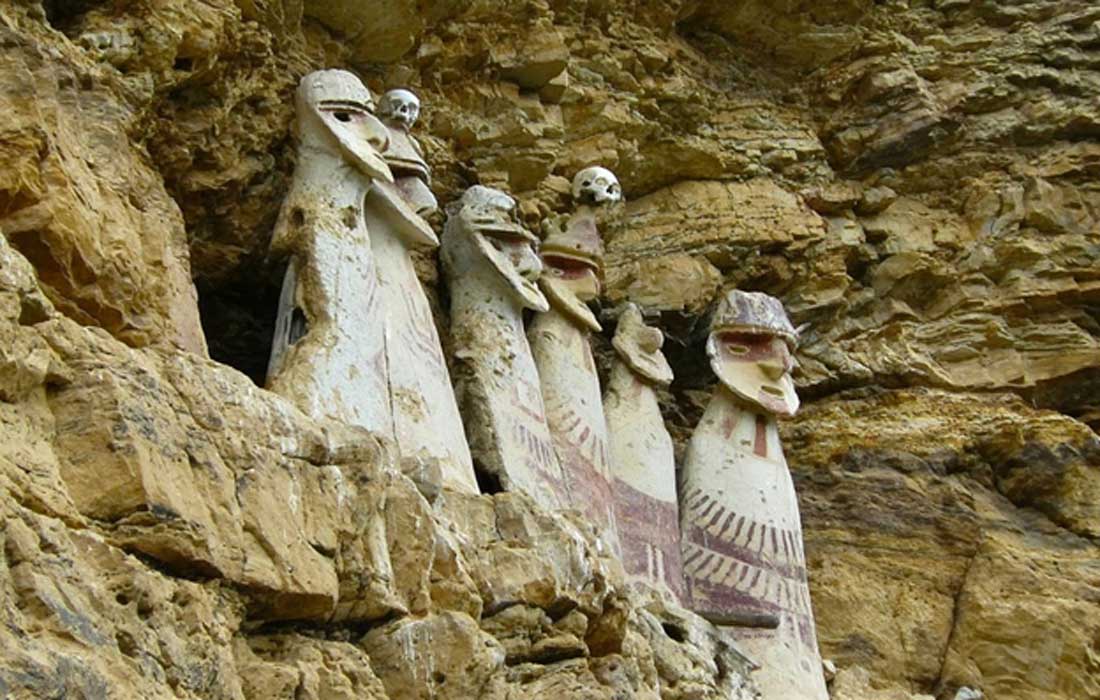
The Cloud Warriors: Sarcophagi Sentries Perched on the Cliffs in Peru
Researchers would have never guessed what they would find inside a seven-foot-tall statue when it came crashing down the Peruvian cliffside in the Utcubamba valley in 1928. The sculpture was a sarcophagus holding a carefully wrapped mummy. Its discovery was just the beginning to the fascinating story of the Cloud Warriors.
Chachapoya mummies. (pmoroni/ CC BY SA 2.0 )
As more of the sarcophagi were found, they became known as the purunmachu, where the ‘ Warriors of the Clouds ’ placed their dead. Although looters had reached many of the sarcophagi before archaeologists, several purunmachu were discovered intact, hidden high up on cliff ledges.
Cloud Warriors: The Mysterious Power of the Lost Chachapoya CultureKuelap, Peru - Ancient Fortress of the Cloud WarriorsFive incredible funerary practices from the ancient world
Sarcophagi on a cliff face, Chachapoyas, Amazonas, Peru. (Jorge Gobbi/ CC BY 2.0 )
The Chachapoya people, commonly known as the Cloud Warriors, began living in the cloud forests of the Amazonas region of present day Peru as early as 200 AD. The Inca culture conquered their region shortly before the Spanish arrived. It only took about a decade for the Chachapoya people to lose most of their cultural traditions following the Inca conquest. Then the Spanish arrival decimated the remainder of the Cloud Warriors. Yet the purunmachu remained patiently standing on the cliffsides.
The Karajía Six, Chachapoya sarcophagi. (A. Davey/ CC BY NC ND 2.0)
Purunmachu sarcophagi were made in a series of steps. First, clay was sculpted around the carefully wrapped bodies of the dead. Then a mixture of mud and straw was applied. Finally, the sarcophagi were painted cream colored of white and decorative details such as necklaces, feathered tunics, and faces were painted on in yellow and red. When placed on a ledge of a high cliff, the sarcophagi look like sentries guarding the dead.
Archaeologists may have found children’s cemetery belonging to ‘Warriors of the Clouds’Ten Precariously Situated Cliffside Constructions from the Ancient WorldScientists Set to Unravel Secrets of Oldest Peruvian Mummies Ever Found
Chachapoya mummies wrapped in cloth. (C-Monster/ CC BY NC 2.0 )
Eventually, the Chachapoya people were forgotten, what they held sacred had been lost in the years that passed, and many of their sarcophagi were destroyed by looters in search of treasure.
miércoles, 30 de agosto de 2017
Bizarre 'alien' tomb found by Brit investigators in Peru
UFO investigators claim that the discovery of mummified 'aliens' in a tomb in Peru are linked to the Roswell UFO conspiracy.
British UFO boffins travelled to Cusco in Peru to look into five 1,700 year-old mummies that conspiracy theorists claim look more reptilian than human.
New images of the "alien mummies" were unveiled during a press conference called "The mummies of Nazca" in Peru by Mexican ufologist and journalist Jamie Maussan last month.
Investigadores de OVNI afirman que el descubrimiento de "alienígenas" momificados en una tumba en Perú están vinculados a la conspiración OVNI de Roswell.
Británicos UFO boffins viajó a Cusco en Perú para mirar en cinco mil 1.700 momias de edad que los teóricos de la conspiración dicen mirar más reptilian que humanos.
Nuevas imágenes de las "momias alienígenas" fueron reveladas durante una conferencia de prensa titulada "Las momias de Nazca" en Perú por el ufólogo y periodista mexicano Jamie Maussan el mes pasado.
UFO investigators claim that the discovery of mummified 'aliens' in a tomb in Peru are linked to the Roswell UFO conspiracy.
British UFO boffins travelled to Cusco in Peru to look into five 1,700 year-old mummies that conspiracy theorists claim look more reptilian than human.
Steve Mera claims he was told a foldable 'alien' metal was found in Peru
Major Jesse Marcel from the Roswell Army Air Field with debris found 75 miles north west of Roswell in June 1947
But while they were out there they were told that a "self-folding foil-like metal" was also found in the tomb.
The metal could be the same self-repairing material that UFOlogists claim was found near the crash site in Roswell, in the US state of New Mexico.
He said: "Some of these things are getting out there, and one of these things was apparently just like the Roswell... incident.
"This foil that unfolds itself - some of this was found and sold for only $8,000 to someone in Asia.
He added: "The (Peruvian) government is struggling to contain this problem of tomb raiders... who are getting hold of these artefacts and are being sold across the world on some sort of black market."
New images of the "alien mummies" were unveiled during a press conference called "The mummies of Nazca" in Peru by Mexican ufologist and journalist Jamie Maussan last month.
In the summer of 1947, a farmer discovered unidentifiable debris in his sheep fields just outside Roswell, New Mexico.
The debate rumbles on, with people continuing to make claims about “leaked US government documents”, which supposedly prove it was a cover-up.
X-rays of the so-called mummified remains were shown during a press conference to attempt to banish claims that they were fake
Could there be a link between mummified remains in Peru and the Roswell incident?
This included X-rays of the mummified remains so Maussan could banish claims that they were fake or made of plaster, Ruptly has reported.
Mr Maussan alleges that of the five bodies discovered, three of them had "characteristics that are closer to reptiles than humans".
He added: "Nobody has proved it is a fraud.
"We are going to present preliminary evidence that will determine in the vision of the media, in the collective vision of the popular conscious, the validity that it has."
Maussan has claimed carbon dating samples of the body dates between 245 to 410 AD, though the result has not been verified as true.
Footage of the so-called mummified alien was released in June though some were not convinced.
Supposedly filmed in the ancient city of Nazca, Peru, users pointed out the “corpse” looks like it is a half-finished cardboard creation.
While some have said they will keep an 'open mind' about the 'alien mummies' others have branded them as fake
The video was posted by website Gaia.com which charges curious users money to view their exclusive paranormal content.
The site claims the extraterrestrial beast’s body was dug up during an excavation of the mysterious caves.
One viewer reported commented: "Something seems off. The corpse looks like it was made of plaster.”
Earlier in July we reported how the "discovery" prompted a number of experts and conspiracy theorists to offer their opinion.
In a short documentary on the bizarre find, Dr Konstantin Korotkov, who claims to be a professor at Saint-Petersburg University, claims these features are not a deformity – it is “another creature, another humanoid”.
One website, Ancient Origins says: “We should keep an open mind.”
Maussan has claimed carbon dating samples of the body dates between 245 to 410 AD, though the result has not been verified as true
Some point to the fact people are being charged up to $300 (£232) to attend a conference to discuss it as proof it is fake.
Nigel Watson, author of the UFO Investigations Manual, told MailOnline: “This seems to be a plaster cast over a bone structure with three fingers attached to the hands.
“Such hoaxes are the product of wishful thinking mixed with greed and a lust for publicity.”
Investigadores de OVNI afirman que el descubrimiento de "alienígenas" momificados en una tumba en Perú están vinculados a la conspiración OVNI de Roswell. Británicos UFO boffins viajó a Cusco en Perú para examinar cinco momias de 1.700 años de edad que los teóricos de la conspiración dicen buscar más reptilian que humanos. Steve Mera afirma que le dijeron que se encontró un metal "alien" plegable en Perú El mayor Jesse Marcel del Campo Aéreo del Ejército de Roswell con escombros halló 75 millas al noroeste de Roswell en junio de 1947 Pero mientras estaban allí, se les dijo que en la tumba también se encontraba un "metal parecido a una lámina". El metal podría ser el mismo material auto-reparador que los ufólogos afirman haber sido encontrado cerca del sitio del accidente en Roswell, en el estado de Nuevo México. Dijo: "Algunas de estas cosas están saliendo por ahí, y una de estas cosas fue aparentemente como el incidente de Roswell ...". "Este papel de aluminio que se despliega - algo de esto fue encontrado y vendido por sólo $ 8,000 a alguien en Asia. Agregó: "El gobierno (peruano) está luchando para contener este problema de los invasores de tumbas ... que se están apoderando de estos artefactos y se están vendiendo en todo el mundo en algún tipo de mercado negro". Nuevas imágenes de las "momias alienígenas" fueron reveladas durante una conferencia de prensa titulada "Las momias de Nazca" en Perú por el ufólogo y periodista mexicano Jamie Maussan el mes pasado. En el verano de 1947, un agricultor descubrió restos no identificables en sus campos de ovejas en las afueras de Roswell, Nuevo México. El debate retumba, y la gente continúa haciendo afirmaciones sobre "documentos filtrados del gobierno de Estados Unidos", lo que supuestamente demuestra que fue un encubrimiento. Las radiografías de los así llamados restos momificados se mostraron durante una conferencia de prensa para intentar desterrar las afirmaciones de que eran falsas ¿Podría haber un vínculo entre restos momificados en el Perú y el incidente de Roswell? Esto incluyó rayos X de los restos momificados para que Maussan pudiera desterrar las afirmaciones de que eran falsos o hechos de yeso, informó Ruptly. El Sr. Maussan alega que de los cinco cuerpos descubiertos, tres de ellos tenían "características más cercanas a los reptiles que los humanos". Él agregó: "Nadie ha demostrado que es un fraude. "Vamos a presentar evidencia preliminar que determinará en la visión de los medios de comunicación, en la visión colectiva de la conciencia popular, la validez que tiene". Maussan ha reclamado muestras de datación de carbono de las fechas de cuerpo entre 245 a 410 dC, aunque el resultado no se ha verificado como cierto. Se grabaron videos de los llamados alienígenas momificados en junio, aunque algunos no estaban convencidos. Supuestamente filmado en la antigua ciudad de Nazca, Perú, los usuarios señalaron el "cadáver" parece que es una creación de cartón a medio terminar. Mientras que algunos han dicho que mantendrán una "mente abierta" sobre las "momias extranjeras" otros los han calificado como falsos El video fue publicado por el sitio web Gaia.com, que cobra a los usuarios curiosos dinero para ver su contenido paranormal exclusivo. El sitio afirma que el cuerpo de la bestia extraterrestre fue desenterrado durante una excavación de las misteriosas cuevas. Un espectador comentó: "Algo parece apagado, el cadáver parece estar hecho de yeso". A principios de julio informamos de cómo el "descubrimiento" hizo que varios expertos y teóricos de la conspiración ofrecieran su opinión. En un breve documental sobre el hallazgo extraño, el Dr. Konstantin Korotkov, que afirma ser un profesor en la Universidad de San Petersburgo, afirma que estas características no son una deformidad - es "otra criatura, otro humanoide". Un sitio web, Ancient Origins dice: "Debemos mantener una mente abierta". Maussan ha reclamado muestras de datación de carbono de las fechas de cuerpo entre 245 a 410 dC, aunque el resultado no se ha verificado como cierto Algunos apuntan a que la gente se está cobrando hasta $ 300 (£ 232) para asistir a una conferencia para discutirlo como prueba de que es falso. Nigel Watson, autor del Manual de Investigaciones de OVNI, le dijo a MailOnline: "Esto parece ser un yeso sobre una estructura ósea con tres dedos pegados a las manos. "Estos engaños son el producto de un deseo ilusorio mezclado con la avaricia y una lujuria por la publicidad".
jueves, 24 de agosto de 2017
SWIC radiology professor makes surprising find in skulls of Peru's mummies
About two weeks into X-raying mummies at an isolated and slightly primitive museum in Peru, Julie Ostrowski noticed something odd.
The frontal sinus - the cauliflower-shaped cavity in the middle of the forehead - was missing in most of the mummies. Typically, only 1 to 4 percent of the population is missing the frontal sinus.
The Belleville woman went back and reviewed the X-rays she had already taken on that June trip, and added it to her findings: 72 percent of the mummified remains of the Chachapoya were missing frontal sinuses.
Why? Nobody knows.
"When I brought it up" to the other scientists, "I started to see a lot of eye(s) opening wide," she said.
Ostrowski hopes to go back to Peru next summer, again when she's not teaching radiology at Southwestern Illinois College, and pursue if elevation has an effect on that particular sinus cavity. She did not notice signs of agenesis, or a missing sinus, in the other sinus cavities.
"I think anything we learn of the past is going to give us a pathway to the future," Ostrowski said from her home.
The expedition had scientists and experts from several countries helping to preserve and document the mummies and relics of the Chachapoya, a civilization conquered by the Inca Empire. The mummies were between about 800 to 1,000 years old, and most of them were in their 20s, 30s and 40s at the time of their death.
"Fifty was considered pretty old," she said.
Ostrowski has a habit of naming things, she says.
"I like to call him 'Juicy,'" she said while showing photos of a skeleton that still had skin. The Chachapoya mummified their dead with the hands cradling the face, sitting with the knees drawn up tight. They broke bones to push the bodies into small bundles, which were wrapped in textiles.
Most bundles remained wrapped during documentation, Ostrowski said. Those that were not, like "Juicy," were cleaned of dirt and rocks and rewrapped in a cloth for safe storage.
The mummies are stored at the museum to prevent looting. Many mummies are unadorned by precious stones, but some have amulets with diamonds or amethysts or copper jewelry, Ostrowski said, that looters will hack open the bundled mummies to find.
I think anything we learn of the past is going to give us a pathway to the future.
Julie Ostrowski
"I love this one," she says at another photograph. "I named him George - look at those toes! I love those feet. Juicy feet. He's 500 years old" and the mummy's foot looks freshly preserved.
From Peru, Ostrowski went to Uganda to be part of a medical mission in July. They saw 1,250 people in four and a half days on one island, she said, treating 1,028 of them for malaria, syphilis, parasites, HIV and other diseases.
"We can treat you, but there's no (ongoing) care" in that area, she said.
Ostrowski, wife of a retired airman and daughter of a Navy Seabee, finds going from Peru to Uganda, and then to Mississippi and Kentucky to visit family, a comfortable way to spend the summer break from SWIC.
"I did not want to come back," she said. "Coming back to reality is hard."
miércoles, 2 de agosto de 2017
The Racism Behind Alien Mummy Hoaxes
Peruvian archaeologists are tired of debunking claims of extraterrestrial influence on human history. In 1968, Swiss author Erich von Däniken’s Chariots of the Gods? introduced the mainstream to the theory that the ‘Nazca Lines,’ the massive geoglyphs in Southern Peru whose shapes are fully visible only from the air, were landing strips for “ancient astronauts.” Archaeologists calmly disagree, positing that they were astronomical designs that turned the desert itself into an observatory, or counter constellations matching the dark spaces in the Milky Way, or, more abstractly, cosmological figures meant to be seen by skyward deities, of which ancient Peru had many. 2008’s Indiana Jones and the Kingdom of the Crystal Skull put a new spin on this old tale, including, for good measure, the large-skulled aliens that pepper North American abduction stories.
Now, Peruvian scientists are furious at a new and possibly pernicious permutation of the “ancient astronaut” theory. A web series named “Unearthing Nazca” purports to depict the investigation of a Pre-Columbian and “humanoid” mummy. Archaeologists, who have been denied access to the mummy, worry that it is as old as the series’ creators claim, but that it is actually Indigenous and Andean—a real human individual that has been mutilated to look like an alien. They worry that “Unearthing Nazca” is an archaeological snuff film in disguise.
The series’ success is also of concern. Since the series’ launch in June by Gaia.com—a website specializing in “Conscious Media, Yoga & More”—the teaser episode of “Unearthing Nazca” has been viewed 2.35 million times on Youtube alone. It starts with what at first seems to be a typical seated Peruvian mummy, arms wrapped around its knees, like a child waiting for its parent. Its head is elongated like those of other pre-Columbian mummies, whose societies artificially shaped their children’s crania to achieve ideals of beauty or represent group belonging.
The resemblance ends there. A Hans Zimmer-esque score throbs, and a Russian-accented expert in “bioelectrography”—who elsewhere claims to have photographed the human soul escaping the body after death—declares the mummy “one of the most important discoveries of the twenty-first century.” The camera orbits the mummy, revealing that it has only three long fingers on each hand and three long toes on each foot. Its elongated head has no nose, no ears, and large, heavy-lidded eyes. And its skin is an eerie, powdery white.
The video’s experts stop short of the A-word, letting a series of vest-wearing and white coat-clad “experts” claim that x-rays, CT scans, and DNA and Carbon 14 tests of the mummy’s flesh reveal that this new “humanoid” or “organic creature,” whom they have dubbed “Maria,” is no fraud. To learn more, viewers were initially encouraged to watch the rest of the investigation behind Gaia’s paywall.
The English- and Spanish-language tabloids and Youtube channels that cover the “discovery” reliably fill in the blanks, guarding journalistic integrity with scare quotes: “The ‘Alien’ Mummies of Nazca,” trumpeted The Sun in mid-July, when the mummy’s most prominent promoter, a Mexican ‘ufologist’ and TV personality named Jaime Maussan, produced photographic and x-ray “proof” of at least four additional more “reptilian” “humanoid” bodies.
Because of course: What else could they be?
* * *
Human beings, and indigenous ones to boot.
In 2015, Maussan tried to promote a photographic slide from the late 1940s that, he hinted, depicted the corpse of an alien child found in the American Southwest. More skeptical Ufologists applied de-blurring technology to the “Roswell Slide” when it was released, and found that a previously undecipherable placard next to the body revealed that it was actually the mummy of a two-year-old Puebloan boy removed from the cliff dwellings Mesa Verde in 1894. Returned to a National Park museum in 1938, the boy was repatriated to a local tribe in 2015. Incredibly, Maussan then offered $10,000 for information that might permit the Puebloan boy’s “location and recuperation.”
This inclusion of Pre-Columbian Peruvians in Science’s supposed cover-up of extraterrestrials echoes the previous collection and study of the Indigenous dead. In the nineteenth century, Anglo-American and European craniologists and scholars who came upon artificially molded skulls in Peruvian tombs hypothesized that they were either the undeformed remnants of a lost and civilized people they named the ‘Ancient Peruvians,’ or artificial deformations of later peoples inspired by those Ancient Peruvians’ natural forms. Archaeologists came to realize that “deformed” Peruvian skulls were bound and shaped from infancy, when cranial bones weren’t yet fused—with no change to cranial capacity and, judging from the monumental societies their elites achieved, without handicap to cognitive ability. But Ufology’s rise after the “Roswell incident” of 1947 has resurrected the search for secret ancestors—and its less responsible practitioners have re-enlisted ancient Peruvian skulls as evidence of the presence of large-skulled “Grey Aliens.” They speculate that Peru’s greatest pre-Columbian achievements—including Machu Picchu, according to a theory aired on the History channel program “Ancient Aliens”—are literally out of this world, the product of a superior, extraterrestrial “race.” or their borrowed technology.
Illustration of a mummy collected and unwrapped in 1836 by John Harrison Blake (Peabody Museum of Archaeology and Ethnology)
The use of the word “race” is telling, as it suggests how the repurposing of older, European collections of non-European bodies and research upon them can reproduce old and debunked theories of racial deficiency: that Indigenous Peruvians, in particular, could not have built such advanced, monumental societies on their own. (“Ancient Astronaut” theorists claim evidence of extraterrestrial inspiration worldwide, but only Indigenous Americans see their bodies and achievements remade as only explicable by alien presence.) From the eighteenth century on, Northern Europeans have accused the Spanish of exaggerating or misidentifying the origins of the Incas’ achievements. Alexander von Humboldt asserted that the first Incas were actually Chinese. Inca embalming of their dead was attributed instead to natural mummification by the elements or to the diffusion of Egyptian knowledge.
With the rise of specifically racialized science in the nineteenth and twentieth century, evidence for Native American otherness was sought in the ancient Peruvians’ very bones. In the 1920s, one German scholar and future SS officer would seek confirmation that the Andes’ most megalithic cultures were actually Aryan or Atlantean, and that their elongated skulls “belonged to a superior Nordic race.” More dismissively, earlier scholars took ancient Peruvian skulls’ distinctive size, shape, and possession of unique interparietal bones as evidence of a similarity to rodents and marsupials, or a contradiction that undercut their attributed civilization. In his great assault on racial bias in the scientific estimation of intelligence, The Mismeasure of Man (1981), Stephen Jay Gould famously claimed that the Philadelphia craniologist Samuel George Morton had “plummeted” the average size of Indian skulls in his collection by including a “major overrepresentation of an extreme group—the small-brained Inca Peruvians.”
Archaeology and museums have come a long way in their study and portrayal of an Indigenous past in which Peruvians are proud, and conversations about the repatriation or more ethical study of the Indigenous American dead are ongoing. (Simultaneous to “Unearthing Nazca’s release, there was massive attendance at a new and decidedly non-extraterrestrial show on the Nazca culture at the Lima Museum of Art.) Gould’s use of Morton as an illustration of racial bias in science has also been debated—Morton actually used a grouped mean of the groups included among his “Americans,” controlling for the Peruvians’ greater presence so that their inclusion would not plummet the average.
Nevertheless, “Unearthing Nazca” is support for Gould’s larger warning against describing non-European bodies as deficient, abnormal, or non-human. The Internet in particular has provided a platform for claims of Peruvian skulls’ alien or alt-hominid abnormality that rely on the repetition of old scholarship without grappling with the racist presumptions behind the very metrics they used. Proponents of the idea that elongated Peruvian skulls were naturally occurring, for example, have embraced the work of Morton and his cohort, such as the Swiss author who compared the ancient Peruvians to marsupials. It also shows how zombified racial science—even when it claims not to be about race—might abuse actual human bodies.
It was for this reason that “Unearthing Nazca” broke Peruvian archaeologists’ studious reserve. The trouble began late last year, when the Peruvian Youtuber Paul Ronceros got local media to cover an earlier “alien” or “reptilian” mummy and separated three-fingered hand from Nazca, which he claimed were discovered by interested parties other than himself. At some point Ronceros brought that hand and the first “mummy” to a series of museums, including the natural history museum at Lima’s University of San Marcos, the oldest university in the hemisphere. According to that museum’s head of vertebrate paleontology, Dr. Rodolfo Salas Gismondi—who is also an investigator affiliated with the American Museum of Natural History in New York—Ronceros changed his story when challenged on the obvious fabrication, claiming that it instead a Pre-Columbian “representation” of alien life, made of a mixture of animal and human bones. Around this time, Maussan and fellow international UFO “experts” got involved, declaring that the mummies in question—they kept multiplying—were fabrications, possibly ancient, but that others were “genuine, non-human biological remains.”
That archaeological human bones may have been used to mount Ronceros’s “reptile” mini-mummy and its accompanying hand was bad enough. But Peruvian scientists held their fire in public until June, when “Unearthing Nazca’ revealed the previously un-photographed “Maria,” whose dramatic resemblance to actual Peruvian mummies—down to almost anatomically correct CT scan—suggested that she wasn’t a pastiche of animal and human bones, but an actual Pre-Columbian Andean, looted and remade for the sake of a hoax.
From the x-rays of the mummified hands featured on “Unearthing Nazca,” Salas Gismondi has proposed that they were part of a pre-Columbian mummy that was subsequently mutilated—two fingers or toes cut from each extremity and redeployed to augment the number of falanges in the remaining three digits to conform to our alien pop culture stereotypes. Its skeletal extremities, Salas Gismondi observes, are otherwise identical to that of a human being with five fingers, which “makes no evolutionary sense.” To complete the package of “Maria,” her nose and ears may have been sliced away from what was either an unsurprisingly elongated head, or were left off of a recently fabricated one. Evidence of all alterations could easily be covered up with the white, plastery powder that the talking heads on “Unearthing Nazca” claim is a desiccant. The benefit of using an actual mummy is that the body may be probed for samples of actual pre-Columbian flesh, as some face-masked participants in “Unearthing Nazca” are seen to be doing in the name of “Carbon-14 and DNA testing.” The “experts” later declare that those tests reveals that the mummy was a 1600-1800 year-old female “humanoid”—results that have not been verified by outside parties.
Pre-Columbian Peruvian mummy as depicted for the 1851 work Antigüedades Peruanas. (Mariano Eduardo de Rivero / Johann Jakob von Tschudi)
Maria’s guardians have not let her be examined by established mummy experts. In late June, Peru’s Ministry of Culture announced that it was investigating the possibility that the composition of the mummies were the product of looting. And in July, the organizers of last year’s World Congress on Mummy Studies in Lima—Peru’s actual experts on pre-Columbian remains—denounced “Unearthing Nazca,” calling upon Peruvian authorities to investigate, find, and prosecute the mummies’ apparent makers for violating Peru’s laws against trafficking in pre-Columbian human remains, which are considered Peruvian cultural patrimony. The Congress’s organizers were particularly galled by the possibility that this assault upon the dignity of an actually pre-Columbian mummy bolstered believers—even in Peru—that Andean culture and achievements owed to “outside help.”
These Peruvian archaeologists and bio-anthropologists have been careful not to say who they believe is responsible for the suspected fraud; the experts on Gaia.com are likewise careful to say that “Maria” was “discovered” by “Mario,” a pseudonymous third party. When reached for comment, Gaia.com’s media representatives say that the organization has only investigated and reported “on facts related to artifacts presented to us,” and “arranged for independent testing including carbon 14 and DNA sequencing.” The on-camera experts involved in the investigation have apparently not been paid, and Gaia.com has never been “in possession of any artifacts.” During this story’s reporting, the paywall for the rest of the episodes of “Unearthing Nazca” was lowered, releasing them to the open web and possibly helping Gaia answer the charge that it continues to profit from an unraveling story.
But Peru’s mummy experts remain frustrated. In mid-July, one of Peru’s most respected bio-anthropologists, Elsa Tomasto-Cagigao, agreed to be interviewed alongside debate Maussan and another member of his team—a Mexican naval surgeon whose claims to be a forensic anthropologist have not checked out—live on Peruvian TV.
Maussan took the opportunity to claim that he and his colleagues were being defamed; that they never said it was an ‘extraterrestrial; just that that they sought the truth on whether or not it was a “human being.” But Tomasto-Cagigao wasn’t having it. She laid out the case clearly, patiently, unflappably, observing that no one in Peru’s actual scientific community of mummy experts had been consulted or had seen “Maria” or the actual X-rays other than what was flashed on “Unearthing Nazca” or in Maussan’s “press conferences.”
“And if they present them tomorrow?” asks the host.
“I’ll eat a cockroach, live, with mayonnaise,” Tomasto-Cagigao replied. “It is not just grave-robbing … Peruvian law says that to extract, alter, or manipulate cultural patrimony without the permission of the state is a crime.”
The interviewer tries to break in.
“I’m not saying that they did it,” she adds, refusing to look at the “Unearthing Nazca” experts, whose latest episode investigates a mummified pre-Columbian infant whose tiny hands and feet have, or were made to have, three fingers.
“But there’s a crime here.”
jueves, 20 de julio de 2017
Mummy Congress Not Buying Peruvian 3-Fingered Mummies | Mysterious Universe
Here's some good news for those shaking their heads in disbelief at the unfolding stories out of Peru about the five (so far) 3-fingered, long-skulled mummies being touted as anything from 3-fingered, long-skulled mummies to aliens. The world's leading authorities on mummies have come out with an official statement (well, as official as a statement on Facebook can be), and they’re not buying any of the possibilities and predictions put out by paranormal journalist Jamie Maussan and his friends at Gaia.com who are said to be conducting studies on the mummies, including DNA testing.
The experts in this case are mummy researchers from around the world who have been meeting about every four years for a World Congress on Mummy Studies to discuss new technology, mummy conservation and the controversial subject of having human remains as part of museum exhibits and collections. Coincidentally, the 9th World Congress on Mummy Studies was held in Peru last August and that country's legitimate mummies, mummy collections and mummy research were discussed.
One of those researchers, Rodolfo Salas-Gismondi of the Department of Vertebrate Paleontology at the Natural History Museum in Lima, had this to say in an interview about what he saw in the Gaia presentations so far:
“Based on the X-ray of this hand and using basic comparative anatomy, I identify the bones that make it up and show that, one, the hand is formed by at least two human individuals and, two, that each finger has two human metacarpals – an absolute anatomical and evolutionary aberration. This is not an opinion, it is the result of anatomical-comparative analysis. This shameless assembly is the scientific evidence that Maussan’s team defends as authentic. I simply can not bear to put up a lie of this magnitude through the manipulation of scientific evidence."
The English translation of the Spanish language "Declaration Of The Scientific Community Regarding The Fraud Of Extraterrestrial Mummies" (no question what their conclusion is) on Facebook gets right to the point as well:
"In the last few months, the alleged discovery of “extraterrestrial mummies” in our country has been publicized through an irresponsible, organized disinformation campaign."
After looking at the X-rays of the mummies, the Congress concludes that what is inside are undoubtedly:
"... pre-Columbian human remains – Cultural Patrimony of the Nation -, maliciously manipulated and even mutilated to obtain an ‘ad hoc’ appearance for commercial exploitation."
Human hand and alleged alien hand
In case you haven't been keeping up, Gaia.com is charging fees to watch the video series showing the study of the mummies. The members of the Congress work hard to stop the looting and trafficking of human remains, which they believe this is. Not only does it break the law, the Congress sees it as a worse offense:
"... the criminal abuse of corpses for petty ends violates human dignity in a profound way. Thus, exploitation of pre-Columbian mummies carried out by this organization, attacks and particularly offends the Andean Culture, implying that its achievements were due to an alleged ‘alien aid’."
Will this declaration stop Jamie Maussan and Gaia.com from continuing with their pay-to-view series and so-called scientific study? Probably not. One Facebook post doesn't have that kind of power … does it?
If it did, we'd be ignoring this story and paying homage to the kitten and meerkat gods.
lunes, 17 de julio de 2017
¿Qué representa el hallazgo de las momias de Nazca en Perú

El periodista mexicano Jaime Maussan asegura que "los cuerpos momificados tienen aspecto alienígena" y fueron "enterrados en lugares sagrados", lo que indica "una convivencia entre humanos y extraterrestres".
Jaime Maussan es un periodista mexicano que ha dedicado gran parte de su existencia a la investigación del fenómeno extraterrestre, los indicios de vida inteligente en otros planetas y la aparición de objetos voladores no identificados (ovnis) en México y gran parte del mundo.
50 años de avistamientos de ovnis: Desclasifican los 'Expedientes X británicos'
En 1999, inició su programa 'Ovni: un fenómeno inteligente', transmitido por ABC Radio. En 2004, estrenó su programa televisivo a nivel nacional titulado 'Los grandes misterios del tercer milenio', el cual sigue vigente e incluye temas como medio ambiente, ciencia y tecnología.
En entrevista con RT en Español, Maussan asegura que "los seres humanos somos egoístas porque creemos que somos los únicos entes que viven en un universo tan inmenso". Y esto obedece a una simple razón: "Si los seres humanos no somos capaces de ir hacia otro planeta, ¿por qué alguien diferente a nosotros sí puede venir a la Tierra?".
RT: ¿Por qué investigar el fenómeno extraterrestre en México y gran parte del mundo?
J.M.: Considero que los fenómenos extraterrestres y la probable existencia de vida inteligente en la Tierra y otros planetas es una noticia que puede cambiar la historia de la humanidad. Por eso me he empeñado en seguir cada indicio y darle la importancia que merece, ya que en los medios de comunicación tradicionales no hay un interés genuino por el tópico.
RT: ¿En qué momento se da cuenta de que existen diferentes formas de vida inteligente en el universo?
J.M.: A través de la investigación periodística, es decir, testimonios, imágenes y videos que nos comparte la gente, y los cuales hemos documentado en 'Tercer Milenio TV'. Sin embargo, esto no puede confirmar un hecho tan importante que es la existencia de seres inteligentes en la Tierra.
RT: ¿Y en el caso de su más reciente investigación periodística, en la que hallaron momias de apariencia alienígena en la ciudad de Lima, Perú?
J.M.: En el caso de las momias de la región de Nazca, ahí sí podríamos confirmar con pruebas científicas la existencia de seres de otro mundo. Tenemos en nuestro poder radiografías, análisis de ADN y de carbono 14, es decir, datos contundentes de un acercamiento a cuerpos, presuntamente, de un origen no común al del ser humano, es decir, alienígena.
RT: A este respecto, ¿usted puede confirmar la presencia y existencia de otros seres en la Tierra?
J.M.: Sí, antes era una posibilidad, ahora es una realidad.
RT: ¿Qué estarían haciendo estos presuntos alienígenas en la Tierra?
J.M.: Es muy difícil saberlo, sin embargo hay un dato muy interesante: las momias estaban sepultadas en tumbas humanas, en lugares sagrados. Esto quiere decir que tuvieron convivencia con nuestros antepasados, no eran enemigos y se tenían, hasta cierto punto, un grado de respeto entre ambas razas o culturas.
RT: Al parecer México y Rusia son naciones atractivas para la vida alienígena. ¿Por qué?
J.M.: En el caso de México, es su vasta cultura; y de Rusia, la tecnología. En la década de 1990, nuestro país fue un referente en la investigación extraterrestre, pero me atrevo a decir que en los últimos años Rusia se ha posicionado como el país con más evidencias en este rubro. Y esto obedece a que la sociedad quiere conocer qué hay más allá de nuestro entendimiento humano, y para ello hay estímulos.
RT: ¿En México existe alguna organización gubernamental encargada de investigar el fenómeno extraterrestre?
J.M.: No, somos la única institución, el único medio en México, encargado de la investigación del fenómeno ovni. Existen en Rusia, Chile, Uruguay y Ecuador, en donde, si bien no hay una oficina de representación, la apertura del Gobierno indica que hay algún tipo de apoyo para organizaciones no gubernamentales y medios de comunicación.
RT: Mucha gente duda de la existencia del 'Área 51', un lugar altamente secreto en el sur del estado americano de Nevada. ¿Es real?
J.M.: Sí, existe y es real. Y dentro del 'Área 51' hay un lugar llamado 'S-4', en donde aparentemente se encuentran las naves extraterrestres y algunos cuerpos alienígenas.
RT: Finalmente, ¿en quién cree Jaime Maussan?
J.M.: Creo en un ser supremo encargado de crear tantas maravillas en la Tierra. Estamos descubriendo que la vida, más que rara o extraña, es común en otros planetas.
jueves, 4 de mayo de 2017
Mystifying mummy found in Peru raises questions
A rather fascinating discovery has been made in the country of Peru recently. Author and speaker L. A. Marzulli made his way to a private museum that suffered from earthquake damage. With permission and contacts, he was able to enter this location along with his cameraman.
They photographed a rather unusual mummy, enclosed inside a glass case. They were not allowed to record video of it yet, as a team of researchers were currently examining the mummy. It is unlike anything else ever seen before. The dimensions of the body, are quite different. The skull is elongated and large to be that of a normal-sized human being.
The spine protrudes from the skin substantially, beyond taking into account the deterioration of the corpse. With a few photos, it is easy to see just how bizarre the spine of this mummy is—from different angles.
All of this is suggests, that this mummy may actually be an entirely different species from us and what we deem to be alien. The assumption is this mummy has a longer spine than a human and being able to see it under an X-ray machine would further provide more information.
Seen in the video, L. A. Marzulli makes mention that perhaps this specimen—may well be that of a Nephilim. The Nephilim are the offspring, the “sons of God” and the “daughters of men” before the Deluge, according to Genesis 6:4 a passage from the Bible.
“When people began to multiply on the face of the ground, and daughters were born to them, the sons of God saw that they were fair; and they took wives for themselves of all that they chose. Then the Lord said, ‘My spirit shall not abide in mortals forever, for they are flesh; their days shall be one hundred twenty years.’ The Nephilim were on the earth in those days—and also afterward—when the sons of God went in to the daughters of humans, who bore children to them. These were the heroes that were of old, warriors of renown.” (Genesis 6:1-4, New Revised Standard Version)
Apparently, Peru has previously been a hot spot for giants and other oddities. There are a number of privatized museums which exist. These museums, have quietly been collecting rare specimen’s from around the world without sharing the remains and artifacts with the rest of humanity.
Many wonder what the reasoning of this is. Perhaps there are a very select few, who know more than the rest of us with the newfound information they have obtained.
L. A. Marzulli has followed the paranormal and fringe type cases for years. As a researcher, he has become a part of the paranormal community with his writings, radio and television appearances.
viernes, 4 de noviembre de 2016
Since its discovery in the 1920s, the necropolis had been ransacked by grave robbers many times. Fortunately, a law was finally put in place to protect the area in 1997.
This Ancient Cemetery Has Remains Strewn About That Seem Perfectly Preserved
Around 200 A.D., the Chauchilla Cemetery was established in Nazca, Peru.
However, if you were to visit the ancient burial ground, you'd immediately see that it is anything but ordinary. What's special about this place is that although the last person was laid to rest here sometime close to 1,000 A.D., the bodies are amazingly well-preserved.
Since its discovery in the 1920s, the necropolis had been ransacked by grave robbers many times. Fortunately, a law was finally put in place to protect the area in 1997.
But despite the destruction caused by greedy people, many of the bodies inside the open-pit graves are still in the same positions that they were put into when they died.
Read More: These Fully Furnished Mansions Are Downright Gorgeous, But Also Full Of Dead Bodies
The hot, dry climate of the Sechura Desert is part of the reason why the corpses were mummified.
The other is that Nazca customs called for the dead to be wrapped in cotton and painted with resin before being "buried."
Archeologists have found wooden posts at the site that also contributed to the mummification, as they were used to dry the dead bodies.
The preservation is so extraordinary, in fact, that some of them still have their hair and skin even after being dead for over a thousand years.
miércoles, 26 de octubre de 2016
new research in genetics and historical records is tracing noble Inca bloodlines to the direct descendants of Atahualpa and his kin – often among the most humble families of modern Perú
When the last Inca emperor, Atahualpa, was executed by Francisco Pizarro in 1533, the conquistadores moved quickly to obliterate all traces of what had been the largest empire of its time.
Temples were sacked and stripped of gold; on holy days, Inca nobles were forced to parade Christian saints instead of the mummies of their ancestors; the engineering skills behind Machu Picchu and a 25,000-mile network of roads stretching from Colombia to Argentina were forgotten.
And in this new society that oppressed all of Peru’s indigenous population, the names of noble families – the “children of the sun” who had once lived as demigods – were gradually erased from history.
But new research in genetics and historical records is tracing noble Inca bloodlines to the direct descendants of Atahualpa and his kin – often among the most humble families of modern Peru.
The Dutch historian Ronald Elward has been investigating the fate of the Inca nobility since he moved to Peru in 2009. “I discovered it was more common to find a gardener or servant with an Inca surname than a person from a middle- or upper-class background,” he said.
While surnames that indicate direct descent from royal blood – such as Yupanqui, meaning “memorable”, and Pachacutec, meaning “transformer of the Earth” – were proudly preserved in rural areas, indigenous names were looked down upon in urban centres.
Elward pored through tens of thousands of pages of public documents in Cusco, once the centre of the Incan empire, checking all available parish records for the period from 1720 to 1920 as well as the archives of more than 250 public notaries. After identifying 25 royal Inca families, he set about tracking down their descendants.
“The moment I started interviewing people about their life stories, the whole thing became less dusty records and more a social and cultural reality which had been very untouched. That was the main surprise,” he said.
Roberta Huamanrimanchi Tupahuacayllo, with her daughter, is descended from Inca blue blood on her mother's side. Photograph: Dan Collyns for the Guardian
One of Elward’s interviewees was Roberta Huamanrimanchi Tupahuacayllo, 40, who inherits Inca blue blood from her mother. A former municipal worker now caring for infant children, Huamanrimanchi described how she was teased at school for her long indigenous surnames.
“I’m very proud of my surname. I’m not ashamed, although people still laugh because it’s difficult to pronounce,” she said.
Perhaps in an unconscious echo of the Inca custom of keeping the mummies of deceased family members, Huamanrimanchi’s 79-year-old father, Mariano, proudly displays the skulls of his mother, sister and brother on the mantelpiece.
Other descendants are far more conscious of their royal pedigree. Alfredo Inca Roca, 69, claims he can trace his lineage back nearly 500 years to 1560, 17 years after the first Spanish people arrived in Cusco in 1543.
The urbane lawyer also claims to have the documentation to prove it, in the form of a parchment signed in 1545 by the Holy Roman emperor Carlos V, who was also the king of Spain. The missive grants his ancestor “Inga Roca” corresponding royal status and gives him a coat of arms which replaces the lions of the old world with South American jaguars.
Mariano Huamanrimanchi, 79, shows a relative's skull that he keeps at home out of respect for his ancestors. Photograph: Dan Collyns for the Guardian
“He used this nice phrase [to the conquistadores]: I don’t send you to kill kings but to serve kings,” Inca Roca said. “But it did not do much to alter the behaviour of the Spanish viceroyalty, which subjugated my ancestors.”
Inca pride is infectious in San Sebastian, where schoolchildren are now encouraged to learn their once-denigrated Quechua mother tongue.
The Peruvian geneticist Ricardo Fujita has drawn on Elward’s work to establish a DNA correlation between two groups numbering around 35 people who claim patrilineal descent from Huayna Capac, father to the executed Atahualpa.
The absence of any Inca mummies, which were destroyed by the Spanish, means DNA comparisons can be made only between those who claim they are descendants .
But backed by the National Geographic’s Genographic Project, the investigation has found genetic links between supposed Inca descendants and indigenous populations near Lake Titicaca, appearing to corroborate the myth that the sun-worshipping conquerors originated there.
“The official history of Peru [begins] when the Europeans arrive here in 1532 but before that we have 1,400 years of history,” said Fujita, head of genetics and molecular biology at Lima’s San Martin de Porres University.
“That history is not recorded in writing – but it is recorded in our DNA: we are reconstructing the history of the people that don’t have history.
Cuando el último emperador inca, Atahualpa, fue ejecutado por Francisco Pizarro en 1533, los conquistadores se movieron rápidamente para eliminar todos los restos de lo que fue el imperio más grande de su tiempo.
Los templos fueron saqueados y despojados de oro; en los días festivos, los nobles incas se vieron obligados a desfile de santos cristianos en lugar de las momias de sus antepasados; Se olvidan las habilidades de ingeniería detrás de Machu Picchu y una red de 25.000 millas de carreteras que se extienden desde Colombia a Argentina.
Y en esta nueva sociedad que oprimía a toda la población indígena de Perú, los nombres de las familias nobles - los "Hijos del Sol" que una vez había vivido como semidioses - se borran gradualmente de la historia.
Pero una nueva investigación de la genética y los registros históricos está trazando líneas de sangre noble Inca a los descendientes directos de Atahualpa y sus parientes - a menudo entre las familias más humildes del Perú moderno.
El historiador holandés Ronald Elward ha sido investigar el destino de la nobleza Inca desde que se trasladó a Perú en 2009 "descubrí que era más común encontrar un jardinero o servidor con un apellido Inca que una persona de una clase media o alta fondo ", dijo.
Mientras que los apellidos que indican descendencia directa de sangre real - como Yupanqui, que significa "memorable", y Pachacutec, que significa "transformador de la Tierra" - se conservaron con orgullo en las zonas rurales, los nombres indígenas eran despreciadas en los centros urbanos.
Elward estudió minuciosamente a través de decenas de miles de páginas de documentos públicos en Cusco, una vez que el centro del imperio Inca, la comprobación de todos los registros parroquiales disponibles para el período 1720-1920, así como los archivos de más de 250 notarios públicos. Después de la identificación de 25 familias real Inca, se dedicó a la pista a sus descendientes.
"En el momento en que empecé a entrevistar a la gente acerca de sus historias de vida, todo el asunto se convirtió en los registros menos polvorientos y más una realidad social y cultural que había sido muy intacta. Esa fue la principal sorpresa ", dijo.
Roberta Huamanrimanchi Tupahuacayllo, con su hija, es descendiente de la sangre azul de Inca por parte de su madre. Fotografía: Dan Collyns para The Guardian
Uno de los entrevistados de Elward era Roberta Huamanrimanchi Tupahuacayllo, 40, que hereda la sangre azul Inca de su madre. Un ex trabajador municipal ahora el cuidado de los niños lactantes, Huamanrimanchi describió cómo era objeto de burlas en la escuela por sus largas apellidos indígenas.
"Estoy muy orgulloso de mi apellido. No me da vergüenza, aunque la gente todavía se ríen porque es difícil de pronunciar ", dijo.
Tal vez en un eco inconsciente de la costumbre inca de mantenimiento de las momias de los miembros difuntos de la familia, de 79 años de edad y padre de Huamanrimanchi, Mariano, muestra con orgullo el cráneo de su madre, hermana y hermano en la repisa de la chimenea.
Otros descendientes son mucho más conscientes de su pedigrí real. Alfredo Inca Roca, de 69 años, afirma que puede rastrear su linaje hasta casi 500 años para 1560, 17 años después de las primeras personas españoles llegaron a Cusco en 1543.
El abogado urbana también dice tener la documentación para probarlo, en forma de un pergamino firmado en 1545 por la Santa emperador romano Carlos V, que era también el rey de España. La misiva otorga su antepasado "Inga Roca" correspondiente estatus real y le da un escudo de armas que sustituye a los leones del viejo mundo con jaguares de América del Sur.
Mariano Huamanrimanchi, 79, muestra el cráneo de un pariente que guarda en su casa por respeto a sus antepasados. Fotografía: Dan Collyns para The Guardian
"Él utilizó esta frase agradable [a] los conquistadores: no te mando a matar a los reyes, sino para servir reyes", dijo Inca Roca. "Pero no hizo mucho para alterar el comportamiento del virreinato español, que subyugó a mis antepasados."
orgullo del inca es infecciosa en San Sebastián, donde ahora se anima a los alumnos a aprender su lengua materna el quechua denigrado vez.
El genetista peruano Ricardo Fujita se ha basado en la obra de Elward para establecer una correlación de ADN entre dos grupos de numeración de alrededor de 35 personas que dicen la descendencia patrilineal de Huayna Cápac, padre de Atahualpa ejecutado.
La ausencia de momias incas, las cuales fueron destruidas por el español, significa comparaciones de ADN se pueden realizar sólo entre aquellos que afirman ser descendientes.
Pero respaldado por el Proyecto Genográfico de National Geographic, la investigación ha encontrado vínculos genéticos entre los supuestos descendientes del Inca y poblaciones indígenas cerca del lago Titicaca, que aparece para corroborar el mito de que los conquistadores de culto al sol se originaron allí.
"La historia oficial del Perú [comienza] cuando los europeos llegan aquí en 1532, pero antes de eso tenemos 1.400 años de historia", dijo Fujita, director de la genética y la biología molecular en la Universidad San Martín de Porres de Lima.
"Que la historia no se registra por escrito - pero se graba en nuestro ADN: estamos reconstruyendo la historia de las personas que no tienen historia".