Mostrando entradas con la etiqueta history. Mostrar todas las entradas

sábado, 30 de mayo de 2020

El misterio de las Momias de Nazca, por History Channel


¿Un mensaje del más allá?

Un documental avanza sobre las investigaciones de los restos fósiles hallados en Perú en 2017, cuyo origen está en el centro de una controversia científica.

"Momias de Nazca", un documental que intenta dar nuevas pistas acerca del descubrimiento arqueológico realizado en Perú en 2017.

El próximo sábado 30 de mayo, a las 21.50, History Channel estrena Momias de Nazca, un programa especial que investiga el origen de los fósiles de momias de tres dedos encontrados en Perú en el año 2017 y analiza su supuesta vinculación con extraterrestres.


Presentado por el periodista mexicano Jaime Maussan, este documental cuenta con la palabra de distintos expertos -médicos, periodistas, biólogos y radiólogos- convocados desde México, Rusia y Estados Unidos para analizar el caso de los restos hallados en el departamento de Nazca, en Perú.

Hace tres años allí se encontraron cuerpos de cráneos alargados, torsos estrechos y extremidades con apenas tres dedos cada una. Tienen características humanoides, pero a simple vista no parecen cuerpos de la evolución humana.

Las Momias de Nazca, con características humanoides, pero con marcadas singularidades.

En Perú se habló de estos restos como falsificaciones construidas con partes humanas reales. Otros dicen que se trata de la evidencia de presencia extraterrestre en el planeta. Es una controversia aún en disputa.

Mientras algunos exámenes de ADN determinaron que las momias eran efectivamente humanas, otras muestras no pudieron determinarlo. Algunos científicos aseguran que las características anatómicas de la calavera, su estructura interna y las suturas occipitales, parietales y frontales presentes serían muy difíciles de falsificar.

La ciencia aún no pudo dar una respuesta clara sobre las momias de Nazca y es por eso que las versiones y teorías de que se tratan de extraterrestres ganan cada vez más fuerza. Fueron halladas en una tumba ubicada muy cerca de las denominadas “líneas de Nazca” (Perú) y dos de ella, bautizadas como María y Vavita (sería un bebé). Desde su descubrimiento distintos especialistas trabajan sobre sus restos para tratar de explicar su origen.

Momias de Nazca

Maussan empezó en 2017 una investigación científica sobre los orígenes de esas nueve momias de tres dedos. La investigación continúa: este especial da cuenta de su desarrollo y revela los resultados finales de las pruebas realizadas en las momias.

Todo se centra en María, con fecha de carbono de aproximadamente 1.700 años de antigüedad. El trabajo de colocar el ADN de las momias en registros fósiles y compararlo con los humanos modernos y antiguos ha comenzado, y cada hallazgo arroja más preguntas.

El misterio de las momias con tres dedos que podrían ser extraterrestres

Según explicaron los especialistas, el cuerpo de María data del siglo V antes de Cristo (mil años antes de la llegada de los españoles a América), y tiene 23 pares de cromosomas, como el ser humano. Los estudios sobre el cadáver de María pudieron ser realizados porque al momificarlo se utilizó cloruro de cadmio, sustancia que la mantuvo en muy buen estado.

Las Momias de Nazca son el eje de un misterio que todo indica que tardará en ser resuelto.

“Diferentes leyendas señalan la existencia de seres venidos de las estrellas que habitaron entre nosotros. Y este descubrimiento de las momias de Nazca abre la posibilidad de que las antiguas civilizaciones de nuestro planeta podrían haber estado en contacto con seres muy extraños, los cuales, de acuerdo con los análisis de ADN no son similares a ninguna de las especias de nuestro mundo”, asegura Maussan.

Y agrega: “Este hallazgo nos ayudaría no sólo a cambiar el pasado, sino que nos acercaría al futuro de los seres humanos, cuando volvamos a tener un contacto con otros seres inteligentes, una posibilidad que aún parece de ciencia ficción, pero que cada vez está más cerca de hacerse realidad”.

El misterio de las Momias de Nazca fue abordado por científicos de distintas partes del mundo, sin que hayan llegado aún a una conclusión.

Nazca es una zona que envuelve otros misterios, como las “Líneas de Nazca”, figuras que se pueden ver desde el aire trazadas en el desierto de esa región. Se trata de un conjunto de gigantescos geoglifos que forman figuras animales, humanas y geométricas.

Sus orígenes y creación han tenido decenas de teorías, inclusive vinculadas con los alienígenas. Están quienes aseguran que se trata de dibujos realizados por culturas diferentes con el fin de ser “centros de adoración” para las divinidades, o incluso como calendarios. Sin embargo, el escritor suizo Erich von Däniken asoció, en 1968, estas líneas a pistas de aterrizaje para naves alienígenas.

E.S.

sábado, 14 de abril de 2018

Peru is built upon millennia of cultures and their histories.

When the words "ancient Peru" are mentioned, images of Machu Picchu and the Nazca Lines come to mind. But Peru is built upon millennia of cultures and their histories.

The traces they left behind may not be as big as lost cities, but they are no less rare and mysterious. New mummies are breaking old beliefs and revealing new civilizations. Settlements show the realities of the time, invasions, brutal leadership, and even blood sacrifices from otherwise advanced people.

10 The Inca Tree

It was one of those discoveries that surprised everyone because the tree was large and everywhere. Researchers noticed the tall specimens for some time - some grew up to 30 meters (100 ft) tall - but only realized in 2017 that this was a whole new kind of rubber tree.

Relatives to this newcomer include poinsettias and other latex-leaking plants from the spurge family. But the latest addition is truly special - a new genus had to be created to fit the species. It is like finding oak or cabbage for the first time.

Called Incadendron esseri ("Esser's tree of the Inca"), they are a common sight along the Trocha Union, an old Inca road in Peru. The canopy tree carpets the landscape from southern Peru to Ecuador.[1]

Scientists do not fully understand why it appears to be so successful in a harsh environment. But the 0.6-meter-thick (2 ft) Incadendron is susceptible to the planet's rising temperatures and deforestation.

9 Elite Skulls

Around three centuries before the Incas arrived in Peru, the Collagua began to press their skulls into long shapes. This tradition began around AD 1300 and lasted for hundreds of years.

But skull squashing was not for everyone. In a bid to discover why anyone would deform their children's heads, a recent study looked at 211 skulls from two Collagua graveyards. It concluded that the cone people were mostly from elite graves. More surprisingly, skull binding did not develop overnight but was refined over many generations.

Starting in infancy, boards and cloth were used to press the head into increasingly narrow points. Researchers suspect that there was a bond between individuals who looked different from the norm - and that this united leadership was crucial to their survival against the Incas.

The latter arrived in 1450. But instead of going to war, the Collagua elite could have decided to be drawn peacefully into the powerful Inca Empire. Even so, nobody knows what happened to the Collaguas in the end. Similar to their neighbors, the Cavanas, they disappeared.[2]

8 The Paracas Lines

In 2014, archaeologists announced that they found the older cousins of the famous Nazca Lines. Created by the Paracas culture around 300 BC, they were three centuries older than the earliest Nazca design. They were found in the Chinca Valley as part of a complicated artificial environment.

The 71 rocky lines were accompanied by large mounds, pyramids, 353 stone cairns, and rocks stacked in circles or rectangles. Several geoglyph lines and mounds were aligned with the June solstice sunset.

This was no casual worship of the seasons but likely markers to help people from all over find their way to Paracas-style trade fairs at a certain time of the year. It is also believed that the sites themselves held festivities, tracked time, and had other multiple uses instead of any singular purpose.[3]

7 The Atacama Mummies

It is not every day that one discovers 150 mummies from an unknown culture. But between 2012-2014, their simple graves were unearthed in the Atacama Desert.

The individuals were naturally preserved due to being placed directly in the sand, wrapped only in sheaths made of cotton, reeds, or fishing nets. They were not Inca or Tiwanaku because the bodies predated both civilizations by 500 years (4th-7th centuries AD).

Luckily, the grave goods were happy to talk. Most of the items were high quality and decorated. From domestic items, researchers could see how this civilization made jewelry, pottery, and weapons. They also learned what these people wore and that they caught fish and combed their hair.

The discovery of bows was an incredibly rare Peruvian find. Llama bones in another grave could also readjust the history books as to when the animal first arrived in the region.

Remarkably, right next to the cemetery was another graveyard filled with Tiwanaku burials. This later civilization was never thought to have spread their wings as far as the Tambo River delta, where the mummies were found.[4]

6 First Female Governor

In the Chicama Valley stands an ancient adobe pyramid called Cao Viejo. Inside, a mummy rested that changed a big detail about pre-Hispanic Peru. Scholars had believed that women held no power positions. But that changed in 2006 when the so-called Lady of Cao was discovered.

She belonged to the Moche culture, which flourished from AD 100 to AD 800. This woman ruled northern Peru 1,700 years ago. Among the grave goods were a crown, large war clubs, spear throwers, and artifacts of copper and gold. The mummy's face, feet, and legs bore tattoos of spiders and serpents, both magical symbols.

Since she was the first female political, religious, and cultural governor of Peru, researchers wanted the meet the Lady of Cao. The closest they could manage was a facial reconstruction. This happened through skull analysis, 3-D printing, and 10 months of painstakingly weaving all the details together.

The result was a handsome, capable-looking woman in her twenties. A medical examination showed that her cause of death was likely tied to pregnancy complications or childbirth.[5]

5 Flash Inca Invasion

Ayawiri, a town on a hill in the central Andes, was once called home by about 1,000 people. The citizens belonged to the native Colla civilization. When Ayawiri was recently excavated, archaeologists soon sobered up to the fact that the scene was abnormal. Too many valuables were strewn about. It appeared that the inhabitants had left so fast that there was no time to pack.

The amount of valuable metal tools and jewelry, as well as stone implements and useful pottery, is exceedingly rare for an abandoned town. It is believed that Inca warriors descended on the hill with such speed that the Colla dropped everything and ran.[6]

Findings suggested that the event happened around AD 1450 and not everyone was clueless about the impending attack. When excavations reached the homes of the wealthier families, several were almost empty of possessions. Aware of the invasion, they departed earlier. But, for some reason, they chose not to warn the rest of the town. Where the Colla people went after they fled the hill remains a puzzle.

4 Geoglyphs From Three Cultures

Early in 2018, National Geographic broke the news that about 50 new "Nazca" designs were found in Peru. However, these were different from the famous geometric and animal-shaped lines. They were smaller (about the size of a football field), only inches across, and mostly depicted human figures. Unlike the Nazca Lines, which spread across the flat earth, the new images crept up hills.

In 2017, the previously unknown artwork was spotted by drones during a project to conserve the known sites. Their value does not exist only in the visual differences but also in the fact that they were made by three successive civilizations. This showed that the Nazca (AD 200-700) did not invent the tradition.

Instead, they continued what the Paracas started and the Topara culture (500 BC-AD 200) maintained until the Nazca people showed up.[7] It remains a good question to ask: Why did this labor-intensive tradition survive across three cultures?

There are many theories, such as representations of constellations, an aid to pilgrims, or a ritual ingredient. The truth is that nobody knows what drove the ancient Peruvians to create giant images in their environment.

3 Prehistoric Hazing

At the ceremonial site of Pacopampa, skeletons with brutal injuries were found in 2017. Considering the history of the Andes, one could be pardoned for thinking that they were victims of war or sacrifice. But then researchers noticed several things that made it implausible.

Pacopampa had no defenses, which meant that the people there had no fear of being attacked. Their existence must have been peaceful as far as war was concerned. All the injuries showed healing, so nobody died from the horrific blows. Both sexes were equally bashed, none showed defensive injuries (they took the beatings), and the fractures showed up in the same places (skull, face, limbs, and dislocated elbows).[8]

The most important clue came from the fact that none of the skeletons came from elite graves. Everything pointed at a disturbing process. From the 13th to the 6th centuries BC, the ruling class used brutal rituals as a way to maintain their dominance over civilians. Previous excavations had already established that inequality existed at Pacopampa as well as a deep penchant for ceremonies.

2 Chimu Child Sacrifices

The adults at Pacopampa faced nonlethal ceremonies, but some children from the Chimu culture never survived theirs. They were not meant to. In 2017, construction workers were preparing to install pipes when they stumbled upon human remains. Realizing that the bones were ancient, archaeologists were called to the beach town of Huanchaco.

Soon, 77 burials were identified. They were a blend of pre-Inca nations such as the Chimu, Salinar, and Viru. At least 12 were children who died 1,500 years ago. All of the kids' chest bones showed cut marks, as if somebody had sawed at the ribs to remove their hearts.[9]

Apart from the dozen youngsters, there was also a newborn who had been sacrificed. The killings were likely performed by the Chimu culture (AD 900-1470) in a gruesome attempt to please the rain gods. The region was extremely dry.

In a stark contrast, the Chimu people are remembered for their advanced crafts and engineering. Their capital, Chan Chan, is recognized by UNESCO as an "absolute masterpiece of town planning."

1 Living Royal Incas

The last Inca emperor fell in 1533 when he was murdered by the Spanish. Atahualpa had ruled the biggest empire of its time and the culture that produced engineering treasures such as Machu Picchu and a 40,200-kilometer (25,000 mi) network of roads from Colombia to Argentina.

After the emperor's execution, the empire was obliterated. Dutch Historian Ronald Elward moved to Peru in 2009 and spent years looking for any royal descendants. He identified 25 noble family names directly linked to Atahualpa.

Remarkably, most living descendants showed up in the lower social groups. This could be because indigenous surnames are preserved in rural areas but frowned upon in the cities.

One woman traced by Elward was 40-year-old Roberta Huamanrimanchi Tupahuacayllo. During the day, she looks after other people's children. On her mother's side, Roberta inherited royal Inca blood. Her father collects family skulls, an ancient Inca tradition.[10]

Elward's research was supported mainly by parish records and interviews. In turn, it provided the groundwork for Peruvian geneticist Ricardo Fujita. Testing those who claimed descent from Atahualpa's father, Huayna Capac, DNA linked around 35 people to indigenous populations near Lake Titicaca. This supports the myth that the Inca originated in that region.

sábado, 10 de febrero de 2018

Noticias sobre los cráneos alargados de Paracas

Video explicativo de la historia real de los craneos alargados de Paracas


En el medio paranormal, la cura para un día de noticias lento es ver qué se está cocinando en Perú. La semana pasada, hicimos que el conductor del camión aventara su vehículo sobre las antiguas líneas de Nazca, destruyendo partes de estos famosos e inexplicables geoglifos a fin de evitar pagar un peaje. Ha pasado un tiempo desde que escuchamos algo sobre las momias de tres dedos, pero no hay nada nuevo en los informes. ¡Afortunadamente, los cráneos alargados vinieron al rescate! "Esto podría reescribir la historia tal como la conocemos". Sí, fue otro momento de "Esto lo cambia todo" durante el fin de semana cuando se celebró el Simposio Elongated Skulls en Los Ángeles. Organizado por el autor, conferenciante y cineasta LA Marzulli, reunió a una variedad de oradores sobre el tema de los cráneos de Paracas, incluyendo el camarógrafo Richard Shaw, el experto forense Chase Kloetske, el arqueólogo Mondo Gonzales, la artista forense 3D Marcia K. Moore, el antropólogo Rick Woodward, el médico Dr. Michael Alday y el quiropráctico Dr. Malcolm Warren. Sin embargo, la gran noticia sobre las pruebas de ADN de los cráneos provino de Marzulli y Brien Forester de Hidden Inca Tours. Si esos dos últimos nombres te resultan familiares, es probable que tengan un "¡esto lo cambia todo!" Similar. momento en 2016, cuando se realizaron pruebas de ADN en los cráneos alargados de Paracas en Perú. En ese momento, revelaron que los resultados de las pruebas mostraron que los cráneos no eran de Perú, pero tampoco eran extraños. Se cree que los humanos vinieron de Europa y Mesopotamia, especialmente Siria. Eso fue interesante y ciertamente agregó un giro al cual los humanos llegaron por primera vez a las Américas, pero no un cambio de juego. ¿Fue el Simposio de cráneos alargados? El sitio web megalithicmarvels.com dio una sinopsis de la charla de Brien Forester. "Los resultados del ADN en realidad fueron increíblemente complicados ... Me tomará un tiempo descubrir realmente qué significan los resultados. Lo que sí muestra con certeza es que las personas con cráneo alargado de Paracas no eran 100% indígenas. Eran una mezcla o incluso podrías decir, de alguna manera, un híbrido de diferentes personas ". Espera un minuto ... esto suena familiar. Entonces es cuando Forester agrega un nuevo giro. "Parece que se han encontrado los cráneos alargados más grandes del planeta," A "en Paracas, Perú y" B "en el área del Cáucaso, entre el Mar Negro y el Mar Caspio ... así que mi teoría es que había una subespecies de humanos que eventualmente llamaremos Homo-Sapiens-Sapiens-Paracas, y que vivían en el área entre el Mar Caspio y el Mar Negro ". Y ... "Fueron invadidos por alguien ... y entonces se vieron obligados a huir". Forester establece un camino para que esta subespecie navegue desde el Golfo Pérsico hasta Perú. Ahí es donde él cree, y dice que algunos de los otros oradores están de acuerdo, que estas personas naturalmente de cráneo largo se asentaron y florecieron durante un tiempo. "... debido a las anomalías encontradas con algunas de las Calaveras alargadas del cementerio de Chongos en Perú, no tienen otra opción que afirmar que algunas de estas antiguas Paracas eran una subespecie de la humanidad ... tenía que ser genética , tenían que nacer con estas anormalidades. Tenían el pelo rojo oscuro ... los Paracas reales eran los que tenían la cabeza alargada, no la gente común ... la familia real de los Paracas, vivían en casas subterráneas subterráneas y yo creo que la razón es que tenían una piel de color claro, probablemente ojos sensibles debido a la extrema luz del sol ... " Entonces, Forester cree que los cráneos largos son una anormalidad genética, no el resultado de la unión, y aquellos con ellos fueron considerados como líderes y superiores. La palabra clave es "cree", no prueba. Esto sin duda refuerza la idea de que la composición genética de los nativos sudamericanos es realmente una mezcla variada. También continúa desilusionando a aquellos que quieren creer que los cráneos alargados son extraterrestres. Sin embargo, no prueba cómo los Paracas podrían ser una subespecie separada, mientras que los demás cultivos de cráneo alargados no lo son. Esperemos que el próximo "esto lo cambie todo" las pruebas de ADN lleguen durante otra semana de noticias lenta.

jueves, 12 de octubre de 2017

Origin Myths of the Inca Civilization & Piecing Together Royal Heritage 2


Manco Cápac holds a shining staff. First Inca, 1 of 14 Portraits of Inca Kings ( Public Domain)

It was said that where this staff was thrust into, and sank completely into the ground, they would establish a new home. Accounts vary, but according to some versions of these legends, Manco Capac got rid of his three brothers, trapping them or turning them into stone, thus becoming the leader of Cusco.

Shifting Genetics of the Noble Line

The ”Inca” does not refer to the general population, but to the highest class of the society, who protected their royal bloodline by breeding with each other. Garcilaso de la Vega was a Peruvian writer of the 16th and early 17th centuries, and was half Inca and half Spanish. In De La Vega’s accounts, just after the arrival of the Spanish in Peru, they found that a civil war among the Inca was raging.

Garcilaso de la Vega, a famous Peruvian writer. (Public Domain)

The Inca world, erroneously called an empire (which is a European term) had been divided into two by the last of the great Inca rulers named Huayna Capac. Just prior to his death in 1527 (likely the result of smallpox), he divided the land between his northern son Atahuallpa, and his Cusco-based son, Huascar. After five years of unease between the brothers, Atahuallpa’s army moved rapidly from their base in the northern city of Cajamarca, entered Cusco, and wiped out all the royal Inca people that they could find, which was most of them.

That means that the genetic ‘purity’ of the Inca began to dissipate from that time afterwards, and presently there are not many people who can claim a high Inca blood quantum. Two ladies that the author has met live in Cusco and have documentation showing that they are direct descendants of the 6th high Inca ruler named Inca Roca (magnanimous Inca.) According to their family’s stories the Inca did not originate in one place, but were an amalgam of different people of noble heritage. It is quite clear that inbreeding over time causes birth defects, and thus they may have introduced other people of noble blood into their lineage both to reduce genetic problems, and also as a way to strengthen ties with other indigenous groups.

Inca Ruler Lineage (Public Domain)

The Red Hair of the Inca

In the earliest of the Spanish chronicles, the accounts of one of the brothers of the head conquistador Francisco Pizarro states that some of the Inca he saw had reddish hair, and pale complexions. As most of the Inca royal family had been wiped out at the orders of Atahuallpa prior to the Spanish entering Cusco, this is the only account we have of such a genetic variation from the common Native people of the area. However, another ancient society that had genetically auburn red hair, and likely light skin color, were the Paracas people of the coast of modern-day Peru. The Paracas existed from about 800 BC to about 100 BC or perhaps 100 AD, and evidence is strongly suggesting that a culture called the Topara invaded Paracas territory around 100 BC to 100 AD and exterminated the noble classes of the Paracas. These ancient people are most famous for having elongated skulls, as well as dark red hair.

Such characteristics disappear from the archaeological record around 100 AD, and thus it is the author’s belief that the Topara, who later became known as the Nazca, exterminated the Paracas. However, it is highly unlikely that all of the Paracas perished during this onslaught, and that some were able to escape. There is a modern highway, laid on top of an ancient Inca road that goes from the Paracas area east and into the highlands, ending in Cusco. Any of the Paracas that were able to escape from the Topara attack would likely have fled on this route.

Elongated Skulls

Also, what is little known is that the Inca performed artificial cranial deformation on their royal children in order to physically distinguish themselves from the common people, and, as stated earlier, some of them appear to have red hair. Thus, it is not a stretch to consider that the Paracas may have been part of the foundation of the Inca. Aside from the Runa Simi language, which was the common one used during the time of the Inca up until the Spanish conquest, the Inca royalty also had a secret language that they used only amongst one another called Qapaq (or Capac) Simi, which means the “noble speak.” Interestingly enough, this was also the language that most scholars believe the Paracas spoke.

Origin Myths of the Inca Civilization & Piecing Together Royal Heritage


According to most historical accounts, especially those collected by the early Spanish chroniclers of the 16th century, and just after the destructive efforts of the conquistadors, the Inca were believed to have originated in the area of Lake Titicaca, south of present day Cusco, Peru. More specifically, archaeological evidence suggests that the Inca developed as a cohesive group on the Island of the Sun and Island of the Moon on what is today the Bolivian side of Lake Titicaca, as well as the nearby town of Copacabana. This is thought by many scholars to have begun around 100 BC to 100 AD.

Lake Titicaca, Peru (Public Domain)

Over the course of the next number of centuries, the Inca evolved as a rather complex society, especially in regards to agricultural cultivation, mainly in the form of terracing systems called Andene. Almost the entire Island of the Sun was developed with these Andene, which can be witnessed to this very day, though they are largely no longer in use.

Andenes at Moray, Peru. ( CC BY 3.0 )

The Navel of the World

Lake Titicaca was once part of the Pacific Ocean, and over the course of millions of years, due to friction between the Pacific and Nazca tectonic plates, it slowly rose to its present elevation of approximately 13,000 feet. Slowly, over time, the saline content of the lake was reduced from millions of years of rainfall, and a major or several major tectonic shifts caused the Altiplano area to tilt, rising in the north and sinking in the south. The last of these catastrophic movements likely occurred between 45,000 and 12,000 years ago, creating the largest salt flat in the world at Uyuni, south of Lake Titicaca, and shrinking the lake’s size by 90 percent.

The Search for the Tomb and Treasure of the Last Inca EmperorGod’s Gate and the Sun Temple: A Mysterious Incan Portal Leading to Other Worlds

The Salar Salt Flats of Uyuni (Public Domain)

The lake still has a high enough salt mineral content that the water cannot be used for irrigation, and that would have been true during Inca times as well; thus, they were dependent on rainfall to water their crops. Around 900 to 1000 AD, there was a 40-year drought, the result of local climate change, perhaps exacerbated by an excessive El Nino event, which put great hardship on the Inca people. This was further complicated by the invasion of indigenous Aymara Natives, who plotted to, and eventually ran the Inca out of the territory.

Again, according to most accounts, especially those of the Spanish chronicles, the Inca then ventured north, and over the course of time established themselves in what was to become their capital city of Cusco. In the Inca language, called Runa Simi which means the “peoples’ voice” and not Quechua which most presume, Cusco means “navel”, and was the navel or core of their world from its inception to the destruction by the Spanish in about 1532 AD.

Inca terraces at P'isaq. (Public Domain)

Children of Viracocha

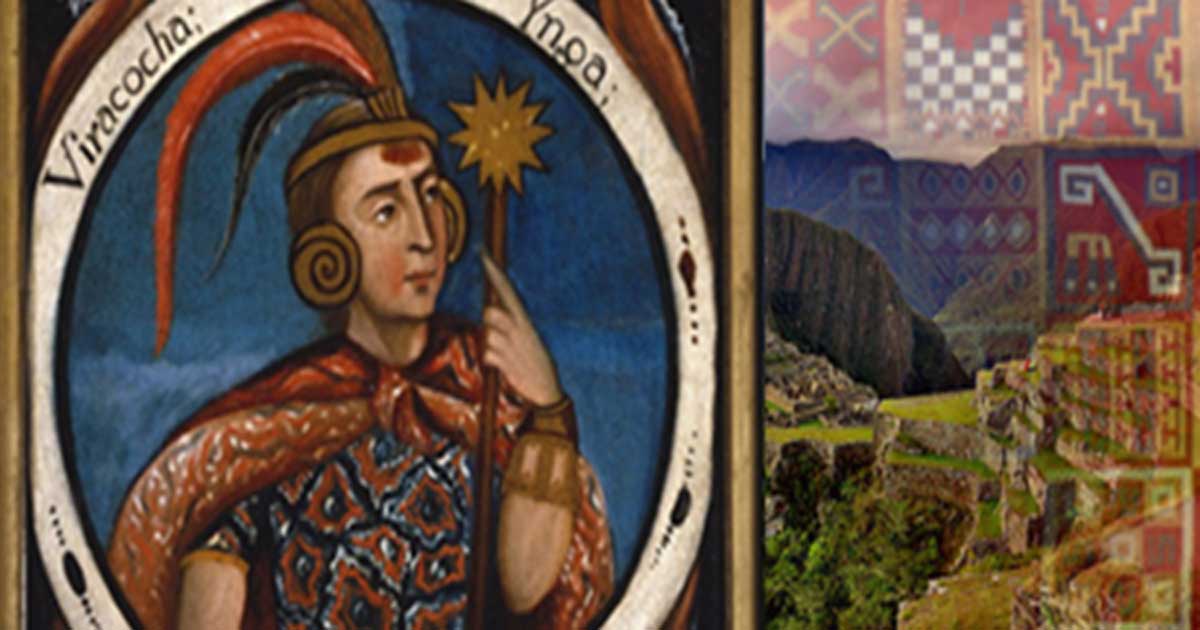
Oral tradition states that the Inca “rose from the waters” of Lake Titicaca at the behest of their creator God Viracocha, who had previously made a race of giants, but they were stupid and cumbersome, so he destroyed them in a great flood. In most of the accounts four pairs of twin brothers and sisters were created, the two most prominent of them being Manco Capac (royal founder) and his sister/wife Mama Ocllo, who became the first official Inca rulers, likely by the time they reached and established Cusco.

Viracocha (Public Domain)

Another account, taught to the author by Cusco-based anthropologist Dr. Theo Paredes, is that this first ruler’s name was Mallku Capac, which could be translated as “of royal wisdom.” Dr. Paredes, who is an expert of the Runa Simi Inca language believes that the reason why the Inca first arrived in Cusco was not that they had been chased out of the Lake Titicaca area by the Aymara people, but that ancient wisdom keepers, who were carriers of very ancient traditions lived in Cusco, and that Mallku Capac had to go there to complete his education in order to become the first high Inca.

Part of the Inca Trail system (Public Domain)

In other legends, Manco Capac (also known as Ayar Manco) was the son of Viracocha of Paqariq Tampu (six leagues or 25 km south of Cusco). He and his brothers (Ayar Auca, Ayar Cachi and Ayar Uchu) and sisters (Mama Ocllo, Mama Huaco, Mama Raua and Mama Ipacura) lived near Cusco at Paqariq Tampu, and they united their people with other tribes encountered in their travels. They sought to conquer the tribes of the Cusco Valley, and these legends also incorporate an important golden staff, thought to have been given to Manco Capac by his father.

viernes, 1 de septiembre de 2017

The Crux Constellation - Universe Today

Welcome to another edition of Constellation Friday! Today, in honor of the late and great Tammy Plotner, we take a look at the "Southern Cross" - the Crux constellation. Enjoy!

In the 2nd century CE, Greek-Egyptian astronomer Claudius Ptolemaeus (aka. Ptolemy) compiled a list of all the then-known 48 constellations. This treatise, known as the Almagest, would be used by medieval European and Islamic scholars for over a thousand years to come, effectively becoming astrological and astronomical canon until the early Modern Age.

One of these constellations is known as Crux, a small constellation located in the southern skies. Despite its size, it is one of the most well-known constellations in the southern hemisphere due to its distinctive cross-shape. Today, it has gone on to become one of the 88 modern constellations currently recognized by the International Astronomical Union (IAU).

Name and Meaning:

For the people of the Southern Hemisphere, the Crux constellation has a great deal of cultural significance. The Incas knew the constellation as Chakana (Quechua for "the stair"), and a stone image of the stars was found in Machu Picchu, Peru. To the Maori, the constellation was known as Te Punga, or "the anchor", due to the important role it played in maritime navigation.

The "Emu in the Sky", an important constellation recognized by the Aborigines of Australia. Credit: RSAA/ANU

To the Aborigines of Australia, the cross and the Coalsack Nebula together represented the head of the Emu in the Sky. This mythical bird is associated with several Aborigine creation myths and is one of the most important constellations in their astronomical traditions. Because of this significance, the Southern Cross is represented on the flags of Australia, Papua New Guinea, New Zealand Brazil, and Brazil.

The first recorded instance of Crux being named is believed to have occurred in 1455, when Venetian navigator Alvise Cadamosto made note of an asterism in the southern skies that he called carr dell'ostro ("southern chariot"). However, historians generally credit Portugese astronomer Joao Faras with the discovery, which occurred in 1500 when he spotted it from Brazil and named it "Las Guardas" ("the guards").

By the late 16th century, Crux began to be depicted as a separate constellation on celestial globes and maps. In these and subsequent maps, the name Crux was used (Latin for "Cross"), referring to the constellation's distinct shape.

History of Observation:

Crux was originally considered to be part of Centaurus, but as the precession of the equinoxes gradually lowered these stars below the European horizon, they were lost sight of, and so was the memory of these stars. At one time, around 1000 BCE, the stars of Crux were visible to the northern hemisphere, but by 400 CE they had slipped below the horizon for most populated areas.

The constellation Crux as it can be seen by the naked eye. Credit: Till Credner/AlltheSky.com

Even though it was originally plotted on Ptolemy's Almagest, it first appeared as "Crux" on the charts of Petrus Plancius and Jodocus Hondius in 1598 and 1600 - both navigators. It is known that Amerigo Vespucci mapped the stars of Crux on his expedition to South America in 1501, and with good reason!

Two of the stars of Crux (Alpha and Gamma, Acrux and Gacrux respectively) are commonly used to mark due south. Following the line defined by the two stars for approximately 4.5 times the distance between them leads to a point close to the Southern Celestial Pole. A definite point needed for navigation! In 1920, Crux was included among the 88 modern constellations recognized by the IAU.

Notable Objects:

Of the major stars in Crux, Alpha Crucis (Acrux) is the brightest, and the 12th brightest star in the night sky. It is located approximately 320 light years away and is a multiple star system composed of Alpha-1 Crucis (a B class subgiant) and Alpha-2 Crucis (a B class dwarf). Both stars are very hot and their respective luminosities are 25,000 and 16,000 times that of the Sun.

Beta Crucis (Becrux, or Mimosa) is the second brightest star of the Southern Cross and the 20th brightest star in the night sky. It is approximately 350 light years distant, is classified as a Beta Cephei variable, and is a spectroscopic binary composed of two stars that are about 8 AU apart and orbit each other every five years. The name Mimosa refers to its color (blue-hued).

Gamma Crucis (Gacrux) is a red giant that is approximately 88 light years distant from Earth. It is the third brightest star in the Crux constellation and the 26th brightest star in the sky. Located about 400 light years distant from Earth, this binary star is composed of a M4 red dwarf star and a A3 white dwarf star.

Crux is also associated with several Deep Sky Objects, the most notable of which is the Coalsack Nebula. This object is easily seen as a dark patch in the southern region of the Milky Way (hence the name) and crosses into the neighboring constellations of Centaurus and Musca. It is located about 600 light years from Earth and is between 30 and 35 light years in radius. In Aboriginal astronomy, the nebula represents the head of the Emu.

Then there's the Kappa Crucis Cluster (aka. the "Jewel Box" or "Herschel's Jewel Box"), an open star cluster that is located approximately 6,440 light years from Earth. It contains roughly 100 stars and is one of the youngest clusters ever discovered (only 14 million years old). To the naked eye, the cluster appears like a star near Beta Crucis.

Finding Crux:

The constellation itself consists of four bright, main stars and 19 stars which have Bayer/Flamsteed designations. It is bordered by the constellations of Centaurus and Musca. At present, Crux is visible at latitudes between +20° and -90°. While it is fairly circumpolar for the southern hemisphere, it is best seen a culmination during the month of May.

The location of the Crux constellation. Credit: IAU

Now, let's take out binoculars and examine its stars, started with Alpha Crucis, the "a" shape on our map. Its proper name is Acrux and it is the twelfth brightest star in the night sky. If you switch your binoculars out for a telescope, you'll find that 321 light year distant Acrux is also a binary star, with components separated by about 4 arc seconds and around one half stellar magnitude difference in brightness.

The brighter of the two, A1 is itself a spectroscopic binary star - with a companion that orbits no further away than our own Earth, yet is around 14 times larger than our own Sun! Needless to say, there's a very good chance this star may one day go supernova. While you're there, take a look an addition 90 arc seconds away for a third star. While it may just be an optical companion to the Acrux system, it does share the same proper motion!

Back to binoculars an on to Beta Crucis - the "B" shape on the map. Mimosa is located about 353 light years away from our solar system and it is also a spectroscopic binary star. This magnificent blue/white giant star is tied at number 19 as one of the brightest stars in the sky, and if we could put it side by side with our Sun it would be 3000 times brighter. Mimosa is also a multiply-periodic Beta-Cephi type star, too, fluxing by about 1/10 of a magnitude in as little as hours. What's going on? Inside Beta Crucis the iron content is only about half that of Sol and it's nearing the end of its hydrogen-fusing stage. When the iron core develops? Watch out! It's supernova time....

Now hang on to your binoculars and head north for Gamma Crucis, the "Y" shape on the map. Gacrux, is a red giant star approximately 88 light-years away from Earth. Did you notice its optical companion about 2 arc minutes away at an angle of 128 degrees from the main star? While the two look close together in the sky, the secondary star is actually 400 light years away! Gacrux shows its beautiful orange coloring to prove it has evolved off of the main sequence to become a red giant star, and it may even be evolving past the helium-burning stage.

The Coalsack Nebula and Kappa Crucis Cluster. Credit: A. Fujii

Move on now to Delta Crucis - the figure "8" on our map. Decrux is a red giant star located about 360 light years away from our vantage point. Delta Crucis is also Beta Cephei variable and changes its brightness just a tiny bit over a period of about an hour and 20 minutes. Another cool factoid about Delta Crucis is that it's a fast rotator - spinning at a speed of at least 194 kilometers per second at the equator and making a full rotation in about 32 hours.

This massive star also produces a massive stellar wind, shooting off 1000 times more material than our own Sun every second of every day! Or try R Crucis... It's also a Beta-Cephi type variable star, but it changes by nearly a full stellar magnitude in just a little over five days!

Keep your binoculars handy and head back to Beta and sweep south a degree and a half for the Kappa Crucis star cluster. This beautiful galactic cluster of stars commonly known as the Jewel Box (NGC 4755). After you see its glittering collection of multi-colored stars, you'll understand how it got its name! It is one of the youngest clusters, perhaps only a few million years old.

Kappa Crucis is also right on the edge of a dark void in the sky called the "Coal Sack". While you're looking around, you'll notice that there seem to be very few stars in this area. That's because they are being blocked by a dark nebula! The Coal Sack is a large, dark dust cloud about 500 light years away and it's blocking out the light from stars which lie beyond it. The few stars you do see are in front of the cloud and much nearer to the Earth.

The Jewel Box - the Kappa Crucis Cluster. Credit: ESO/NASA/ESA/Digitized Sky Survey 2/Jesús Maíz Apellániz (Instituto de Astrofísica de Andalucía, Spain)

Now it's telescope time. Head to Alpha Crucis and slightly less than 2 degrees east for NGC4609. Also on the edge of the Coalsack, this large, fairly condensed open cluster contains about 40 members and they are well spread across the sky. The pattern somewhat resembles the constellation of Orion (in the imagination, of course!). Mark you observing notes for Caldwell 98. Next stop? Back to Delta and less than 3 degrees south/southwest for NGC4103, another open cluster on the edge of night. With a little bit of imagination, this grouping of stars could appear to look like a celestial water tower!

We have written many interesting articles about the constellation here at Universe Today. Here is What Are The Constellations?, What Is The Zodiac?, and Zodiac Signs And Their Dates.

Be sure to check out The Messier Catalog while you're at it!

For more information, check out the IAUs list of Constellations, and the Students for the Exploration and Development of Space page on Canes Venatici and Constellation Families.

Sources:

By Tammy Plotner
Tammy was a professional astronomy author, President Emeritus of Warren Rupp Observatory and retired Astronomical League Executive Secretary. She's received a vast number of astronomy achievement and observing awards, including the Great Lakes Astronomy Achievement Award, RG Wright Service Award and the first woman astronomer to achieve Comet Hunter's Gold Status. (Tammy passed away in early 2015... she will be missed)

88 IAU constellations, Acrux, Almagest, Constellations, Crux, Featured, Mimosa, the southern cross

sábado, 3 de junio de 2017

Desentierran figuras de 3.500 años de antigüedad en un santuario prehispánico en Lima


Los arqueólogos descubrieron dos antiguos frisos en la huaca Garagay, un complejo arqueológico de la capital peruana.


La semana pasada se dio a conocer que en la huaca Garagay, ubicada en la capital de Perú en el distrito de San Martín de Porres, un equipo de arqueólogos de la Municipalidad de Lima desenterró dos antiguos frisos polícromos. El jefe del equipo, Héctor Walde, explicó que el hallazgo representa "figuras en barro ricamente decoradas con materiales minerales muy bien adheridos".

"No pareciera que hubieran pasado 3.500 años desde que se hicieron", indica. El arqueólogo agrega que se trata de personajes "antropomorfizados con características de felinos, de aves rapiñas, de serpientes, que es más o menos lo que las personas ven cuando están en una ceremonia ritual".

Las decoraciones en alto relieve del santuario prehispánico se asemejan a las de la cultura Chavín. El sitio arqueológico de la huaca Garagay tiene 3.800 años de antigüedad y es "el único lugar en Lima que muestra una arquitectura tan compleja y tan ricamente decorada", comenta Walde.

¿La cuna de la civilización?

Recientemente Perú ha sido escenario de otro descubrimiento asombroso. Tras analizar cientos de miles de artefactos de Huaca Prieta, arqueólogos de la Universidad Atlántica de Florida (EE.UU.) concluyeron que aproximadamente hace 15.000 años en Perú existió una civilización mucho más avanzada de lo que se pensaba.

Contaba con una organización social muy estructurada y podría ser la más antigua establecida en el país.


miércoles, 26 de octubre de 2016

new research in genetics and historical records is tracing noble Inca bloodlines to the direct descendants of Atahualpa and his kin – often among the most humble families of modern Perú

When the last Inca emperor, Atahualpa, was executed by Francisco Pizarro in 1533, the conquistadores moved quickly to obliterate all traces of what had been the largest empire of its time.

Temples were sacked and stripped of gold; on holy days, Inca nobles were forced to parade Christian saints instead of the mummies of their ancestors; the engineering skills behind Machu Picchu and a 25,000-mile network of roads stretching from Colombia to Argentina were forgotten.

And in this new society that oppressed all of Peru’s indigenous population, the names of noble families – the “children of the sun” who had once lived as demigods – were gradually erased from history.

But new research in genetics and historical records is tracing noble Inca bloodlines to the direct descendants of Atahualpa and his kin – often among the most humble families of modern Peru.

The Dutch historian Ronald Elward has been investigating the fate of the Inca nobility since he moved to Peru in 2009. “I discovered it was more common to find a gardener or servant with an Inca surname than a person from a middle- or upper-class background,” he said.

While surnames that indicate direct descent from royal blood – such as Yupanqui, meaning “memorable”, and Pachacutec, meaning “transformer of the Earth” – were proudly preserved in rural areas, indigenous names were looked down upon in urban centres.

Elward pored through tens of thousands of pages of public documents in Cusco, once the centre of the Incan empire, checking all available parish records for the period from 1720 to 1920 as well as the archives of more than 250 public notaries. After identifying 25 royal Inca families, he set about tracking down their descendants.

“The moment I started interviewing people about their life stories, the whole thing became less dusty records and more a social and cultural reality which had been very untouched. That was the main surprise,” he said.

Roberta Huamanrimanchi Tupahuacayllo, with her daughter, is descended from Inca blue blood on her mother's side. Photograph: Dan Collyns for the Guardian

One of Elward’s interviewees was Roberta Huamanrimanchi Tupahuacayllo, 40, who inherits Inca blue blood from her mother. A former municipal worker now caring for infant children, Huamanrimanchi described how she was teased at school for her long indigenous surnames.

“I’m very proud of my surname. I’m not ashamed, although people still laugh because it’s difficult to pronounce,” she said.

Perhaps in an unconscious echo of the Inca custom of keeping the mummies of deceased family members, Huamanrimanchi’s 79-year-old father, Mariano, proudly displays the skulls of his mother, sister and brother on the mantelpiece.

Other descendants are far more conscious of their royal pedigree. Alfredo Inca Roca, 69, claims he can trace his lineage back nearly 500 years to 1560, 17 years after the first Spanish people arrived in Cusco in 1543.

The urbane lawyer also claims to have the documentation to prove it, in the form of a parchment signed in 1545 by the Holy Roman emperor Carlos V, who was also the king of Spain. The missive grants his ancestor “Inga Roca” corresponding royal status and gives him a coat of arms which replaces the lions of the old world with South American jaguars.

Mariano Huamanrimanchi, 79, shows a relative's skull that he keeps at home out of respect for his ancestors. Photograph: Dan Collyns for the Guardian

“He used this nice phrase [to the conquistadores]: I don’t send you to kill kings but to serve kings,” Inca Roca said. “But it did not do much to alter the behaviour of the Spanish viceroyalty, which subjugated my ancestors.”

Inca pride is infectious in San Sebastian, where schoolchildren are now encouraged to learn their once-denigrated Quechua mother tongue.

The Peruvian geneticist Ricardo Fujita has drawn on Elward’s work to establish a DNA correlation between two groups numbering around 35 people who claim patrilineal descent from Huayna Capac, father to the executed Atahualpa.

The absence of any Inca mummies, which were destroyed by the Spanish, means DNA comparisons can be made only between those who claim they are descendants .

But backed by the National Geographic’s Genographic Project, the investigation has found genetic links between supposed Inca descendants and indigenous populations near Lake Titicaca, appearing to corroborate the myth that the sun-worshipping conquerors originated there.

“The official history of Peru [begins] when the Europeans arrive here in 1532 but before that we have 1,400 years of history,” said Fujita, head of genetics and molecular biology at Lima’s San Martin de Porres University.

“That history is not recorded in writing – but it is recorded in our DNA: we are reconstructing the history of the people that don’t have history.

Cuando el último emperador inca, Atahualpa, fue ejecutado por Francisco Pizarro en 1533, los conquistadores se movieron rápidamente para eliminar todos los restos de lo que fue el imperio más grande de su tiempo.

Los templos fueron saqueados y despojados de oro; en los días festivos, los nobles incas se vieron obligados a desfile de santos cristianos en lugar de las momias de sus antepasados; Se olvidan las habilidades de ingeniería detrás de Machu Picchu y una red de 25.000 millas de carreteras que se extienden desde Colombia a Argentina.

Y en esta nueva sociedad que oprimía a toda la población indígena de Perú, los nombres de las familias nobles - los "Hijos del Sol" que una vez había vivido como semidioses - se borran gradualmente de la historia.

Pero una nueva investigación de la genética y los registros históricos está trazando líneas de sangre noble Inca a los descendientes directos de Atahualpa y sus parientes - a menudo entre las familias más humildes del Perú moderno.

El historiador holandés Ronald Elward ha sido investigar el destino de la nobleza Inca desde que se trasladó a Perú en 2009 "descubrí que era más común encontrar un jardinero o servidor con un apellido Inca que una persona de una clase media o alta fondo ", dijo.

Mientras que los apellidos que indican descendencia directa de sangre real - como Yupanqui, que significa "memorable", y Pachacutec, que significa "transformador de la Tierra" - se conservaron con orgullo en las zonas rurales, los nombres indígenas eran despreciadas en los centros urbanos.

Elward estudió minuciosamente a través de decenas de miles de páginas de documentos públicos en Cusco, una vez que el centro del imperio Inca, la comprobación de todos los registros parroquiales disponibles para el período 1720-1920, así como los archivos de más de 250 notarios públicos. Después de la identificación de 25 familias real Inca, se dedicó a la pista a sus descendientes.

"En el momento en que empecé a entrevistar a la gente acerca de sus historias de vida, todo el asunto se convirtió en los registros menos polvorientos y más una realidad social y cultural que había sido muy intacta. Esa fue la principal sorpresa ", dijo.

Roberta Huamanrimanchi Tupahuacayllo, con su hija, es descendiente de la sangre azul de Inca por parte de su madre. Fotografía: Dan Collyns para The Guardian

Uno de los entrevistados de Elward era Roberta Huamanrimanchi Tupahuacayllo, 40, que hereda la sangre azul Inca de su madre. Un ex trabajador municipal ahora el cuidado de los niños lactantes, Huamanrimanchi describió cómo era objeto de burlas en la escuela por sus largas apellidos indígenas.

"Estoy muy orgulloso de mi apellido. No me da vergüenza, aunque la gente todavía se ríen porque es difícil de pronunciar ", dijo.

Tal vez en un eco inconsciente de la costumbre inca de mantenimiento de las momias de los miembros difuntos de la familia, de 79 años de edad y padre de Huamanrimanchi, Mariano, muestra con orgullo el cráneo de su madre, hermana y hermano en la repisa de la chimenea.

Otros descendientes son mucho más conscientes de su pedigrí real. Alfredo Inca Roca, de 69 años, afirma que puede rastrear su linaje hasta casi 500 años para 1560, 17 años después de las primeras personas españoles llegaron a Cusco en 1543.

El abogado urbana también dice tener la documentación para probarlo, en forma de un pergamino firmado en 1545 por la Santa emperador romano Carlos V, que era también el rey de España. La misiva otorga su antepasado "Inga Roca" correspondiente estatus real y le da un escudo de armas que sustituye a los leones del viejo mundo con jaguares de América del Sur.

Mariano Huamanrimanchi, 79, muestra el cráneo de un pariente que guarda en su casa por respeto a sus antepasados. Fotografía: Dan Collyns para The Guardian

"Él utilizó esta frase agradable [a] los conquistadores: no te mando a matar a los reyes, sino para servir reyes", dijo Inca Roca. "Pero no hizo mucho para alterar el comportamiento del virreinato español, que subyugó a mis antepasados."

orgullo del inca es infecciosa en San Sebastián, donde ahora se anima a los alumnos a aprender su lengua materna el quechua denigrado vez.

El genetista peruano Ricardo Fujita se ha basado en la obra de Elward para establecer una correlación de ADN entre dos grupos de numeración de alrededor de 35 personas que dicen la descendencia patrilineal de Huayna Cápac, padre de Atahualpa ejecutado.

La ausencia de momias incas, las cuales fueron destruidas por el español, significa comparaciones de ADN se pueden realizar sólo entre aquellos que afirman ser descendientes.

Pero respaldado por el Proyecto Genográfico de National Geographic, la investigación ha encontrado vínculos genéticos entre los supuestos descendientes del Inca y poblaciones indígenas cerca del lago Titicaca, que aparece para corroborar el mito de que los conquistadores de culto al sol se originaron allí.

"La historia oficial del Perú [comienza] cuando los europeos llegan aquí en 1532, pero antes de eso tenemos 1.400 años de historia", dijo Fujita, director de la genética y la biología molecular en la Universidad San Martín de Porres de Lima.

"Que la historia no se registra por escrito - pero se graba en nuestro ADN: estamos reconstruyendo la historia de las personas que no tienen historia".