Mostrando entradas con la etiqueta DNA. Mostrar todas las entradas

sábado, 17 de febrero de 2018

Mystery behind the origin of 3,000-year-old 'alien' Paracas skulls revealed by DNA testing


Conspiracy theorists and alien enthusiasts believe that these skulls are evidence of ancient alien visitations on our planet.
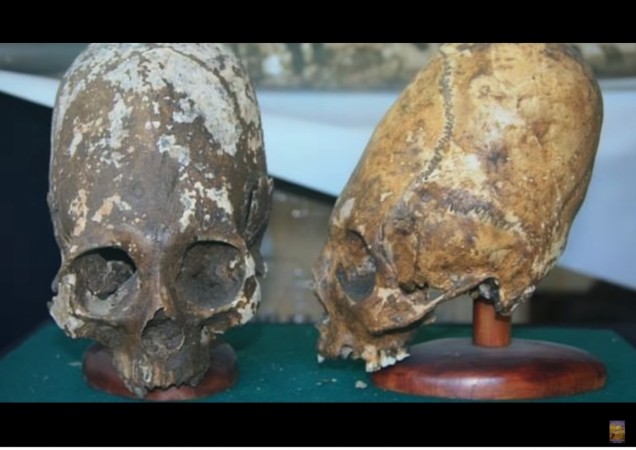
The DNA test results carried out on the 3,000-year-old elongated Paracas skulls to find whether they belonged to an alien race have been released.
The elongated craniums were discovered in Peru and have extraordinarily huge foreheads. Conspiracy theorists and alien enthusiasts believe that these skulls are evidence of ancient aliens visiting our planet.
The DNA research was carried out by Brian Foerster, who initially believed that these skulls wouldn't fit into the "known evolutionary tree".
These Paracas skulls were discovered in 1928 in the desert peninsula of Paracas which is located on the southern coast of Peru by Julio Tello, a native archaeologist.
"The mitochondrial DNA (from the mother) presented mutations unknown to any man, primate or any other animal and the mutations suggested we are dealing with a completely new human-like being, very distant from Homo sapiens, Neanderthals or Denisovans," Tello had said in 2015, while discussing the earlier DNA tests on skulls, a report by Express revealed.
"I am not sure it will even fit into the known evolutionary tree," he added.
A research by skeptics unveiled that people involved in this research had a history of involvement and belief in research related to subjects which are paranormal, such as Yeti and alien hybrids, which are said to be a cross breed between aliens and humans.
These skulls are just another example of intentional cranial deformation, which was observed in many ancient South American tribes, according to the disbelievers.
The details of the DNA tests have been released by Foerster, who is the director of the Paracas History Museum. And he accepts that the skulls are probably humans in origin.
Two videos regarding the updates about the DNA of these skulls were uploaded by Foerster, but doesn't mention anything about extra-terrestrials in them.
He described about how the Paracas skulls seemed to share DNA links with other elongated craniums which were found between the Black Sea and the Caspian Sea.
According to Foerster, skull elongation is not caused only by artificial cranial deformation, rather by genetics with some of the elongated skulls cranial volume being up to 25 percent larger and 60 percent heavier than conventional human skulls, Express stated.
The skulls could not be deformed purposely through flattening or head binding as the skull's shape can be changed by cranial deformation but it doesn't change the skull's volume and weight.
"What it does show for sure is that the Paracas elongated skull people were not 100 percent Native American. They were a mix or even you could say, in some ways, a hybrid of different people," Foerster said while speaking at the Elongated Skulls Symposium in Los Angeles. 
"Their blood types are very complicated as well, they should be blood type O if they're 100 percent Native American and that's not the case. We are likely looking at a sub-species of humanity as regards to the Paracas. It seems to be a lot of DNA evidence from extreme eastern Europe and extreme western Asia."
"More specifically I'm talking about the area in between the Black Sea and the Caspian Sea where ancient elongated skull people lived I think about 3,000 years ago. So, I think we are looking at a migration pattern starting in the Caspian Black Sea area and then entering through the Persian Gulf and then moving eastwards eventually winding up on the coast of Peru." 
"It appears that the largest elongated skulls on the planet have been found, A in Paracas, Peru and B in the Caucasus area in between the Black Sea and the Caspian Sea. So my theory is that there was a sub-species of human which we are going to be eventually calling Homo-Sapiens-Sapiens-Paracas, and they were living in the area in between the Caspian and Black Sea. They were invaded by somebody and so they were forced to flee," he added.
In 1928, more than 300 odd skeletal remains in a complex grave system were found by archaeologist Tello. According to scientists, it was the most extreme example of skull elongation ever found. 


sábado, 10 de febrero de 2018

Noticias sobre los cráneos alargados de Paracas

Video explicativo de la historia real de los craneos alargados de Paracas


En el medio paranormal, la cura para un día de noticias lento es ver qué se está cocinando en Perú. La semana pasada, hicimos que el conductor del camión aventara su vehículo sobre las antiguas líneas de Nazca, destruyendo partes de estos famosos e inexplicables geoglifos a fin de evitar pagar un peaje. Ha pasado un tiempo desde que escuchamos algo sobre las momias de tres dedos, pero no hay nada nuevo en los informes. ¡Afortunadamente, los cráneos alargados vinieron al rescate! "Esto podría reescribir la historia tal como la conocemos". Sí, fue otro momento de "Esto lo cambia todo" durante el fin de semana cuando se celebró el Simposio Elongated Skulls en Los Ángeles. Organizado por el autor, conferenciante y cineasta LA Marzulli, reunió a una variedad de oradores sobre el tema de los cráneos de Paracas, incluyendo el camarógrafo Richard Shaw, el experto forense Chase Kloetske, el arqueólogo Mondo Gonzales, la artista forense 3D Marcia K. Moore, el antropólogo Rick Woodward, el médico Dr. Michael Alday y el quiropráctico Dr. Malcolm Warren. Sin embargo, la gran noticia sobre las pruebas de ADN de los cráneos provino de Marzulli y Brien Forester de Hidden Inca Tours. Si esos dos últimos nombres te resultan familiares, es probable que tengan un "¡esto lo cambia todo!" Similar. momento en 2016, cuando se realizaron pruebas de ADN en los cráneos alargados de Paracas en Perú. En ese momento, revelaron que los resultados de las pruebas mostraron que los cráneos no eran de Perú, pero tampoco eran extraños. Se cree que los humanos vinieron de Europa y Mesopotamia, especialmente Siria. Eso fue interesante y ciertamente agregó un giro al cual los humanos llegaron por primera vez a las Américas, pero no un cambio de juego. ¿Fue el Simposio de cráneos alargados? El sitio web megalithicmarvels.com dio una sinopsis de la charla de Brien Forester. "Los resultados del ADN en realidad fueron increíblemente complicados ... Me tomará un tiempo descubrir realmente qué significan los resultados. Lo que sí muestra con certeza es que las personas con cráneo alargado de Paracas no eran 100% indígenas. Eran una mezcla o incluso podrías decir, de alguna manera, un híbrido de diferentes personas ". Espera un minuto ... esto suena familiar. Entonces es cuando Forester agrega un nuevo giro. "Parece que se han encontrado los cráneos alargados más grandes del planeta," A "en Paracas, Perú y" B "en el área del Cáucaso, entre el Mar Negro y el Mar Caspio ... así que mi teoría es que había una subespecies de humanos que eventualmente llamaremos Homo-Sapiens-Sapiens-Paracas, y que vivían en el área entre el Mar Caspio y el Mar Negro ". Y ... "Fueron invadidos por alguien ... y entonces se vieron obligados a huir". Forester establece un camino para que esta subespecie navegue desde el Golfo Pérsico hasta Perú. Ahí es donde él cree, y dice que algunos de los otros oradores están de acuerdo, que estas personas naturalmente de cráneo largo se asentaron y florecieron durante un tiempo. "... debido a las anomalías encontradas con algunas de las Calaveras alargadas del cementerio de Chongos en Perú, no tienen otra opción que afirmar que algunas de estas antiguas Paracas eran una subespecie de la humanidad ... tenía que ser genética , tenían que nacer con estas anormalidades. Tenían el pelo rojo oscuro ... los Paracas reales eran los que tenían la cabeza alargada, no la gente común ... la familia real de los Paracas, vivían en casas subterráneas subterráneas y yo creo que la razón es que tenían una piel de color claro, probablemente ojos sensibles debido a la extrema luz del sol ... " Entonces, Forester cree que los cráneos largos son una anormalidad genética, no el resultado de la unión, y aquellos con ellos fueron considerados como líderes y superiores. La palabra clave es "cree", no prueba. Esto sin duda refuerza la idea de que la composición genética de los nativos sudamericanos es realmente una mezcla variada. También continúa desilusionando a aquellos que quieren creer que los cráneos alargados son extraterrestres. Sin embargo, no prueba cómo los Paracas podrían ser una subespecie separada, mientras que los demás cultivos de cráneo alargados no lo son. Esperemos que el próximo "esto lo cambie todo" las pruebas de ADN lleguen durante otra semana de noticias lenta.

jueves, 12 de octubre de 2017

Origin Myths of the Inca Civilization & Piecing Together Royal Heritage 3


Paracas elongated skulls ( CC BY 2.0 )

Qapac Simi faded out of existence after the atrocities committed by Atahuallpa, and was further reduced by the Spanish trying to wipe out any vestiges of the Inca culture. The conditioning of the Inca into becoming Spanish subjects was not done through persuasion, but persecution. Luckily for modern researchers, what was able to be saved from extinction of the Inca cultural ways was kept secretly by the descendants of the Inca, and other people.

So, the story of the Inca and their origins is likely not as is written in most text books today. Rather than the simple movement of a people from the shores of Lake Titicaca about 1000 years ago, it is likely far more complex, as has been shown in this article. To complicate matters even more, the writings of Fernando de Montesinos adds another wrinkle to the whole story.

Inti, Sun God of the Inca, Spawned the First Rulers of An Unforgettable EmpireInca Empire Constructed Over 40,000 Kms of Roads and Superhighways in 100 Years

He arrived in Peru from Spain in 1628, and over the course of decades compiled vast manuscripts about the plight of the Native people of the Andes regions. Being a Jesuit, he was able to access the first records made by the Spanish of what they had learned from the Inca and other Native people soon after contact. Among these accounts included a list of 93 Inca or pre-Inca rulers that supposedly existed in Cusco prior to the time of Manco Capac. As the latter and his family were either likely related to, or amalgamated with these earlier noble people, that would make a royal heritage not of 12 Inca, but a total of 105.

Inti Raymi (Festival of the Sun) at Sacsayhuaman, Cusco ( CC BY-SA 3.0 )

Weaving History Back Together

The high or Sapa Inca ruled on average for 30 years, being replaced at death by his first-born son in most cases. That would mean that the Inca heritage, rather than being about 500 years in duration, was more on the order of 3500 years. More facts and evidence will be revealed as the author continues to weave back together the heritage of the Inca, thanks to sources and friends in the Cusco area.

Top image: Hatun Tópac; Viracocha, Portraits of Inca Kings, and Inca Tunic (Public Domain), Machu Picchu ( CC BY-SA 3.0 )

By Brien Foerster

References

Brien Foerster (2011) ‘Inca Before the Conquest’. 2017 Hidden Inca Tours

Brien Foerster, David Hatcher Childress (2013) ‘The Enigma of Cranial Deformation: Elongated Skulls of the Ancients’, Adventures Unlimited Press (September 11, 2013)