Mostrando entradas con la etiqueta skulls. Mostrar todas las entradas

lunes, 26 de marzo de 2018

Tragic skeletons of Chimu child sacrifices who had their hearts RIPPED OUT 3,400 years ago are found alongside more than 100 treasures in Peru


Easter travel chaos fears with snow, temperatures of minus 10C and rail strikes set to wreak havoc across Britain as the 'Beast...

The finds were made in the district of Huanchaco, around 11 miles (13 km) from the coastal city of Trujillo At least 12 children are believed to have been ritually sacrificed by the Chimu civilisation at this locationThe Chimu were a pre-Incan culture that emerged out of the remnants of the Moche people in around 900ADAround 130 pottery vessels have also been uncovered, some of which date to before the Chimu sacrifice

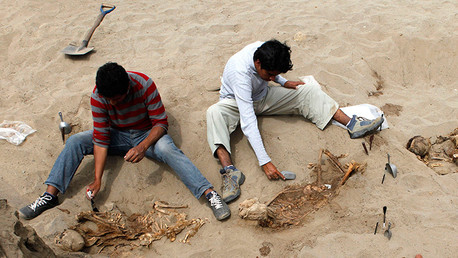
Buried beneath the streets of Peru, archaeologists have discovered the bodies of at least 12 children believed to have been sacrificed by the ancient Chimu civilisation.


A group of 47 tombs has been found, along with a hoard of more than 100 buried artefacts, thought to date back to around 1,200 to 1,400 AD.

Researchers have uncovered evidence that suggest the people behind their sacrifice may have tried to remove their hearts to appease the weather gods, it has been reported. 

Stunning images have also revealed several of the ceramics objects adorned with maritime themes, coastal animals, and geometric shapes, reflecting the connection to the sea felt by the ancient culture.


Buried beneath the streets of Peru, archaeologists have discovered the bodies of at least 12 children believed to have been sacrificed by the Chimu civilisation. A group of 47 tombs has been found in the Trujillo region, along with a hoard of more than 100 buried artefacts, thought to date back to around 1,200 to 1,400 AD

Stunning images reveal that several of the objects are ceramics with maritime themes, coastal animals, and geometric shapes, reflecting the connection to the sea felt by the ancient culture

The finds were made in the district of Huanchaco, around 11 miles (13 km) from the city of Trujillo, by archaeologists working on behalf of the local government ahead of the construction of new water and drainage networks. 

Víctor Campaña León, director at the archaeological site, said the children were found with cuts to their chest, which may have been an attempt to break the ribs of the children - possibly to remove their hearts, according to reports in Newsweek.

One of the children was buried with 39 shells belonging to spondylus, a mollusc known as the spiny oyster, the most found in a Peruvian burial to date.

The Chimu were a pre-Incan culture that emerged out of the remnants of the Moche culture along the coast of Peru in 900AD. They are famed for their black ceramics, which were mass produced, as well as intricately worked precious metals. Chimu pottery is often adorned with maritime imagery

The Chimu people lived in a strip of desert less than 100 miles wide between the Pacific and the Andes. They are thought to have survived by fishing and worshipped the moon, believing it to be more powerful than the sun

WHO WERE THE CHIMU PEOPLE OF ANCIENT PERU?

The Chimu were a pre-Incan culture that emerged out of the remnants of the Moche culture along the coast of Peru in 900AD.

They are famed for their black ceramics and intricately worked precious metals.

The Chimu people lived in a strip of desert, 20 to 100 miles (30 to 160 km) wide, between the Pacific and the Andes. 

They are thought to have survived by fishing and worshipped the moon, believing it to be more powerful than the sun. 

Archaeologists believe they practised ritual sacrifice.

Around 1470 AD, the Inca ruler Tupac Inca Yupanqui conquered the Chimu. 

His rule was short lived, however, as the Spanish conquered the region in 1534 AD.

In a written statement, he said: 'What they wanted to do with the presence of the children in this arid area is to attract rain, to improve cultivation.'

Around 130 pottery vessels have also been uncovered, some of which are believed to date to before the Chimu sacrifice. 

Fishing tools such as weights, hooks and needles have also been found. 

Many of these artefacts probably belonged to residents of Chan Chan, the capital of the Chimu kingdom, who came to the site to leave offerings to their deities. 

The Chimu were a pre-Incan culture that emerged out of the remnants of the Moche culture along the coast of Peru in 900AD. 

Around 1470 AD, the Inca ruler Tupac Inca Yupanqui conquered the Chimu. His rule was short lived, however, as the Spanish conquered the region in 1534 AD. Many of the symbolic representations on Chimu pottery revolves around its people's relationship with the sea

Around 130 pottery vessels have also been uncovered, some of which are believed to date to before the Chimu sacrifice. Fishing tools such as weights, hooks and needles have also been found

They are famed for their black ceramics and intricately worked precious metals.

The Chimu people lived in a strip of desert, 20 to 100 miles (30 to 160 km) wide, between the Pacific and the Andes. 

They are thought to have survived by fishing and worshipped the moon, believing it to be more powerful than the sun. 

Around 1470 AD, the Inca ruler Tupac Inca Yupanqui conquered the Chimu. His rule was short lived, however, as the Spanish conquered the region in 1534 AD.

The precise details of the sacrifices are unknown, but similar rituals appear to have been adopted by the Incan civilisation when it rose to prominence in the region. 

Archaeologists unearth tombs and human remains from the Chimu culture in Trujillo, Peru. The artefacts uncovered probably belonged to residents of Chan Chan, the capital of the Chimu kingdom, who came to the site to leave offerings to their deities

The precise details of the sacrifices are unknown, but similar rituals appear to have been adopted by the Incan civilisation when it rose to prominence in the region

The Chimu are best known for their distinctive monochromatic pottery and fine metal working of copper, gold, silver, bronze, and tumbaga - a mixture of copper and gold

Among the finds revealing this ritual behaviour is the mummified remains of a child's body, discovered in 1985 by a group of mountaineers.

The remains were uncovered at around 17,388ft (5,300 metres) on the southwestern ridge of Cerro Aconcagua mountain in the Argentinean province of Mendoza.

The boy is thought to have been a victim of an Inca ritual called capacocha, where children of great beauty and health were sacrificed by drugging them and taking them into the mountains to freeze to death.

Ruins of a sanctuary used by the Inca to sacrifice children to their gods was discovered by archaeologists in at a coastal ruin complex in Peru in 2016. 

Víctor Campaña León, director at the archaeological site, said the children were found with cuts to their chest area, which may have been an attempt to break the ribs of the children - possibly to remove their hearts

Capacocha was a ritual that took place upon the death of an Inca king. The local lords were required to select unblemished children representing the ideal of human perfection. Children were married and presented with sets of miniature human and llama figurines in gold, silver, copper and shell

Experts digging at Chotuna-Chornancap, in north Lima, discovered 17 graves dating to at least the 15th century. This included the graves of six children placed side by side in pairs of shallow graves. 

Capacocha was a ritual that took place upon the death of an Inca king. The local lords were required to select unblemished children representing the ideal of human perfection.

Children were married and presented with sets of miniature human and llama figurines in gold, silver, copper and shell. 

The male figures have elongated earlobes and a braided headband and the female figurines wore their hair in plaits.

Uncer Capacocha, children were returned to their original communities, where they were honoured before being sacrificed to the mountain gods on the Llullaillaco Volcano. The Chimu culture appears to have had similar rituals around child sacrifice

 One of the children uncovered was buried with 39 shells belonging to spondylus, a mollusc known as the spiny oyster, the most found in a Peruvian burial to date

The children were then returned to their original communities, where they were honoured before being sacrificed to the mountain gods on the Llullaillaco Volcano. 

The phrase Capacocha has been translated to mean 'solemn sacrifice' or 'royal obligation.'

The rationale for this type of sacrificial rite has typically been understood as the Inca trying to ensure that humanity's best were sent to join their deities.

The finds were made in the district of Huanchaco, around 11 miles (13 km) from the city of Trujillo, by archaeologists working on behalf of the local government, ahead of the construction of new water and drainage networks 

WHY DID ANCIENT SOUTH AMERICAN CULTURES SACRIFICE THEIR CHILDREN?

Child sacrifice seems to have been a relatively common occurrence in the cultures of ancient Peru, including the pre-Incan Sican, or Lambayeque culture and the Chimu people who followed them, as well as the Inca themselves.

Among the finds revealing this ritual behaviour are the mummified remains of a child's body, discovered in 1985 by a group of mountaineers.

The remains were uncovered at around 17,388ft (5,300 metres) on the southwestern ridge of Cerro Aconcagua mountain in the Argentinean province of Mendoza.

Child sacrifice seems to have been a relatively common occurrence in the cultures of ancient Peru. Among the finds revealing this ritual behaviour were the mummified remains of a child's body (pictured), discovered in 1985 by a group of mountaineers

The boy is thought to have been a victim of an Inca ritual called capacocha, where children of great beauty and health were sacrificed by drugging them and taking them into the mountains to freeze to death.

Ruins of a sanctuary used by the Inca to sacrifice children to their gods was discovered by archaeologists in at a coastal ruin complex in Peru in 2016.

Experts digging at Chotuna-Chornancap, in north Lima, discovered 17 graves dating to at least the 15th century. This included the graves of six children placed side by side in pairs of shallow graves. 

Capacocha was a ritual that took place upon the death of an Inca king. The local lords were required to select unblemished children representing the ideal of human perfection.

Ruins of a sanctuary used by the Inca to sacrifice children to their gods was discovered by archaeologists in at a coastal ruin complex in Peru in 2016. Experts digging at Chotuna-Chornancap (pictured), in north Lima, discovered 17 graves dating to at least the 15th century

Children were married and presented with sets of miniature human and llama figurines in gold, silver, copper and shell. The male figures have elongated earlobes and a braided headband and the female figurines wore their hair in plaits.

The children were then returned to their original communities, where they were honoured before being sacrificed to the mountain gods on the Llullaillaco Volcano. 

The phrase Capacocha has been translated to mean 'solemn sacrifice' or 'royal obligation.'

The rationale for this type of sacrificial rite has typically been understood as the Inca trying to ensure that humanity's best were sent to join their deities.

jueves, 8 de marzo de 2018

Drilling Holes in the Skull was Never a Migraine Cure


Trepanation – the technique of removing bone from the skull by scraping, sawing, drilling or chiselling – has long fascinated those interested in the darker side of medical history. One stocktale is that trepanning is one of the most ancient treatments for migraines. As I study the history of the migraine, it certainly has always caught my attention.

The word trepanation comes from the Greek trypanon, meaning a borer. The earliest known trepanned skulls date from around 10,000 BCE, and come from North Africa. There are trepanation accounts in the Hippocratic texts (5th century BCE), when it was used in cases of fracture, epilepsy or paralysis, and in the second century CE Galen wrote of his experiments with trepanation on animals in his clinical studies.

But the reasons for trepanning remain largely unknown. While the famous 17th-century physician William Harvey may havesuggested that the procedure was used for migraines, recent authors have acknowledged that there is little evidence to suggest this. So where did this persistent idea come from?

Migraines and fairies

Inca skull showing trepanning. Image: © Wellcome Collection

The real source of the myth seems to have come much later. In 1902, the Journal of Mental Science published a lecture by Sir Thomas Lauder Brunton , a London physician well-known for his work on pharmacology and ideas about migraine pathology. The lecture mixed neurological theory and armchair anthropology, and ranged over subjects including premonitions, telepathy, hypnotism, hallucinations, and epileptic and migrainous aura. In one notable passage, Brunton proposed that visions of fairies and the sound of their jingling bells were “nothing more” than the zigzags of migraine aura, and the aural results of nerve centre stimulation.

Brunton proposed that openings bored into ancient Stone Age skulls during life had been made to cure migraine. His suggestion followed considerable excitement during the 1870s when the French physician and anthropologist Paul Broca claimed that ancient skulls discovered in Peru and France had not only been opened surgically during life in order to release evil spirits, but that the patients had survived. To Brunton, it seemed obvious that the holes would have been made at the request of migraine sufferers in order to “let the headache out”. He wrote:

‘For when the pain of headache becomes almost unbearably severe, an instinctive desire sometimes arises either to strike the place violently in the hope of relieving the pain, or to wish that some operation could be done to remove the pain.’

Ancient skull was drilled and harvested for medicine in the 18th centuryMedieval man with facial deformity may have had head drilled in an exorcismFirst Ever Evidence for Ancient Bone Surgery found in Peru - Holes Drilled in Legs

Instruments for trepanning, 18 th century. ( CC BY 4.0 )

The French surgeon Just Lucas-Champonnière had claimed in 1878 that some South Sea islanders still performed a similar procedure but, essentially, Brunton’s ideas about trepanning were as imaginative as his thoughts on fairies.

Nevertheless, the theory gained traction. In 1913, the world-famous American physician William Osler repeated that trepanation operations had been used “for epilepsy, infantile convulsions, headache and various cerebral diseases believed to be caused by confined demons”. By 1931, T Wilson Parry (who was partial to the odd experiment of his own) reasoned in The Lancet that as the large numbers of trepanned skulls found throughout France could not all be accounted for by epilepsy, the procedure must also have been used to cast out “other devils”. He proposed that this included disorders with “exasperating” head symptoms such as migraine, giddiness, “and distracting noises of the head”.

Trepanated skull of a 50-year old woman, found in tumb 3 Corseaux-En Seyton (3500 BC). Cicatrisation of the bones indicate the patient survived. ( CC BY-SA 3.0 )

A ‘burr hole’

If Victorian theories about ancient trepanation for migraine were largely speculative, there is evidence of cutting holes in skulls for migraine somewhat closer to home. In 1936, Alfred Goltman, a physician from Tennessee, observed something strange about a woman with migraine that he was treating for allergies.

In the left frontal region of her skull, the woman had a depression, an inch in diameter, with a marked concentration of blood vessels. Four years earlier, she had been admitted to the care of Dr Raphael Eustace Semmes, the first neurosurgeon in Memphis, who had trained under Harvey Cushing, the American “father” of modern neurosurgery. Semmes had drilled a small circular opening known as a “burr hole” during one of the woman’s severe headaches, while she was under local anaesthetic. As he opened the thick membrane surrounding the brain, “a quantity of fluid escaped under increased pressure”. There was no evidence of a tumour.


sábado, 17 de febrero de 2018

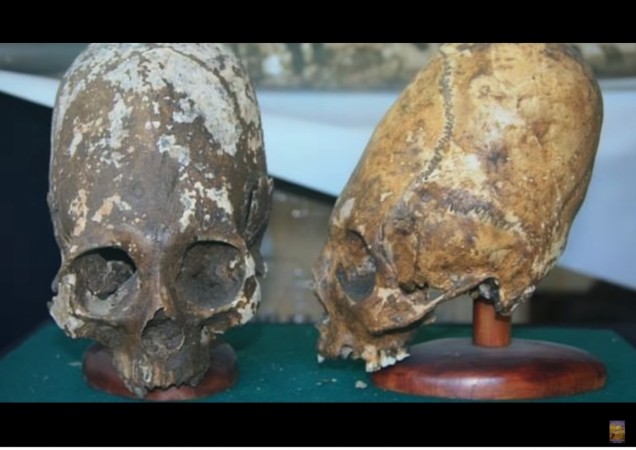
Mystery behind the origin of 3,000-year-old 'alien' Paracas skulls revealed by DNA testing


Conspiracy theorists and alien enthusiasts believe that these skulls are evidence of ancient alien visitations on our planet.
The DNA test results carried out on the 3,000-year-old elongated Paracas skulls to find whether they belonged to an alien race have been released.
The elongated craniums were discovered in Peru and have extraordinarily huge foreheads. Conspiracy theorists and alien enthusiasts believe that these skulls are evidence of ancient aliens visiting our planet.
The DNA research was carried out by Brian Foerster, who initially believed that these skulls wouldn't fit into the "known evolutionary tree".
These Paracas skulls were discovered in 1928 in the desert peninsula of Paracas which is located on the southern coast of Peru by Julio Tello, a native archaeologist.
"The mitochondrial DNA (from the mother) presented mutations unknown to any man, primate or any other animal and the mutations suggested we are dealing with a completely new human-like being, very distant from Homo sapiens, Neanderthals or Denisovans," Tello had said in 2015, while discussing the earlier DNA tests on skulls, a report by Express revealed.
"I am not sure it will even fit into the known evolutionary tree," he added.
A research by skeptics unveiled that people involved in this research had a history of involvement and belief in research related to subjects which are paranormal, such as Yeti and alien hybrids, which are said to be a cross breed between aliens and humans.
These skulls are just another example of intentional cranial deformation, which was observed in many ancient South American tribes, according to the disbelievers.
The details of the DNA tests have been released by Foerster, who is the director of the Paracas History Museum. And he accepts that the skulls are probably humans in origin.
Two videos regarding the updates about the DNA of these skulls were uploaded by Foerster, but doesn't mention anything about extra-terrestrials in them.
He described about how the Paracas skulls seemed to share DNA links with other elongated craniums which were found between the Black Sea and the Caspian Sea.
According to Foerster, skull elongation is not caused only by artificial cranial deformation, rather by genetics with some of the elongated skulls cranial volume being up to 25 percent larger and 60 percent heavier than conventional human skulls, Express stated.
The skulls could not be deformed purposely through flattening or head binding as the skull's shape can be changed by cranial deformation but it doesn't change the skull's volume and weight.
"What it does show for sure is that the Paracas elongated skull people were not 100 percent Native American. They were a mix or even you could say, in some ways, a hybrid of different people," Foerster said while speaking at the Elongated Skulls Symposium in Los Angeles. 
"Their blood types are very complicated as well, they should be blood type O if they're 100 percent Native American and that's not the case. We are likely looking at a sub-species of humanity as regards to the Paracas. It seems to be a lot of DNA evidence from extreme eastern Europe and extreme western Asia."
"More specifically I'm talking about the area in between the Black Sea and the Caspian Sea where ancient elongated skull people lived I think about 3,000 years ago. So, I think we are looking at a migration pattern starting in the Caspian Black Sea area and then entering through the Persian Gulf and then moving eastwards eventually winding up on the coast of Peru." 
"It appears that the largest elongated skulls on the planet have been found, A in Paracas, Peru and B in the Caucasus area in between the Black Sea and the Caspian Sea. So my theory is that there was a sub-species of human which we are going to be eventually calling Homo-Sapiens-Sapiens-Paracas, and they were living in the area in between the Caspian and Black Sea. They were invaded by somebody and so they were forced to flee," he added.
In 1928, more than 300 odd skeletal remains in a complex grave system were found by archaeologist Tello. According to scientists, it was the most extreme example of skull elongation ever found. 


Descubren la razón por la que los antiguos peruanos se alargaban los cráneos


AFP KHALED DESOUKI
Las clases altas de la sociedad preincaica vendaban la cabeza de los niños para darle forma alargada.
Los científicos creen haber descubierto el motivo por el cual los antiguos peruanos alargaban los cráneos. El alargamiento de los cráneos era un sello distintivo de la elite gobernante en las tribus Collagua, según informa ScienceNews.
El bioarqueólogo antropológico Mathew Velasco, de la Universidad de Cornell (EE.UU.), examinó 211 calaveras de los indios Collagua, que vivían en lo que actualmente es la provincia de Caylloma, en el sur de Perú. Los cráneos analizados pertenecen al periodo comprendido entre los siglos XII y XV, y tienen una forma inusual. Aproximadamente 300 años antes de la llegada de los incas al Perú en 1450, los grandes representantes de la sociedad preincaica vendaban su cabeza durante la infancia para darle forma alargada.
De este modo fue como se desarrolló el signo de pertenencia a altos grupos de la sociedad. Según los expertos, las mujeres de Collagua cuyos cráneos eran alargados de manera artificial tenían menos posibilidades de morir en accidentes o ataques, y su dieta era más diversa. Por el contrario, se cree que los cráneos hallados que tienen una forma plana desde la parte posterior de la cabeza pertenecían a las clases bajas de dicha tribu.
Fotos: Hallan en Perú un templo y 14 tumbas funerarias preincaicas
Velasco analizó un total de 211 cráneos preincaicos de grupos tempranos (entre 1150 y 1300) y tardíos (entre 1300 y 1450), todos mediante análisis de radiocarbono. Según los resultados de la investigación, el 39% de los cráneos del primer grupo fueron alargados de manera intencionada, mientras que aproximadamente el 74% del segundo grupo hizo lo propio.
Según Velasco, además de los Collagua, esta técnica de alteración de los cráneos también se observó en otras culturas antiguas, donde este tipo de lesiones se consideraban un signo de belleza y expresaban la pertenencia a un estatus social más alto. Para ello, se utilizaba la técnica de tirar de la cabeza del bebé con una tela, o de sujetarla entre dos palos de madera.


jueves, 15 de febrero de 2018

Elongated Skulls Increased Kudos in Ancient Peru

Archaeologists dig them up all over the ancient world from Egypt to Peru, and now, these curious elongated skulls are believed to have been "status symbols," according to a recent paper in Current Anthropology . The ruling elite in parts of ancient South America artificially extended their skulls to "bind communities together with a collective identity," according to Bioarchaeologist Matthew Velasco of Cornell University.
Although cranial deformation is generally associated with the Inca civilization, more than half a century before they came to dominate the west coast of the Americas "cranial deformation" or "skull binding" was developed by the Collagua people. In southern Peru the Colca River runs for about 450 kilometers before flowing into the Pacific Ocean and it was home of the Collaguas and the Cavanas.
Possible methods used by the Collagua people to shape a child's head. ( Public Domain )
In his 1966 book The Human Skull: A Cultural History, s cholar Folk Henschen explained that this skull shape was achieved by "small boards tied around children's heads," compressing the growing skull and forcing it to elongate. Velasco believes these people "intentionally created tall thin skull shapes," made these aesthetic modifications to bind "the powerful elite together." Spanish accounts state that the Cavanas also modified their skulls, widening and flattening them, in contrast to the Collaguas, but this practice was forbidden in the early 16th century.
  •  New DNA Testing on 2,000-Year-Old Elongated Paracas Skulls Changes Known History
  •  The Story Of Elongated Skulls And The Denied History Of Ancient People: An Interview With Mark Laplume
  •  Elongated Human Skulls Of Peru: Possible Evidence Of A Lost Human Species?
A case of skulls from the Andean Paracas culture, as seen in the Museo Nacional de Arqueología, Antropología e Historia del Perú in Lima. They illustrate head flattening practiced in this culture's elite. ( CC BY-SA 3.0 )
Mr Velasco was the first archaeologist to consider these skulls shapes "as class differentiators within the Collagua" and to test the validity of his suspicions, he examined over 200 skulls from a 300-year period. According the research paper, Mr Velasco's team noticed "tall thin skulls became increasingly linked to high social status." The primary observation leading to this conclusion was that females with elongated skulls "ate a broader diet than those without cranial alterations" and these women had endured "fewer injuries from physical attacks than women with unaltered skulls," Science News reports.
Summarizing his finds Mr Velasco said "Greater standardization of head-shaping practices echoes broader patterns of identity formation across the south-central highlands and may have provided a symbolic basis for the cooperation of elite groups during an era of intensive conflict."
  •  Initial DNA analysis of Paracas elongated skull released - with incredible results
  •  New study reveal origins of elongated skulls in the Carpathian Basin
  •  Why Did Parents in the Chinookan tribe Perform Cranial Deformation on their Babies?
These skulls are on display at Museo Regional de Ica in the city of Ica in Peru. ( CC BY 2.0 )
Meanwhile, alternative historians present these oddities as having extraterrestrial origins, belonging to unknown subspecies of human being, or that they are descendants from Atlantis. You generally find these researchers sharing their deep insights at "Truth" type conferences with like-minded folk. They all clap together when jabs are made at "accepted" archaeology and anthropology and the two most often repeated lies are "Elongated skulls are larger than normal skulls" and "cranial deformation cannot increase the volume of the skull!" Because no scientists attend such events, nobody stands up and says, "Hold on mate, what you just said is a load of rubbish. You just made that up."
Sometimes, when book sales are required, elongated skull researchers get carried away and archaeologically, for a few weeks, things get really bent out of shape. The most famous modern skull scam was the "Starchild" incident, when the skeleton of a five-year-old child was discovered in a cave in Mexico dated to about 900 years old. The skull was exceptionally bulbous, just like "gray aliens," says the skull's owner, Ray Young, who promotes the skull as "alien, or possibly an alien-human hybrid."
The 'Starchild' skull (left).( Fair Use ) Photo of baby with hydrocephalus(right). ( GFDL)
The scientific sector and humans beings with a mature disposition quite readily accepted the reports of neurologists who explained that the "Starchild" had hydrocephaly, a condition where a build-up of fluid causes the young pliable skull to expand. What's more, a 2003 dna test established that the child had "normal human DNA and was male, having both X and Y chromosomes," therefore it had a human father and mother. However, a tad embarrassingly, Young (and other support) continues to tout his "alien-human hybrid theory" in the face of a really well understood illness that affected children.


sábado, 10 de febrero de 2018

Noticias sobre los cráneos alargados de Paracas

Video explicativo de la historia real de los craneos alargados de Paracas


En el medio paranormal, la cura para un día de noticias lento es ver qué se está cocinando en Perú. La semana pasada, hicimos que el conductor del camión aventara su vehículo sobre las antiguas líneas de Nazca, destruyendo partes de estos famosos e inexplicables geoglifos a fin de evitar pagar un peaje. Ha pasado un tiempo desde que escuchamos algo sobre las momias de tres dedos, pero no hay nada nuevo en los informes. ¡Afortunadamente, los cráneos alargados vinieron al rescate! "Esto podría reescribir la historia tal como la conocemos". Sí, fue otro momento de "Esto lo cambia todo" durante el fin de semana cuando se celebró el Simposio Elongated Skulls en Los Ángeles. Organizado por el autor, conferenciante y cineasta LA Marzulli, reunió a una variedad de oradores sobre el tema de los cráneos de Paracas, incluyendo el camarógrafo Richard Shaw, el experto forense Chase Kloetske, el arqueólogo Mondo Gonzales, la artista forense 3D Marcia K. Moore, el antropólogo Rick Woodward, el médico Dr. Michael Alday y el quiropráctico Dr. Malcolm Warren. Sin embargo, la gran noticia sobre las pruebas de ADN de los cráneos provino de Marzulli y Brien Forester de Hidden Inca Tours. Si esos dos últimos nombres te resultan familiares, es probable que tengan un "¡esto lo cambia todo!" Similar. momento en 2016, cuando se realizaron pruebas de ADN en los cráneos alargados de Paracas en Perú. En ese momento, revelaron que los resultados de las pruebas mostraron que los cráneos no eran de Perú, pero tampoco eran extraños. Se cree que los humanos vinieron de Europa y Mesopotamia, especialmente Siria. Eso fue interesante y ciertamente agregó un giro al cual los humanos llegaron por primera vez a las Américas, pero no un cambio de juego. ¿Fue el Simposio de cráneos alargados? El sitio web megalithicmarvels.com dio una sinopsis de la charla de Brien Forester. "Los resultados del ADN en realidad fueron increíblemente complicados ... Me tomará un tiempo descubrir realmente qué significan los resultados. Lo que sí muestra con certeza es que las personas con cráneo alargado de Paracas no eran 100% indígenas. Eran una mezcla o incluso podrías decir, de alguna manera, un híbrido de diferentes personas ". Espera un minuto ... esto suena familiar. Entonces es cuando Forester agrega un nuevo giro. "Parece que se han encontrado los cráneos alargados más grandes del planeta," A "en Paracas, Perú y" B "en el área del Cáucaso, entre el Mar Negro y el Mar Caspio ... así que mi teoría es que había una subespecies de humanos que eventualmente llamaremos Homo-Sapiens-Sapiens-Paracas, y que vivían en el área entre el Mar Caspio y el Mar Negro ". Y ... "Fueron invadidos por alguien ... y entonces se vieron obligados a huir". Forester establece un camino para que esta subespecie navegue desde el Golfo Pérsico hasta Perú. Ahí es donde él cree, y dice que algunos de los otros oradores están de acuerdo, que estas personas naturalmente de cráneo largo se asentaron y florecieron durante un tiempo. "... debido a las anomalías encontradas con algunas de las Calaveras alargadas del cementerio de Chongos en Perú, no tienen otra opción que afirmar que algunas de estas antiguas Paracas eran una subespecie de la humanidad ... tenía que ser genética , tenían que nacer con estas anormalidades. Tenían el pelo rojo oscuro ... los Paracas reales eran los que tenían la cabeza alargada, no la gente común ... la familia real de los Paracas, vivían en casas subterráneas subterráneas y yo creo que la razón es que tenían una piel de color claro, probablemente ojos sensibles debido a la extrema luz del sol ... " Entonces, Forester cree que los cráneos largos son una anormalidad genética, no el resultado de la unión, y aquellos con ellos fueron considerados como líderes y superiores. La palabra clave es "cree", no prueba. Esto sin duda refuerza la idea de que la composición genética de los nativos sudamericanos es realmente una mezcla variada. También continúa desilusionando a aquellos que quieren creer que los cráneos alargados son extraterrestres. Sin embargo, no prueba cómo los Paracas podrían ser una subespecie separada, mientras que los demás cultivos de cráneo alargados no lo son. Esperemos que el próximo "esto lo cambie todo" las pruebas de ADN lleguen durante otra semana de noticias lenta.

New DNA Test Results on Peru’s Elongated Skulls

Video the skull Paracas


In the paranormal business, the cure for a slow news day is to see what’s cooking in Peru. Last week, we had the truck driverplowing his vehicle over the ancient Nazca lines, destroying portions of these famous and unexplained geoglyphs in the name of avoiding to pay a toll. It’s been a while since we heard anything about the three-fingered mummies but there’s nothing new to reports. Fortunately, the elongated skulls came to the rescue!
“This could re-write history as we know it.”

Yes, it was another “This changes everything” moment over the weekend when the Elongated Skulls Symposium was held in Los Angeles. Hosted by author, lecturer and film maker L.A. Marzulli, it brought together a variety of speakers on the subject of the Paracas skulls, including videographer Richard Shaw, forensic expert Chase Kloetske, archaeologist Mondo Gonzales, 3D forensic artist Marcia K. Moore, anthropologist Rick Woodward, medical doctor Dr. Michael Alday, and chiropractor Dr. Malcolm Warren. However, the big news on DNA testing of the skulls came from Marzulli and Brien Forester of Hidden Inca Tours.
If those last two names sound familiar, it’s probably because they had a similar “this changes everything!” moment in 2016 whenDNA tests were reportedly conducted on the Paracas elongated skulls of Peru. At that time, they revealed that the test results showed the skulls were not from Peru but were not alien either. The humans were believed to have come from Europe and Mesopotamia, especially Syria. That was interesting and certainly added a twist to which humans first arrived in the Americas, but not a game-changer. Was the Elongated Skulls Symposium?
The website megalithicmarvels.com gave a synopsis of the talk by Brien Forester.
“The DNA results actually were incredibly complicated… It’s gonna take me some time to actually figure out what the results mean. What it does show for sure is that the Paracas elongated skull people were not 100% Native American. They were a mix or even you could say, in some ways, a hybrid of different people.”

Wait a minute … this sounds familiar. That’s when Forester adds a new twist.
“It appears that the largest elongated skulls on the planet have been found, “A” in Paracas, Peru and “B” in the Caucasus area in between the Black Sea and the Caspian Sea… so my theory is that there was a sub-species of human which we are going to be eventually calling Homo-Sapiens-Sapiens-Paracas, and they were living in the area in between the Caspian and Black Sea.”

And …
“They were invaded by somebody… and so they were forced to flee.”

Forester lays out a path for this sub-species to sail from the Persian Gulf to Peru. That’s where he believes, and says some of the other speakers agree, that these naturally long-skulled people settled and flourished for a time.
“ … because of the abnormalities found with some of the Elongated Skulls from the Chongos cemetery in Peru they have no other choice but to state that some of these ancient Paracas were a sub-species of humanity… it had to be genetic, they had to be born with these abnormalities. They had dark red hair… the royal Paracas were the ones with elongated heads, not the common people… the royal family of the Paracas, they lived in subterranean underground houses and I think the reason for that is that they had light-colored skin, probably sensitive eyes because of the extreme sunshine…”

So, Forester believes the long skulls are a genetic abnormality, not the result of binding, and those with them were regarded as leaders and superiors. The key word is “believes,” not proves. This certainly reinforces the idea that the genetic makeup of Native South Americans is truly a varied mix. It also continues to disappoint those who want to believe the elongated skull beings are aliens. However, it doesn’t prove how the Paracas could be a separate sub-species while all other elongated skull cultures are not.
Let’s hope the next ‘this changes everything’ DNA tests come during another slow news week.

Paul Seaburn Paul Seaburn is one of the most prolific writers at Mysterious Universe. He’s written for TV shows such as "The Tonight Show", "Politically Incorrect" and an award-winning children’s program. He's been published in “The New York Times" and "Huffington Post” and has co-authored numerous collections of trivia, puzzles and humor. Paul likes to add a bit of humor to each MU post he crafts. After all, the mysterious doesn't always have to be serious.

The Paracas skulls are not just elongated, they are missing the sagittal suture and they have a larger cranial volume. The foramen magnum is set further back towards the occipital bone, changing the entire way the head sits on the spine. None of these can be affected by head binding. It might have a been a dominant genetic trait, but still human. Just because they’re not mainstream archaeologists or scholars, does not mean the discovery is not important.

This was an incredibly inept and partial review of the 2 and 3/4 hour symposium. Obviously, this writer didn’t view the entire conference or really understand the data. Just quoting Brien Foerster, who is a good researcher, and a good friend of mine but would admit to not being either a forensic expert nor a DNA genetics scientist. That data was presented by two doctors, an anthropologist, and an archeologist. And, Richard Shaw, me, isn’t a videographer . I’ve directed or produced over a dozen documentaries and one feature film since 2003. I don’t do wedding videos. I’ve been exploring this phenomenon with LA Marzulli the past five years. The big new evidence is that at least 50 DNA samples were taken, the largest number of samples perhaps ever done of the elongated skull people, were analyzed by three independent genetics labs. Two in California, and one in Canada. All three specialize in Paleo DNA — the experts necessary for pulling ancient DNA from centuries old bone powder, taken under the surface to avoid contamination — as the labs dictated. Chase Kloetzke, a forensic expert who DISPROVED the Star Child skull of being from alien origin. The results of the Paracas skulls were shown by Archeologist Mondo Gonzales, each set of Haplo groups explained, and nothing left to chance. Special lab containers and sterile conditions were used and the grinding tools were also sterilized. Also, anthropologist Rick Woodward proved, along with the doctors present, that those elongated heads that were natural could be shown to be that way because of a complete repositioning of the foramen magnum at the base of the skull. Dr. Warren also showed how additional holes inside the skull were not normal, but used to pass nerves and musculature to handle the face and other areas due to the unusual placement of the rest of the forehead, palette and occipital areas. Simple cradle headboarding can’t effectively move this opening 10cm or more into the back of the skull without killing the individual. So, overwhelming scientific evidence was presented. If scientists rather wish to offer their results from the ancient books they rely on instead of using modern science, then we’re back in the times of Galileo and Copernicus, where any truth shown is punishable today by the idiots in power.

jueves, 12 de octubre de 2017

Origin Myths of the Inca Civilization & Piecing Together Royal Heritage 3


Paracas elongated skulls ( CC BY 2.0 )

Qapac Simi faded out of existence after the atrocities committed by Atahuallpa, and was further reduced by the Spanish trying to wipe out any vestiges of the Inca culture. The conditioning of the Inca into becoming Spanish subjects was not done through persuasion, but persecution. Luckily for modern researchers, what was able to be saved from extinction of the Inca cultural ways was kept secretly by the descendants of the Inca, and other people.

So, the story of the Inca and their origins is likely not as is written in most text books today. Rather than the simple movement of a people from the shores of Lake Titicaca about 1000 years ago, it is likely far more complex, as has been shown in this article. To complicate matters even more, the writings of Fernando de Montesinos adds another wrinkle to the whole story.

Inti, Sun God of the Inca, Spawned the First Rulers of An Unforgettable EmpireInca Empire Constructed Over 40,000 Kms of Roads and Superhighways in 100 Years

He arrived in Peru from Spain in 1628, and over the course of decades compiled vast manuscripts about the plight of the Native people of the Andes regions. Being a Jesuit, he was able to access the first records made by the Spanish of what they had learned from the Inca and other Native people soon after contact. Among these accounts included a list of 93 Inca or pre-Inca rulers that supposedly existed in Cusco prior to the time of Manco Capac. As the latter and his family were either likely related to, or amalgamated with these earlier noble people, that would make a royal heritage not of 12 Inca, but a total of 105.

Inti Raymi (Festival of the Sun) at Sacsayhuaman, Cusco ( CC BY-SA 3.0 )

Weaving History Back Together

The high or Sapa Inca ruled on average for 30 years, being replaced at death by his first-born son in most cases. That would mean that the Inca heritage, rather than being about 500 years in duration, was more on the order of 3500 years. More facts and evidence will be revealed as the author continues to weave back together the heritage of the Inca, thanks to sources and friends in the Cusco area.

Top image: Hatun Tópac; Viracocha, Portraits of Inca Kings, and Inca Tunic (Public Domain), Machu Picchu ( CC BY-SA 3.0 )

By Brien Foerster

References

Brien Foerster (2011) ‘Inca Before the Conquest’. 2017 Hidden Inca Tours

Brien Foerster, David Hatcher Childress (2013) ‘The Enigma of Cranial Deformation: Elongated Skulls of the Ancients’, Adventures Unlimited Press (September 11, 2013)