El cuento del ESTIGMA DE LA SERPIENTE INCA es parte de la trilogia de cuentos del libro EL ESPECTRO DE SARAH ELLEN ROBERTS Y OTROS RELATOS, puede adquirirla en la TIENDA KINDLE DE AMAZON
Chronicles of a man seeking his fate after Spanish conquest and the start of the Viceroyalty of Peru.
Los científicos estudian genomas procedentes de restos humanos enterrados en el estado alemán de Baviera hace más de 1.500 años.
Un grupo internacional de científicos ha descubierto el origen de los misteriosos cráneos alargados encontrados en Europa Central. Según los resultados de un estudiopublicado en la revista Proceedings of the National Academy of Sciences, los restos humanos, de 1.500 años de antigüedad, pertenecían a mujeres que emigraron al territorio del actual estado alemán de Baviera. Para aumentar su atractivo, a estas féminas de comienzos de la Edad Media se les practicaba la deformación craneal apenas nacían.
Los investigadores analizaron el ADN extraído de los restos de 36 hombres y mujeres adultos enterrados en 41 cementerios bávaros en el año 500. 14 de ellos presentaban signos de deformidad craneal. Los genomas de los hombres estaban estrechamente emparentados con los de los europeos modernos, mientras que las mujeres contaban con una gran diversidad genética.
La deformación craneal en Europa fue muy popular entre los hunos, que invadieron este continente desde Asia. En el siglo II, este procedimiento fue practicado por los pueblos que vivían en el actual territorio de Rumanía. El cráneo alargado era un signo de belleza y alta posición en la sociedad.
En los siglos IV-VII Europa vivió grandes migraciones, ya que las poblaciones buscaban mejores condiciones de vida debido a las olas de frío, el hambre y a la invasión de los hunos. Así, en el siglo V las antiguas tribus germánicas (anglos y sajones) arribaron a las islas Británicas. Casi al mismo tiempo comenzaron a formarse tribus bávaras. Entre los hallazgos arqueológicos en el territorio de Baviera, que datan de este período, hay esqueletos con cráneos muy alargados y deformados artificialmente.
En Europa del Este, los cráneos deformados pertenecían tanto a hombres como a mujeres, pero en la actual Baviera en su mayoría eran de féminas. Los científicos sugirieron que estas emigraron desde el este o adoptaron la misma tradición cultural.
Conspiracy theorists and alien enthusiasts believe that these skulls are evidence of ancient alien visitations on our planet.
The DNA test results carried out on the 3,000-year-old elongated Paracas skulls to find whether they belonged to an alien race have been released.
The elongated craniums were discovered in Peru and have extraordinarily huge foreheads. Conspiracy theorists and alien enthusiasts believe that these skulls are evidence of ancient aliens visiting our planet.
The DNA research was carried out by Brian Foerster, who initially believed that these skulls wouldn't fit into the "known evolutionary tree".
These Paracas skulls were discovered in 1928 in the desert peninsula of Paracas which is located on the southern coast of Peru by Julio Tello, a native archaeologist.
"The mitochondrial DNA (from the mother) presented mutations unknown to any man, primate or any other animal and the mutations suggested we are dealing with a completely new human-like being, very distant from Homo sapiens, Neanderthals or Denisovans," Tello had said in 2015, while discussing the earlier DNA tests on skulls, a report by Express revealed.
"I am not sure it will even fit into the known evolutionary tree," he added.
A research by skeptics unveiled that people involved in this research had a history of involvement and belief in research related to subjects which are paranormal, such as Yeti and alien hybrids, which are said to be a cross breed between aliens and humans.
These skulls are just another example of intentional cranial deformation, which was observed in many ancient South American tribes, according to the disbelievers.
The details of the DNA tests have been released by Foerster, who is the director of the Paracas History Museum. And he accepts that the skulls are probably humans in origin.
Two videos regarding the updates about the DNA of these skulls were uploaded by Foerster, but doesn't mention anything about extra-terrestrials in them.
He described about how the Paracas skulls seemed to share DNA links with other elongated craniums which were found between the Black Sea and the Caspian Sea.
According to Foerster, skull elongation is not caused only by artificial cranial deformation, rather by genetics with some of the elongated skulls cranial volume being up to 25 percent larger and 60 percent heavier than conventional human skulls, Express stated.
The skulls could not be deformed purposely through flattening or head binding as the skull's shape can be changed by cranial deformation but it doesn't change the skull's volume and weight.
"What it does show for sure is that the Paracas elongated skull people were not 100 percent Native American. They were a mix or even you could say, in some ways, a hybrid of different people," Foerster said while speaking at the Elongated Skulls Symposium in Los Angeles.
"Their blood types are very complicated as well, they should be blood type O if they're 100 percent Native American and that's not the case. We are likely looking at a sub-species of humanity as regards to the Paracas. It seems to be a lot of DNA evidence from extreme eastern Europe and extreme western Asia."
"More specifically I'm talking about the area in between the Black Sea and the Caspian Sea where ancient elongated skull people lived I think about 3,000 years ago. So, I think we are looking at a migration pattern starting in the Caspian Black Sea area and then entering through the Persian Gulf and then moving eastwards eventually winding up on the coast of Peru."
"It appears that the largest elongated skulls on the planet have been found, A in Paracas, Peru and B in the Caucasus area in between the Black Sea and the Caspian Sea. So my theory is that there was a sub-species of human which we are going to be eventually calling Homo-Sapiens-Sapiens-Paracas, and they were living in the area in between the Caspian and Black Sea. They were invaded by somebody and so they were forced to flee," he added.
In 1928, more than 300 odd skeletal remains in a complex grave system were found by archaeologist Tello. According to scientists, it was the most extreme example of skull elongation ever found.
Las clases altas de la sociedad preincaica vendaban la cabeza de los niños para darle forma alargada.
Los científicos creen haber descubierto el motivo por el cual los antiguos peruanos alargaban los cráneos. El alargamiento de los cráneos era un sello distintivo de la elite gobernante en las tribus Collagua, según informa ScienceNews.
El bioarqueólogo antropológico Mathew Velasco, de la Universidad de Cornell (EE.UU.), examinó 211 calaveras de los indios Collagua, que vivían en lo que actualmente es la provincia de Caylloma, en el sur de Perú. Los cráneos analizados pertenecen al periodo comprendido entre los siglos XII y XV, y tienen una forma inusual. Aproximadamente 300 años antes de la llegada de los incas al Perú en 1450, los grandes representantes de la sociedad preincaica vendaban su cabeza durante la infancia para darle forma alargada.
De este modo fue como se desarrolló el signo de pertenencia a altos grupos de la sociedad. Según los expertos, las mujeres de Collagua cuyos cráneos eran alargados de manera artificial tenían menos posibilidades de morir en accidentes o ataques, y su dieta era más diversa. Por el contrario, se cree que los cráneos hallados que tienen una forma plana desde la parte posterior de la cabeza pertenecían a las clases bajas de dicha tribu.
Fotos: Hallan en Perú un templo y 14 tumbas funerarias preincaicas
Velasco analizó un total de 211 cráneos preincaicos de grupos tempranos (entre 1150 y 1300) y tardíos (entre 1300 y 1450), todos mediante análisis de radiocarbono. Según los resultados de la investigación, el 39% de los cráneos del primer grupo fueron alargados de manera intencionada, mientras que aproximadamente el 74% del segundo grupo hizo lo propio.
Según Velasco, además de los Collagua, esta técnica de alteración de los cráneos también se observó en otras culturas antiguas, donde este tipo de lesiones se consideraban un signo de belleza y expresaban la pertenencia a un estatus social más alto. Para ello, se utilizaba la técnica de tirar de la cabeza del bebé con una tela, o de sujetarla entre dos palos de madera.
Archaeologists dig them up all over the ancient world from Egypt to Peru, and now, these curious elongated skulls are believed to have been "status symbols," according to a recent paper in Current Anthropology . The ruling elite in parts of ancient South America artificially extended their skulls to "bind communities together with a collective identity," according to Bioarchaeologist Matthew Velasco of Cornell University.
Although cranial deformation is generally associated with the Inca civilization, more than half a century before they came to dominate the west coast of the Americas "cranial deformation" or "skull binding" was developed by the Collagua people. In southern Peru the Colca River runs for about 450 kilometers before flowing into the Pacific Ocean and it was home of the Collaguas and the Cavanas.
Possible methods used by the Collagua people to shape a child's head. ( Public Domain )
In his 1966 book The Human Skull: A Cultural History, s cholar Folk Henschen explained that this skull shape was achieved by "small boards tied around children's heads," compressing the growing skull and forcing it to elongate. Velasco believes these people "intentionally created tall thin skull shapes," made these aesthetic modifications to bind "the powerful elite together." Spanish accounts state that the Cavanas also modified their skulls, widening and flattening them, in contrast to the Collaguas, but this practice was forbidden in the early 16th century.
• New DNA Testing on 2,000-Year-Old Elongated Paracas Skulls Changes Known History
• The Story Of Elongated Skulls And The Denied History Of Ancient People: An Interview With Mark Laplume
• Elongated Human Skulls Of Peru: Possible Evidence Of A Lost Human Species?
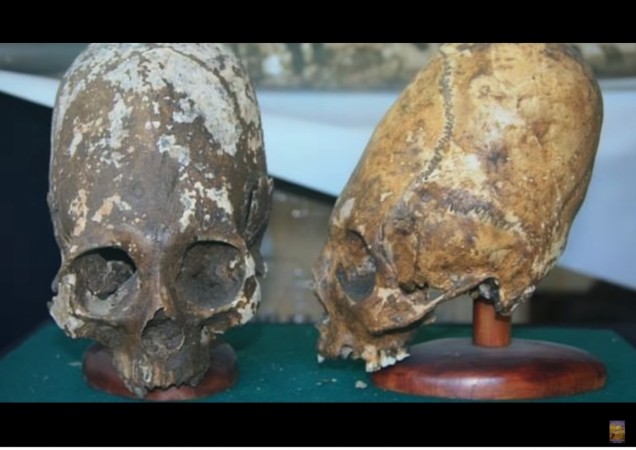
A case of skulls from the Andean Paracas culture, as seen in the Museo Nacional de Arqueología, Antropología e Historia del Perú in Lima. They illustrate head flattening practiced in this culture's elite. ( CC BY-SA 3.0 )
Mr Velasco was the first archaeologist to consider these skulls shapes "as class differentiators within the Collagua" and to test the validity of his suspicions, he examined over 200 skulls from a 300-year period. According the research paper, Mr Velasco's team noticed "tall thin skulls became increasingly linked to high social status." The primary observation leading to this conclusion was that females with elongated skulls "ate a broader diet than those without cranial alterations" and these women had endured "fewer injuries from physical attacks than women with unaltered skulls," Science News reports.
Summarizing his finds Mr Velasco said "Greater standardization of head-shaping practices echoes broader patterns of identity formation across the south-central highlands and may have provided a symbolic basis for the cooperation of elite groups during an era of intensive conflict."
• Initial DNA analysis of Paracas elongated skull released - with incredible results
• New study reveal origins of elongated skulls in the Carpathian Basin
• Why Did Parents in the Chinookan tribe Perform Cranial Deformation on their Babies?
These skulls are on display at Museo Regional de Ica in the city of Ica in Peru. ( CC BY 2.0 )
Meanwhile, alternative historians present these oddities as having extraterrestrial origins, belonging to unknown subspecies of human being, or that they are descendants from Atlantis. You generally find these researchers sharing their deep insights at "Truth" type conferences with like-minded folk. They all clap together when jabs are made at "accepted" archaeology and anthropology and the two most often repeated lies are "Elongated skulls are larger than normal skulls" and "cranial deformation cannot increase the volume of the skull!" Because no scientists attend such events, nobody stands up and says, "Hold on mate, what you just said is a load of rubbish. You just made that up."
Sometimes, when book sales are required, elongated skull researchers get carried away and archaeologically, for a few weeks, things get really bent out of shape. The most famous modern skull scam was the "Starchild" incident, when the skeleton of a five-year-old child was discovered in a cave in Mexico dated to about 900 years old. The skull was exceptionally bulbous, just like "gray aliens," says the skull's owner, Ray Young, who promotes the skull as "alien, or possibly an alien-human hybrid."
The 'Starchild' skull (left).( Fair Use ) Photo of baby with hydrocephalus(right). ( GFDL)
The scientific sector and humans beings with a mature disposition quite readily accepted the reports of neurologists who explained that the "Starchild" had hydrocephaly, a condition where a build-up of fluid causes the young pliable skull to expand. What's more, a 2003 dna test established that the child had "normal human DNA and was male, having both X and Y chromosomes," therefore it had a human father and mother. However, a tad embarrassingly, Young (and other support) continues to tout his "alien-human hybrid theory" in the face of a really well understood illness that affected children.
ANCIENT elites in South American societies bound their skulls to make them longer as a status symbol.
The Collagua people lived in the Colca Valley in south-eastern Peru 700 years ago, where they raised Alpacas and llamas for wool.
Alamy
Their artificially extended heads showed they were members of high society, and could have helped foster a sense of community and collective identity, according to a new study.
According to bioarchaeologist Matthew Velasco of Cornell University the cranial modifications may have bound the powerful elite together.
Accounts from early Spanish visitors also report another ethnic group – the Cavanas, from the same region.
The records say that they also modified their bonces but made them wider and flatter rather than tall.
Alamy
The Collagua used pieces of wood, tightly bound to the heads of babies to change how their heads grew.
The practice was banned by the invading Spanish in the 16th Century.
Mr Velasco’s research, published in the journal Current Anthropology looked at skull shapes from over 200 individuals from a 300-year period, and discovered that tall thin skulls became increasingly linked to high social status.
Chemical analysis of the bones revealed that Collagua women with purposefully distended heads were more likely to eat a broader diet than those without.
The team also observed that these women often had fewer injuries from physical attacks than women with unaltered skulls, Science News reports.
The study suggests the changes to head shape among those with power may have helped pave the way for a peaceful incorporation for the Collagua into the Incan empire.
Mr Velasco said: “Greater standardisation of head-shaping practices echoes broader patterns of identity formation across the south-central highlands and may have provided a symbolic basis for the cooperation of elite groups during an era of intensive conflict.”
The intensive fighting was due to the Incas sweeping in from the highlands of Peru and conquering less powerful civilisations.
They had one of the largest empires in the world in the 16th century before the Spanish conquistadors turned up.
Las élites ANTIGUAS en las sociedades sudamericanas se unieron sus cráneos para hacerlos más largos como un símbolo de estatus.
La gente de Collagua vivió en el valle del Colca en el sudeste de Perú hace 700 años, donde criaron alpacas y llamas para obtener lana.
Alamy
Sus cabezas artificialmente extendidas mostraron que eran miembros de la alta sociedad y podrían haber ayudado a fomentar un sentido de comunidad e identidad colectiva, según un nuevo estudio.
Según el bioarqueólogo Matthew Velasco de la Universidad de Cornell, las modificaciones craneales pueden haber unido a la poderosa élite.
Las cuentas de los primeros visitantes españoles también informan sobre otro grupo étnico: los Cavanas, de la misma región.
Los registros dicen que también modificaron sus bonces pero los hicieron más anchos y planos en lugar de altos.
Alamy
El Collagua usó piezas de madera, unidas firmemente a las cabezas de los bebés para cambiar la forma en que crecían sus cabezas.
La práctica fue prohibida por los invasores españoles en el siglo XVI.
La investigación del Sr. Velasco, publicada en la revista Current Anthropology, analizó las formas craneales de más de 200 individuos de un período de 300 años, y descubrió que las calaveras altas y delgadas se vinculaban cada vez más con un alto estatus social.
El análisis químico de los huesos reveló que las mujeres de Collagua con cabezas estiradas deliberadamente eran más propensas a comer una dieta más amplia que las que no tenían.
El equipo también observó que estas mujeres a menudo tenían menos lesiones por ataques físicos que las mujeres con cráneos inalterados, informa Science News.
El estudio sugiere que los cambios en la forma de la cabeza de quienes tienen el poder pueden haber ayudado a allanar el camino para una incorporación pacífica de Collagua al imperio inca.
El Sr. Velasco dijo: "Una mayor estandarización de las prácticas de conformación de cabezas se hace eco de patrones más amplios de formación de identidad en las tierras altas del centro-sur y puede haber proporcionado una base simbólica para la cooperación de grupos de élite durante una era de conflicto intensivo".
La lucha intensiva se debió a que los incas llegaron desde las tierras altas del Perú y conquistaron civilizaciones menos poderosas.
Tenían uno de los imperios más grandes del mundo en el siglo XVI antes de que aparecieran los conquistadores españoles.
—ScienceNews reports that bioarchaeologist Matthew Velasco of Cornell University examined the 600-year-old skulls of 211 members of Peru’s Collagua ethnic community, and found that intentional head-shaping of the young may have helped to bind together powerful elites. High-ranking elites are thought to have been buried in structures built against a cliff face, while non-elites were buried in caves and under rocky overhangs. Some of the bones and sediments were radiocarbon dated, so that Velasco could track how skull shapes changed over time. He found that about three-quarters of the 114 elite skulls dating to the late pre-Inca period, between A.D. 1300 and 1450, had been modified, and more than 60 percent of the modified skulls had been elongated. Velasco thinks the elongated style may have been preferred by elites, and speculates that their unity may have helped the Collaguas negotiate a peaceful integration into the Inca Empire.
ITHACA, NUEVA YORK - Science News informa que el bioarqueólogo Matthew Velasco de la Universidad de Cornell examinó las calaveras de 600 años de 211 miembros de la comunidad étnica collagua de Perú y descubrió que la formación intencional de los jóvenes podría haber ayudado a unir a élites poderosas . Se cree que las élites de alto rango fueron enterradas en estructuras construidas contra la pared de un acantilado, mientras que las no elites fueron enterradas en cuevas y bajo salientes rocosos. Algunos de los huesos y sedimentos fueron datados por radiocarbono, por lo que Velasco pudo rastrear cómo las formas del cráneo cambiaron con el tiempo. Descubrió que alrededor de las tres cuartas partes de los 114 cráneos de elite que datan del período preincaico tardío, entre el año 1300 y 1450, habían sido modificados y más del 60 por ciento de los cráneos modificados habían sido alargados. Velasco cree que el estilo alargado pudo haber sido preferido por las élites, y especula que su unidad pudo haber ayudado a los Collaguas a negociar una integración pacífica en el Imperio Inca.
Video explicativo de la historia real de los craneos alargados de Paracas
En el medio paranormal, la cura para un día de noticias lento es ver qué se está cocinando en Perú. La semana pasada, hicimos que el conductor del camión aventara su vehículo sobre las antiguas líneas de Nazca, destruyendo partes de estos famosos e inexplicables geoglifos a fin de evitar pagar un peaje. Ha pasado un tiempo desde que escuchamos algo sobre las momias de tres dedos, pero no hay nada nuevo en los informes. ¡Afortunadamente, los cráneos alargados vinieron al rescate! "Esto podría reescribir la historia tal como la conocemos". Sí, fue otro momento de "Esto lo cambia todo" durante el fin de semana cuando se celebró el Simposio Elongated Skulls en Los Ángeles. Organizado por el autor, conferenciante y cineasta LA Marzulli, reunió a una variedad de oradores sobre el tema de los cráneos de Paracas, incluyendo el camarógrafo Richard Shaw, el experto forense Chase Kloetske, el arqueólogo Mondo Gonzales, la artista forense 3D Marcia K. Moore, el antropólogo Rick Woodward, el médico Dr. Michael Alday y el quiropráctico Dr. Malcolm Warren. Sin embargo, la gran noticia sobre las pruebas de ADN de los cráneos provino de Marzulli y Brien Forester de Hidden Inca Tours. Si esos dos últimos nombres te resultan familiares, es probable que tengan un "¡esto lo cambia todo!" Similar. momento en 2016, cuando se realizaron pruebas de ADN en los cráneos alargados de Paracas en Perú. En ese momento, revelaron que los resultados de las pruebas mostraron que los cráneos no eran de Perú, pero tampoco eran extraños. Se cree que los humanos vinieron de Europa y Mesopotamia, especialmente Siria. Eso fue interesante y ciertamente agregó un giro al cual los humanos llegaron por primera vez a las Américas, pero no un cambio de juego. ¿Fue el Simposio de cráneos alargados? El sitio web megalithicmarvels.com dio una sinopsis de la charla de Brien Forester. "Los resultados del ADN en realidad fueron increíblemente complicados ... Me tomará un tiempo descubrir realmente qué significan los resultados. Lo que sí muestra con certeza es que las personas con cráneo alargado de Paracas no eran 100% indígenas. Eran una mezcla o incluso podrías decir, de alguna manera, un híbrido de diferentes personas ". Espera un minuto ... esto suena familiar. Entonces es cuando Forester agrega un nuevo giro. "Parece que se han encontrado los cráneos alargados más grandes del planeta," A "en Paracas, Perú y" B "en el área del Cáucaso, entre el Mar Negro y el Mar Caspio ... así que mi teoría es que había una subespecies de humanos que eventualmente llamaremos Homo-Sapiens-Sapiens-Paracas, y que vivían en el área entre el Mar Caspio y el Mar Negro ". Y ... "Fueron invadidos por alguien ... y entonces se vieron obligados a huir". Forester establece un camino para que esta subespecie navegue desde el Golfo Pérsico hasta Perú. Ahí es donde él cree, y dice que algunos de los otros oradores están de acuerdo, que estas personas naturalmente de cráneo largo se asentaron y florecieron durante un tiempo. "... debido a las anomalías encontradas con algunas de las Calaveras alargadas del cementerio de Chongos en Perú, no tienen otra opción que afirmar que algunas de estas antiguas Paracas eran una subespecie de la humanidad ... tenía que ser genética , tenían que nacer con estas anormalidades. Tenían el pelo rojo oscuro ... los Paracas reales eran los que tenían la cabeza alargada, no la gente común ... la familia real de los Paracas, vivían en casas subterráneas subterráneas y yo creo que la razón es que tenían una piel de color claro, probablemente ojos sensibles debido a la extrema luz del sol ... " Entonces, Forester cree que los cráneos largos son una anormalidad genética, no el resultado de la unión, y aquellos con ellos fueron considerados como líderes y superiores. La palabra clave es "cree", no prueba. Esto sin duda refuerza la idea de que la composición genética de los nativos sudamericanos es realmente una mezcla variada. También continúa desilusionando a aquellos que quieren creer que los cráneos alargados son extraterrestres. Sin embargo, no prueba cómo los Paracas podrían ser una subespecie separada, mientras que los demás cultivos de cráneo alargados no lo son. Esperemos que el próximo "esto lo cambie todo" las pruebas de ADN lleguen durante otra semana de noticias lenta.
In the paranormal business, the cure for a slow news day is to see what’s cooking in Peru. Last week, we had the truck driverplowing his vehicle over the ancient Nazca lines, destroying portions of these famous and unexplained geoglyphs in the name of avoiding to pay a toll. It’s been a while since we heard anything about the three-fingered mummies but there’s nothing new to reports. Fortunately, the elongated skulls came to the rescue!
“This could re-write history as we know it.”
Yes, it was another “This changes everything” moment over the weekend when the Elongated Skulls Symposium was held in Los Angeles. Hosted by author, lecturer and film maker L.A. Marzulli, it brought together a variety of speakers on the subject of the Paracas skulls, including videographer Richard Shaw, forensic expert Chase Kloetske, archaeologist Mondo Gonzales, 3D forensic artist Marcia K. Moore, anthropologist Rick Woodward, medical doctor Dr. Michael Alday, and chiropractor Dr. Malcolm Warren. However, the big news on DNA testing of the skulls came from Marzulli and Brien Forester of Hidden Inca Tours.
If those last two names sound familiar, it’s probably because they had a similar “this changes everything!” moment in 2016 whenDNA tests were reportedly conducted on the Paracas elongated skulls of Peru. At that time, they revealed that the test results showed the skulls were not from Peru but were not alien either. The humans were believed to have come from Europe and Mesopotamia, especially Syria. That was interesting and certainly added a twist to which humans first arrived in the Americas, but not a game-changer. Was the Elongated Skulls Symposium?
“The DNA results actually were incredibly complicated… It’s gonna take me some time to actually figure out what the results mean. What it does show for sure is that the Paracas elongated skull people were not 100% Native American. They were a mix or even you could say, in some ways, a hybrid of different people.”
Wait a minute … this sounds familiar. That’s when Forester adds a new twist.
“It appears that the largest elongated skulls on the planet have been found, “A” in Paracas, Peru and “B” in the Caucasus area in between the Black Sea and the Caspian Sea… so my theory is that there was a sub-species of human which we are going to be eventually calling Homo-Sapiens-Sapiens-Paracas, and they were living in the area in between the Caspian and Black Sea.”
And …
“They were invaded by somebody… and so they were forced to flee.”
Forester lays out a path for this sub-species to sail from the Persian Gulf to Peru. That’s where he believes, and says some of the other speakers agree, that these naturally long-skulled people settled and flourished for a time.
“ … because of the abnormalities found with some of the Elongated Skulls from the Chongos cemetery in Peru they have no other choice but to state that some of these ancient Paracas were a sub-species of humanity… it had to be genetic, they had to be born with these abnormalities. They had dark red hair… the royal Paracas were the ones with elongated heads, not the common people… the royal family of the Paracas, they lived in subterranean underground houses and I think the reason for that is that they had light-colored skin, probably sensitive eyes because of the extreme sunshine…”
So, Forester believes the long skulls are a genetic abnormality, not the result of binding, and those with them were regarded as leaders and superiors. The key word is “believes,” not proves. This certainly reinforces the idea that the genetic makeup of Native South Americans is truly a varied mix. It also continues to disappoint those who want to believe the elongated skull beings are aliens. However, it doesn’t prove how the Paracas could be a separate sub-species while all other elongated skull cultures are not.
Let’s hope the next ‘this changes everything’ DNA tests come during another slow news week.
Paul Seaburn Paul Seaburn is one of the most prolific writers at Mysterious Universe. He’s written for TV shows such as "The Tonight Show", "Politically Incorrect" and an award-winning children’s program. He's been published in “The New York Times" and "Huffington Post” and has co-authored numerous collections of trivia, puzzles and humor. Paul likes to add a bit of humor to each MU post he crafts. After all, the mysterious doesn't always have to be serious.
The Paracas skulls are not just elongated, they are missing the sagittal suture and they have a larger cranial volume. The foramen magnum is set further back towards the occipital bone, changing the entire way the head sits on the spine. None of these can be affected by head binding. It might have a been a dominant genetic trait, but still human. Just because they’re not mainstream archaeologists or scholars, does not mean the discovery is not important.
This was an incredibly inept and partial review of the 2 and 3/4 hour symposium. Obviously, this writer didn’t view the entire conference or really understand the data. Just quoting Brien Foerster, who is a good researcher, and a good friend of mine but would admit to not being either a forensic expert nor a DNA genetics scientist. That data was presented by two doctors, an anthropologist, and an archeologist. And, Richard Shaw, me, isn’t a videographer . I’ve directed or produced over a dozen documentaries and one feature film since 2003. I don’t do wedding videos. I’ve been exploring this phenomenon with LA Marzulli the past five years. The big new evidence is that at least 50 DNA samples were taken, the largest number of samples perhaps ever done of the elongated skull people, were analyzed by three independent genetics labs. Two in California, and one in Canada. All three specialize in Paleo DNA — the experts necessary for pulling ancient DNA from centuries old bone powder, taken under the surface to avoid contamination — as the labs dictated. Chase Kloetzke, a forensic expert who DISPROVED the Star Child skull of being from alien origin. The results of the Paracas skulls were shown by Archeologist Mondo Gonzales, each set of Haplo groups explained, and nothing left to chance. Special lab containers and sterile conditions were used and the grinding tools were also sterilized. Also, anthropologist Rick Woodward proved, along with the doctors present, that those elongated heads that were natural could be shown to be that way because of a complete repositioning of the foramen magnum at the base of the skull. Dr. Warren also showed how additional holes inside the skull were not normal, but used to pass nerves and musculature to handle the face and other areas due to the unusual placement of the rest of the forehead, palette and occipital areas. Simple cradle headboarding can’t effectively move this opening 10cm or more into the back of the skull without killing the individual. So, overwhelming scientific evidence was presented. If scientists rather wish to offer their results from the ancient books they rely on instead of using modern science, then we’re back in the times of Galileo and Copernicus, where any truth shown is punishable today by the idiots in power.
The Nazca lines are still mysterious even after decades of being carefully studied. Archaeologists believe they know how they were made, but why they were made remains uncertain. Recently, researchers have suggested that the lines were related to fertility rituals involving the availability of water, but there are some people who still see something different in lines that are very long and straight. Some alternative thinkers argue that the straighter lines represent runways for ancient airports. Although it is possible that this is the case, the evidence found to support this position is insufficient so far.
Were the Nazca Lines Airports for Ancient Aliens?
The Nazca designs consist of a variety of figures. Some are recognizable as animals, such as spiders and monkeys, while others are more abstract. There is also a subset of figures that consist simply of straight lines. Some of them are built at the tops of hills and appear to stop at the edges of cliffs. Unlike the other designs that are clearly figural, these resemble runways in their length and straightness. This has led some fringe theorists to suggest that these lines were ancient air strips or airports. Some people even suggest that the lines made on hills were specifically created for launching gliders.
Nazca Lines, Nazca, Peru. (Diego Delso/ CC BY SA )
There are two main groups which say that these particular Nazca lines represent runways - those who believe that the Nazca geoglyphs were made by visiting extraterrestrials and those who believe that the Nazca people had flight technology and used it to make the lines. Proponents of both views point to the Tolima artifacts: gold figurines that sometimes resemble jet planes, as further evidence that ancient South Americans either possessed flight technology themselves or encountered flight technology produced by someone else, such as ancient aliens.
• Twenty Four more Ancient Geoglyphs Discovered in Nazca, Peru
• The Enigma of the Nazca Lines: Strange Theories and Unanswered Questions
Aerial view of the "Owlman" aka "Astronaut", the most enigmatic geoglyph of the Nazca Lines in the Nazca Desert in southern Peru.
Aerial view of the "Owlman" aka "Astronaut", the most enigmatic geoglyph of the Nazca Lines in the Nazca Desert in southern Peru. (Diego Delso/ CC BY SA )
The main problem with the extraterrestrial explanation is that there is no other clear evidence that suggests alien visitation. There is no evidence of crashed spaceships, spacecraft parts, rare metal alloys not normally found on earth, or anything else that could not have come from this planet - no indisputable evidence at least. Furthermore, analysis of the lines shows they were made by delicately removing topsoil to create these designs. A spaceship landing would probably have disrupted this fragile configuration.
There is no evidence of parts of the lines being disrupted because of exhaust from landing spacecraft and you would expect such evidence to remain since the desert is not very windy. This is, in fact, why the Nazca lines have not been obscured by windblown material. Based on these facts, it is unlikely that extraterrestrials made any of the Nazca lines, including the alleged runways.
Artist's impression of UFOs over a desert.
Artist's impression of UFOs over a desert. ( Public Domain )
Runways for Forgotten Nazca Aircraft?
The Nazca lines would not have been hard for the Nazca people to make and experimental archaeology has shown that a team of people can make such lines within a few hours to a few days using only the technological means known to have been available to the ancient Nazca through archaeological evidence. As a result, Occam's razor is friendlier to the idea that the Nazca culture made the lines - we have evidence that they lived in the area at the time and could have constructed the lines - whereas we don't have evidence that extraterrestrials were ever present.
Since it is most likely the Nazca people themselves made all the lines, some fringe theorists have logically concluded that the Nazca civilization must have had flight and other advanced technology because of the supposed runways. Proponents of this view point to Nazca geoglyphs that look vaguely mechanical, resembling windmills and hooks, to bolster their case.
• New Study suggests Nazca Lines formed Ancient Pilgrimage Route to Cahuachi Temple
• Greenpeace treads on ancient Nazca lines site to urge renewable energy
Although this hypothesis is probably more likely, there are still problems with it. We must remember that just because a design looks one way to us, doesn't mean that it looked that way to the Nazca. For example, they may have been using a particular style of art to represent natural features such as plants and animals that just by coincidence causes them to resemble machines to us since we live in the age of machines.