sábado, 10 de febrero de 2018

Noticias sobre los cráneos alargados de Paracas

Video explicativo de la historia real de los craneos alargados de Paracas


En el medio paranormal, la cura para un día de noticias lento es ver qué se está cocinando en Perú. La semana pasada, hicimos que el conductor del camión aventara su vehículo sobre las antiguas líneas de Nazca, destruyendo partes de estos famosos e inexplicables geoglifos a fin de evitar pagar un peaje. Ha pasado un tiempo desde que escuchamos algo sobre las momias de tres dedos, pero no hay nada nuevo en los informes. ¡Afortunadamente, los cráneos alargados vinieron al rescate! "Esto podría reescribir la historia tal como la conocemos". Sí, fue otro momento de "Esto lo cambia todo" durante el fin de semana cuando se celebró el Simposio Elongated Skulls en Los Ángeles. Organizado por el autor, conferenciante y cineasta LA Marzulli, reunió a una variedad de oradores sobre el tema de los cráneos de Paracas, incluyendo el camarógrafo Richard Shaw, el experto forense Chase Kloetske, el arqueólogo Mondo Gonzales, la artista forense 3D Marcia K. Moore, el antropólogo Rick Woodward, el médico Dr. Michael Alday y el quiropráctico Dr. Malcolm Warren. Sin embargo, la gran noticia sobre las pruebas de ADN de los cráneos provino de Marzulli y Brien Forester de Hidden Inca Tours. Si esos dos últimos nombres te resultan familiares, es probable que tengan un "¡esto lo cambia todo!" Similar. momento en 2016, cuando se realizaron pruebas de ADN en los cráneos alargados de Paracas en Perú. En ese momento, revelaron que los resultados de las pruebas mostraron que los cráneos no eran de Perú, pero tampoco eran extraños. Se cree que los humanos vinieron de Europa y Mesopotamia, especialmente Siria. Eso fue interesante y ciertamente agregó un giro al cual los humanos llegaron por primera vez a las Américas, pero no un cambio de juego. ¿Fue el Simposio de cráneos alargados? El sitio web megalithicmarvels.com dio una sinopsis de la charla de Brien Forester. "Los resultados del ADN en realidad fueron increíblemente complicados ... Me tomará un tiempo descubrir realmente qué significan los resultados. Lo que sí muestra con certeza es que las personas con cráneo alargado de Paracas no eran 100% indígenas. Eran una mezcla o incluso podrías decir, de alguna manera, un híbrido de diferentes personas ". Espera un minuto ... esto suena familiar. Entonces es cuando Forester agrega un nuevo giro. "Parece que se han encontrado los cráneos alargados más grandes del planeta," A "en Paracas, Perú y" B "en el área del Cáucaso, entre el Mar Negro y el Mar Caspio ... así que mi teoría es que había una subespecies de humanos que eventualmente llamaremos Homo-Sapiens-Sapiens-Paracas, y que vivían en el área entre el Mar Caspio y el Mar Negro ". Y ... "Fueron invadidos por alguien ... y entonces se vieron obligados a huir". Forester establece un camino para que esta subespecie navegue desde el Golfo Pérsico hasta Perú. Ahí es donde él cree, y dice que algunos de los otros oradores están de acuerdo, que estas personas naturalmente de cráneo largo se asentaron y florecieron durante un tiempo. "... debido a las anomalías encontradas con algunas de las Calaveras alargadas del cementerio de Chongos en Perú, no tienen otra opción que afirmar que algunas de estas antiguas Paracas eran una subespecie de la humanidad ... tenía que ser genética , tenían que nacer con estas anormalidades. Tenían el pelo rojo oscuro ... los Paracas reales eran los que tenían la cabeza alargada, no la gente común ... la familia real de los Paracas, vivían en casas subterráneas subterráneas y yo creo que la razón es que tenían una piel de color claro, probablemente ojos sensibles debido a la extrema luz del sol ... " Entonces, Forester cree que los cráneos largos son una anormalidad genética, no el resultado de la unión, y aquellos con ellos fueron considerados como líderes y superiores. La palabra clave es "cree", no prueba. Esto sin duda refuerza la idea de que la composición genética de los nativos sudamericanos es realmente una mezcla variada. También continúa desilusionando a aquellos que quieren creer que los cráneos alargados son extraterrestres. Sin embargo, no prueba cómo los Paracas podrían ser una subespecie separada, mientras que los demás cultivos de cráneo alargados no lo son. Esperemos que el próximo "esto lo cambie todo" las pruebas de ADN lleguen durante otra semana de noticias lenta.

New DNA Test Results on Peru’s Elongated Skulls

Video the skull Paracas


In the paranormal business, the cure for a slow news day is to see what’s cooking in Peru. Last week, we had the truck driverplowing his vehicle over the ancient Nazca lines, destroying portions of these famous and unexplained geoglyphs in the name of avoiding to pay a toll. It’s been a while since we heard anything about the three-fingered mummies but there’s nothing new to reports. Fortunately, the elongated skulls came to the rescue!
“This could re-write history as we know it.”

Yes, it was another “This changes everything” moment over the weekend when the Elongated Skulls Symposium was held in Los Angeles. Hosted by author, lecturer and film maker L.A. Marzulli, it brought together a variety of speakers on the subject of the Paracas skulls, including videographer Richard Shaw, forensic expert Chase Kloetske, archaeologist Mondo Gonzales, 3D forensic artist Marcia K. Moore, anthropologist Rick Woodward, medical doctor Dr. Michael Alday, and chiropractor Dr. Malcolm Warren. However, the big news on DNA testing of the skulls came from Marzulli and Brien Forester of Hidden Inca Tours.
If those last two names sound familiar, it’s probably because they had a similar “this changes everything!” moment in 2016 whenDNA tests were reportedly conducted on the Paracas elongated skulls of Peru. At that time, they revealed that the test results showed the skulls were not from Peru but were not alien either. The humans were believed to have come from Europe and Mesopotamia, especially Syria. That was interesting and certainly added a twist to which humans first arrived in the Americas, but not a game-changer. Was the Elongated Skulls Symposium?
The website megalithicmarvels.com gave a synopsis of the talk by Brien Forester.
“The DNA results actually were incredibly complicated… It’s gonna take me some time to actually figure out what the results mean. What it does show for sure is that the Paracas elongated skull people were not 100% Native American. They were a mix or even you could say, in some ways, a hybrid of different people.”

Wait a minute … this sounds familiar. That’s when Forester adds a new twist.
“It appears that the largest elongated skulls on the planet have been found, “A” in Paracas, Peru and “B” in the Caucasus area in between the Black Sea and the Caspian Sea… so my theory is that there was a sub-species of human which we are going to be eventually calling Homo-Sapiens-Sapiens-Paracas, and they were living in the area in between the Caspian and Black Sea.”

And …
“They were invaded by somebody… and so they were forced to flee.”

Forester lays out a path for this sub-species to sail from the Persian Gulf to Peru. That’s where he believes, and says some of the other speakers agree, that these naturally long-skulled people settled and flourished for a time.
“ … because of the abnormalities found with some of the Elongated Skulls from the Chongos cemetery in Peru they have no other choice but to state that some of these ancient Paracas were a sub-species of humanity… it had to be genetic, they had to be born with these abnormalities. They had dark red hair… the royal Paracas were the ones with elongated heads, not the common people… the royal family of the Paracas, they lived in subterranean underground houses and I think the reason for that is that they had light-colored skin, probably sensitive eyes because of the extreme sunshine…”

So, Forester believes the long skulls are a genetic abnormality, not the result of binding, and those with them were regarded as leaders and superiors. The key word is “believes,” not proves. This certainly reinforces the idea that the genetic makeup of Native South Americans is truly a varied mix. It also continues to disappoint those who want to believe the elongated skull beings are aliens. However, it doesn’t prove how the Paracas could be a separate sub-species while all other elongated skull cultures are not.
Let’s hope the next ‘this changes everything’ DNA tests come during another slow news week.

Paul Seaburn Paul Seaburn is one of the most prolific writers at Mysterious Universe. He’s written for TV shows such as "The Tonight Show", "Politically Incorrect" and an award-winning children’s program. He's been published in “The New York Times" and "Huffington Post” and has co-authored numerous collections of trivia, puzzles and humor. Paul likes to add a bit of humor to each MU post he crafts. After all, the mysterious doesn't always have to be serious.

The Paracas skulls are not just elongated, they are missing the sagittal suture and they have a larger cranial volume. The foramen magnum is set further back towards the occipital bone, changing the entire way the head sits on the spine. None of these can be affected by head binding. It might have a been a dominant genetic trait, but still human. Just because they’re not mainstream archaeologists or scholars, does not mean the discovery is not important.

This was an incredibly inept and partial review of the 2 and 3/4 hour symposium. Obviously, this writer didn’t view the entire conference or really understand the data. Just quoting Brien Foerster, who is a good researcher, and a good friend of mine but would admit to not being either a forensic expert nor a DNA genetics scientist. That data was presented by two doctors, an anthropologist, and an archeologist. And, Richard Shaw, me, isn’t a videographer . I’ve directed or produced over a dozen documentaries and one feature film since 2003. I don’t do wedding videos. I’ve been exploring this phenomenon with LA Marzulli the past five years. The big new evidence is that at least 50 DNA samples were taken, the largest number of samples perhaps ever done of the elongated skull people, were analyzed by three independent genetics labs. Two in California, and one in Canada. All three specialize in Paleo DNA — the experts necessary for pulling ancient DNA from centuries old bone powder, taken under the surface to avoid contamination — as the labs dictated. Chase Kloetzke, a forensic expert who DISPROVED the Star Child skull of being from alien origin. The results of the Paracas skulls were shown by Archeologist Mondo Gonzales, each set of Haplo groups explained, and nothing left to chance. Special lab containers and sterile conditions were used and the grinding tools were also sterilized. Also, anthropologist Rick Woodward proved, along with the doctors present, that those elongated heads that were natural could be shown to be that way because of a complete repositioning of the foramen magnum at the base of the skull. Dr. Warren also showed how additional holes inside the skull were not normal, but used to pass nerves and musculature to handle the face and other areas due to the unusual placement of the rest of the forehead, palette and occipital areas. Simple cradle headboarding can’t effectively move this opening 10cm or more into the back of the skull without killing the individual. So, overwhelming scientific evidence was presented. If scientists rather wish to offer their results from the ancient books they rely on instead of using modern science, then we’re back in the times of Galileo and Copernicus, where any truth shown is punishable today by the idiots in power.

sábado, 16 de diciembre de 2017

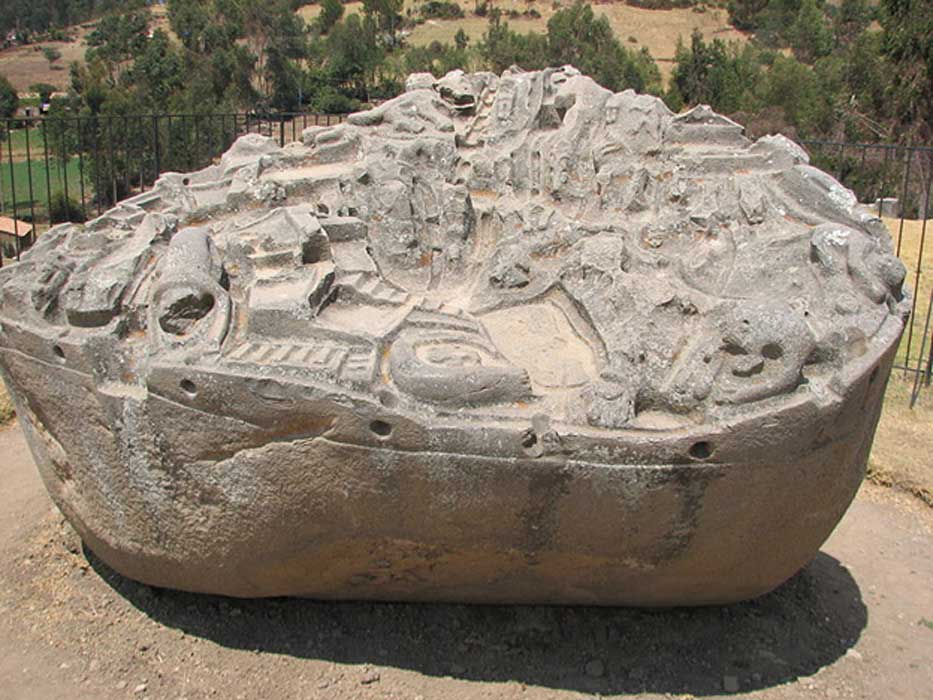
Sayhuite Monolith: Can You Solve the Mystery of the 200 Designs Carved by a Forgotten Creator?


Long ago, forgotten artists put their blood, sweat, and possibly even tears into creating more than 200 designs on a monolith in what is now Peru. They carefully engraved the forms of reptiles, felines, shellfish, and frogs and then surrounded the sacred animals with terraces, ponds, river, tunnels, and irrigation canals. The exact purpose and meaning behind these features remains a mystery.
Sayhuite is a pre-Columbian archaeological site located in Abancay, a province in the southern-central Peruvian region of Apurímac. This site has been dated to the period of the Inca Empire, which flourished between the 15th and 16th centuries AD. Compared to other Incan sites, little has been left from the time of the Incas at Sayhuite. The most noteworthy object at Sayhuite is the Sayhuite Monolith, a mysterious boulder with lots of little carvings on it.
The Sayhuite monolith. ( Public Domain )
The name ‘Sayhuite’ is said to have its origins in the Quechua word ‘saywayta’, which translates as ‘place of orientation’. Located on the top of a terraced hill called Concacha, the site was once home to an enclosed sanctuary. All that remains of this sanctuary today is its raised platform, on which the Sayhuite Monolith may be found. According to some scholars, this site was one of the four sanctuary oracles of Apurimac, known also as the ‘sons’ of Pachacamac. There is, however, at present, a lack of archaeological evidence to establish the veracity of this claime.

Sayhuite Archaeological site (overview). (AgainErick/ CC BY SA 3.0 )
Unique Carvings
The Sayhuite Monolith is not the only carved stone in the area. In the valley below the site, there are a group of carved boulders known collectively as Rumihuasi (which means ‘stone house’). The carvings on the Rumihuasi monolith may be described as geometric, and consists of either steps and / or canals. The Sayhuite Monolith, on the other hand, contains not only carvings that are geometric in design, but also zoomorphic ones. Therefore, whilst it is not the only carved rock in the area, it is undeniably the most unique one.
The Sayhuite Monolith measures about 2 meters () in length, and 4 meters () in width. Although the stone may be found today on the raised platform on top of Concacha, scholars are not certain as to where it might have originally been placed. As the monolith is not a natural rock outcrop, it may have been transported there. The boulder seems to have been moved, perhaps by looters, sometime in the past. Apart from the question of its original location, scholars are also unsure as to who made this object.
In any event, the Sayhuite Monolith has attracted much attention thanks to its carvings. On the upper surface of the monolith, one may observe over 200 zoomorphic and geometric figures. The majority of the former are said to represent reptiles, felines, shellfish, and frogs. Some scholars have argued that the choice of these animals has a symbolic meaning that would have been comprehended by the Incas. For example, the felines may have been a reference to the Incan capital, Cuzco, and its elite, especially Pachacuti, the ninth Sapa Inca, and the first ruler of the Inca Empire.
Drawing showing the zoomorphic and geometric figures on the Sayhuite monolith. ( Maestroviejo)
Interpreting the Designs on the Monolith
Apart from zoomorphic figures, there are also geometric carvings on the monolith. These have been interpreted as representations of terraces, ponds, river, tunnels, and irrigation canals. If this were the case, then it may be said that the stone represented a scale model of the landscape. Some have even taken this interpretation further by suggesting that the Sayhuite Monolith was used as a topographic model for hydraulics. According to this theory, the monolith was used by the ancient Incan engineers as a model to experiment and observe the flow of water, which would then be implemented in public water projects. Moreover, such a model could have been used as a pedagogic tool for other engineers and technicians in this trade.

video del Monolich Sayhuite


Peru recovers 79 pre-Hispanic textiles from the Museum of Gothenburg in Sweden

Textiles belonging to the pre-Inca Paracas culture, dating to 700 BCE-100 BCE, are shown at Peru's Culture Ministry in Lima on December 14, 2017. Fifty lots of 79 textiles from the Paracas culture, recently repatriated, were delivered to the Culture Ministry as part of a second shipment, agreed in 2014 between the governments of Peru and Sweden. Ernesto BENAVIDES / AFP.


LIMA (AFP).- Peru has recovered 79 pre-Hispanic textiles that have been illegally located in Sweden since 1935, the ministry of culture said. 

In 1935, Swedish ambassador to Peru Sven Karrell acquired the fabrics hailing from the Nasca and Paracas cultures and took them to Sweden illegally -- anonymously donating them to The Museum of Gothenburg, according to the Peruvian government. 

"Thanks to the collaboration between the foreign minister, the culture minister and the city of Gothenburg, we are celebrating the arrival of the second of the three scheduled deliveries, made up of 79 textiles," said Jorge Arrunategui, deputy minister of cultural heritage and cultural industries. 

The delivery included wraps, cloths and decorative textile borders from the pre-Hispanic Paracas culture, an Andean society known for their unique composition, colors and weaving techniques using cotton and wool from vicunas -- the national animal of Peru, related to the llama. 

The textiles, repatriated on December 7, were made between 700 BC and 200 AD and are among items the Swedish government promised to return to Peru in a 2014 agreement. 

In 2008, the Gothenburg Museum of World Culture held the exhibition "Paracas: A Stolen World," prompting Peru to begin investigations and in 2013 begin the process of recovering the items. 

The recovered goods will be kept by the Ministry of Culture's General Directorate of Museums for conservation, and displayed in 2018. 

viernes, 15 de diciembre de 2017

The College Student Who Decoded the Data Hidden in Inca Knots

There are many ways a college student might spend spring break. Making an archaeological breakthrough is not usually one of them. In his first year at Harvard, Manny Medrano did just that.

“There’s something in me, I can’t explain where it came from, but I love the idea of digging around and trying to find secrets hidden from the past,” Medrano says.

With the help of his professor, Gary Urton, a scholar of Pre-Columbian studies, Medrano interpreted a set of six khipus, knotted cords used for record keeping in the Inca Empire. By matching the khipus to a colonial-era Spanish census document, Medrano and Urton uncovered the meaning of the cords in greater detail than ever before. Their findings could contribute to a better understanding of daily life in the Andean civilization.

Manny Medrano '19, right, explains the meaning of quipus knots while holding a model. Quipus are knots that Incas used to record censuses, etc., and there are only 1000 left in the world. Medrano is the first name on the paper he co-wrote with Professor Gary Urton, left, Dumbarton Oaks Professor of Pre-Columbian Studies, that is being published in EthnoJournal.

Jon Chase/Harvard Staff Photographer

The Inca Empire reached its height of power in 15th- and 16th-century Peru. When Spanish conquistadors invaded, the Inca had established the largest and most complex society in the Americas. Architectural marvels from the civilization, such as Machu Picchu, survive to this day, but the Inca left behind no written records.

“The only sources we have at present are chronicles of the Inca that were written by the Spaniards,” Urton says. “We know in a lot of cases those histories were skewed by Spanish beliefs and Spanish motivations, and so we don’t really have any indigenous Inca history.”

The only records the Inca are known to have kept are in the form of intricately knotted khipu textiles. In 2002, Urton began Harvard’s Khipu Database Project. He traveled to museums and private collections around the world to record the numbers of knots, lengths of cords, colors of fibers, and other distinguishing details about every Inca khipu he could find—more than 900 in total.

Urton says he and other researchers in the field have always had a general sense of what the khipus represented. Many, they could tell, had to do with census data. Others appeared to be registers of goods or calendar systems. But, until recently, none of the khipus Urton studied could be understood on a very detailed level. If the khipus held messages or cultural information beyond just numbers, the meanings were opaque to modern scholars.

A turning point came when Urton began looking into a set of six khipus from the 17th-century Santa River Valley region of Northwest Peru. One day, Urton picked up a book and happened to spot a Spanish census document from the same region and time period.

“A lot of the numbers that were recorded in that census record matched those six khipus exactly,” Urton says.

It was an exciting enough coincidence that Urton mentioned it to his undergraduate students at the end of class in the spring of 2016. For Medrano, who was sitting in the lecture hall that day, it was too enticing of a lead to ignore.

“I walked up to him and said, ‘hey, spring break is coming up, if you need someone to put a few hours into this, I’d be happy to take a look,’” Medrano recalls.

Medrano, now a 21-year-old junior, was a freshman at the time. He is majoring in economics, but had always found archaeology interesting and had enrolled in Urton’s course on the Inca civilization, curious to study a period of history about which he knew little.

Urton agreed to allow Medrano to look into the Santa Valley khipus and the Spanish census. “[I wasn’t] thinking he’d ever do much with it because I’d had one or two other people look at it before and nobody could ever come up with anything,” Urton says.

The khipus in question are in a private collection in Peru, so Medrano worked from information Urton had recorded in his khipu database. Medrano recalls combing through spreadsheets in Microsoft Excel, graphing some of the data, and enjoying the hunt for patterns.

“I have a love of puzzles, just for entertainment. I love to do a Sudoku on a plane or something, but this is so much more profound,” he says.

Medrano comes from a Mexican-American family and speaks Spanish, so understanding the Spanish census document was no problem. Handling numbers and data came naturally to him as well, as an economics major. The challenge, as both Medrano and Urton note, seemed to demand a perfect alignment of his skills and interests.

“Not every archaeology project operates in Excel,” Medrano points out.

Medrano noticed that the way each cord was tied onto the khipu seemed to correspond to the social status of the 132 people recorded in the census document. The colors of the strings also appeared to be related to the people’s first names. The correlations seemed too strong to be a coincidence. After spring break, Medrano told his professor about his theories.

“I just remember being pretty excited, that, ‘Wow! I think the guy’s got it,’” Urton says. “There were a couple of things that didn’t add up and I’d point that out and he’d take it back and work on it for a week or two and come back and he would have understood something about it at a deeper level.”

Medrano worked with Urton over the next several months and the two compiled their findings into a paper which will be published in the peer-reviewed journal Ethnohistory in January. Medrano is the first author on the paper, indicating he contributed the bulk of the research, something Urton notes is extremely rare for an undergraduate student.

Sabine Hyland researches Andean anthropology at the University of St. Andrews. She has read Medrano and Urton’s forthcoming paper and describes their discoveries as “thrilling.”

“Manny has proven that the way in which pendant cords are tied to the top cord indicates which social group an individual belonged to. This is the first time anyone has shown that and it’s a big deal,” Hyland says.

Urton is now optimistic that the six khipus examined in the research could serve as a key to decode the hundreds of others he has in his database. The colors of the cords as they relate to first names could hint at the meanings of colors in other khipus, for example.

“There’s a lot we can draw on from this one case,” Urton says.

But what’s most exciting to Urton and Medrano is the potential to better understand Inca history from the indigenous point of view. As Medrano puts it, “history has been written from the perspective of the conquerors and to reverse that hierarchy is what I see this project as doing.”

miércoles, 13 de diciembre de 2017

Cara de la antigua reina Wari (Huarmey)

Cara de la antigua reina revelada por primera vez Siglos después de que una noble viviera y muriera en Perú, los científicos han reconstruido su rostro en impresionantes 3-D.   EXCLUSIVO: CARA DE LA REINA ANTIGUA REVELADA POR PRIMERA VEZ Hace unos 1.200 años, una adinerada noble, de al menos 60 años, fue sepultada en el Perú, rica en provisiones para toda la eternidad con joyas, frascos y herramientas de tejido de oro. Ahora, más de cinco años después de que su tumba se encontró intacta en las afueras de la ciudad costera de Huarmey, los científicos han reconstruido su aspecto. "Cuando vi por primera vez la reconstrucción, vi a algunos de mis amigos indígenas de Huarmey en esta cara", dice el becario de National Geographic, Miłosz Giersz, el arqueólogo que co-descubrió la tumba de la nobleza. "Sus genes aún están en el lugar". En 2012, Giersz y el arqueólogo peruano Roberto Pimentel Nita descubrieron la tumba El Castillo de Huarmey. El sitio de la ladera fue una vez un gran complejo de templos para la cultura Wari, que dominó la región siglos antes que el famoso Inca. La tumba, que los saqueadores perdieron milagrosamente, contiene los restos de 58 mujeres de la nobleza, incluidas cuatro reinas o princesas. "Este es uno de los descubrimientos más importantes de los últimos años", dijo Cecilia Pardo Grau, curadora de arte precolombino en el Museo de Arte de Lima, en una entrevista anterior. (Lea más sobre el increíble hallazgo en la revista National Geographic). Una de estas mujeres, apodada la Reina Huarmey, fue enterrada con un esplendor particular. Su cuerpo fue encontrado en su propia cámara privada, y estaba rodeado de joyas y otros lujos, incluyendo bengalas de oro, un hacha ceremonial de cobre y una copa de plata. ¿Quién era esta mujer? El equipo de Giresz examinó cuidadosamente el esqueleto y descubrió que, al igual que muchas de las nobles del sitio, la Reina Huarmey pasaba la mayor parte del tiempo sentada, aunque usaba mucho su parte superior del cuerpo: las tarjetas de visita esqueléticas de una vida dedicada al tejido. Su experiencia probablemente explica su estado de élite. Entre los wari y otras culturas andinas de la época, los textiles se consideraban más valiosos que el oro o la plata, lo que refleja el inmenso tiempo que tardaron en hacer. Giersz dice que los textiles antiguos encontrados en otras partes de Perú pueden haber tardado de dos a tres generaciones en tejer. La Reina Huarmey, en particular, debe haber sido venerada por su tejido; ella fue sepultada con herramientas tejidas a partir de oro precioso. Además, le faltaban algunos de sus dientes, lo que es consistente con la decadencia que viene con beber chicha regularmente, una bebida alcohólica azucarada a base de maíz que solo la élite Wari podía tomar. El equipo de Giersz también ha encontrado un canal que conduce desde la tumba de la Reina Huarmey hasta las cámaras exteriores que contienen residuos de chicha. El canal habría permitido a las personas compartir ceremonialmente líquidos con la mujer noble, incluso después de que su tumba estuviera sellada. "Incluso después de su muerte, la población local seguía bebiendo con ella", dice Giersz. ¿Pero cómo era esta poderosa mujer noble? En la primavera de 2017, Giersz consultó con el arqueólogo Oscar Nilsson, reconocido por sus reconstrucciones faciales, para devolverle la vida a la Reina Huarmey. TAMBIÉN PODRÍA GUSTARTE Vea algunas de las obras de arte de rock más grandes del mundo, escaneadas por primera vez Este perro mexicano sin pelo tiene un pasado legendario y antiguo El fuego quema el antiguo templo peruano Nilsson no es el primero en tratar de reconstruir las caras de la élite precolombina de América del Sur. Recientemente, los arqueólogos resucitaron a la Señora de Cao, una joven aristócrata que vivió hace 1.600 años en la antigua cultura Moche del Perú. (Vea cómo las herramientas de CSI le devolvieron la vida a la Señora de Cao). A diferencia de esa reconstrucción, que se hizo casi en su totalidad con computadoras, Nilsson adoptó un enfoque más manual para la Reina Huarmey. Utilizando un modelo impreso tridimensional del cráneo de la nobleza como base, Nilsson reconstruyó sus rasgos faciales a mano. Para guiarlo, Nilsson confió en la construcción del cráneo, así como en los conjuntos de datos que le permiten estimar el grosor del músculo y la carne sobre el hueso. Como referencia, también usó fotografías de indígenas andinos que vivían cerca de El Castillo de Huarmey. (Los datos químicos confirman que Huarmey Queen creció bebiendo el agua local, justificando la comparación). En total, Nilsson tardó 220 horas en reconstruir el rostro pensativo de la noble, sin ningún detalle demasiado pequeño como para ignorarlo. Para reconstruir su corte de pelo, que el clima árido había conservado, Nilsson usó pelo real de ancianas andinas, que Gilesz había comprado en un mercado peruano de suministros de pelucas. "Si consideras que el primer paso es ser más científico, poco a poco entraré en un proceso más artístico, donde necesito agregar algo de una expresión humana o una chispa de vida", dice Nilsson. "De lo contrario, se parecería mucho a un maniquí". Algunos tendrán la oportunidad de ver la obra maestra de Nilsson en persona. La reconstrucción final estará en exhibición pública a partir del 14 de diciembre, en una nueva exhibición de artefactos peruanos que se inaugurará en el Museo Nacional Etnográfico de Varsovia, Polonia.

viernes, 1 de diciembre de 2017

Nazca lines


The overwhelming majority of people who travel to the town of Nazca, Peru come to see the famous Nazca Lines. We did too, exploring the Nazca Lines from the air and on the ground. But the area also has many archaeological sites that helped us understand a little bit about the Nazca people who were the ones behind those famous lines in the first place.
The Hummingbird, one of the most famous of the Nazca Lines.
The archaeological sites in Nazca, Peru
There are tour companies in Nazca (spelled Nasca in Peru) who will take you to the archaeological sites around the city, but we drove our truck (as usual).
Incredibly well-preserved mummies like these can be seen in situ at the Chauchilla Cemetery archaeological site near Nazca.
The Chauchilla Cemetery site (8 PEN or about US$2.50), in the desert about 20 miles (30 km) from town down a sand road in good condition, is a remarkable spot. Here more than 30 extremely well-preserved mummies can be seen in situ, still resting in their graves which have been excavated and opened for viewing.
The mummies at the Cahuchilla Cemetery still have hair and skin and many have long ropes of hair or fiber draped over them as well.
Mummies with pottery burial objects at the Chauchilla Cemetery archaeological site near Nazca.
A winding path connects the burial chambers where the skeletons of men, women, and children sit in a crouched position, their remains still covered in the textile shrouds they were buried in.
Researchers believe the cemetery was established in 200 AD and bodies were buried here over the next 600-700 years. Most of the bodies still have hair on their skulls and some are draped in what looks like long dreadlocks, but which may be twisted fibers. Many also still have skin on their bones thanks to the dry conditions and what may have been expert mummification work by the Nazca.
A worker restoring a tomb at the Chauchilla Cemetery.
There’s a small museum here as well which displays pottery and more mummies (Spanish only).
The mummified remains of a child in the small museum at the Chauchilla Cemetery archaeological site.
The Cahuachi archaeological site is about 20 miles (30 km) from Nazca. There are two routes to the site and both require nearly 10 miles of driving on a bad road. If you turn at the Mojoja Hotel sign you’ll be on a road that’s less washboarded, but much rockier than the other route. Pick your poison. Once at the site (free) you will likely be met by Pablo, the man who has been the caretaker of this remote site for more than 15 years.
Excavated building foundation at the remote (but worth it) Cahuachi archaeological site.
For a small tip Pablo will explain the basics about the more than 30 structures here (in Spanish) which are spread over a vast area which was believed to have been a ceremonial site or a pilgrimage site that flourished until it was abandoned in 500 AD. Then you’re free to walk around the excavated foundations and some re-constructed areas. Pablo believes the Nazca Lines point to the Cahuachi site.
Not far from Cahuachi is the Estaquieria site (free). There’s not a lot to see here except the jagged remains of more than 200 wooden posts which remain stuck in the ground at evenly spaced intervals. Did the posts support a massive roof? Were they used to chart the movement of the sun or the stars? Or were they, as some speculate, used to begin the mummification process?
Hundreds of wooden poles remain planted in the earth at the eerie Estaquieria archaeological site. Their use remains a mystery.
Looters around the Estaquieria archaeological site have dug up the earth, revealing bones, pottery shards, and even textiles.
Grave robbers have pillaged the area around the wooden pillars and bones, pottery shards, and pieces of fabric can be seen littering the ground. It’s an eerie site with a burned-out and deserted feeling. We saw no one else out there. 
Just a few miles out of Nazca, the Aquaducto Cantalloc site (10 PEN or about US$3 which also gets you into the nearby Los Paredones and Las Agujas sites) is both beautiful and astounding.
These spiral constructions combine form and function at the Aquaducto Cantalloc site near Nazca.
Here the Nazca people meticulously engineered and built 21 spiral holes which descend into the ground. They look like the art of Earthworks artists like Robert Smithson and Andy Goldsworthy, but they served a very serious function.
Part of the ancient aqueduct system at the Aquaducto Cantalloc site.
Researchers believe these stone and earth spirals were part of an elaborate irrigation system along with a network of flumes and aqueducts. The system is still being used to irrigate nearby fields.
Karen at the bottom of one of the spirals at the Aquaducto Cantalloc site.
This aqueduct system is even more impressive from the air so check out our drone travel video footage, below.
One of the most accessible archaeological sites is Los Paredones (The Walls) which is near town on the side of the highway leading from Nazca to Puquio. Here a trail leads up and around a hill past some rebuilt structures and many low walls (hence the name).
Los Paredones was built by the Incas, not a Nazca site, in the 1400s and is thought to have been an administrative site between inland areas and the sea. The same 10 PEN (US$3) ticket also gets you into the nearby Aquaducto Cantalloc and Las Agujas sites. 
Structures at the Los Paredones site were built by the Incas.
Just a few blocks from the central plaza in Nazca you will find the well-curated Museo Didactoco Antonini(15 PEN or about US$4.60). Inside is a great collection of pottery and textiles created by the Nazca people, much of it from the Pueblo Viejo, Estaqueria, and Cahuachi sites. Descriptions are all in Spanish. Visit the back garden to see sections of old aqueduct and some peacocks.
Part of the pottery collection at the Museo Didactoco Antonini in Nazca, Peru.